

 Locations
Even This Lipstick I Wear Comes from Palm Oil
April 21, 2026

Siti - a smallholder palm oil farmer in Desa Mekarsari, Kecamatan Rimbo Ulu, Jambi.

"Did you know," Siti says, touching her lips, "that even this lipstick comes from palm oil!" She says it lightly with pride.
Over the years, she has noticed that whenever palm oil enters the conversation, it is often linked to the impacts of unsustainable management, while everyday realities of small farmers are rarely part of the story. Less often acknowledged are the millions of families who depend on the crop for their livelihoods, including farmers like Siti and many of her neighbours who believe productivity and sustainability must go hand in hand.
So Siti likes to bring the conversation back to what people know best: their own homes. The cooking oil warming in the kitchen, the soap by the sink, cosmetics on store shelves, even sauces and condensed milk in household cupboards all connect, in one way or another, to what farmers like her cultivate on two hectares of Sumatran soil. "So yes," she says, "I am proud to be a oil palm farmer. Especially as an independent smallholder."
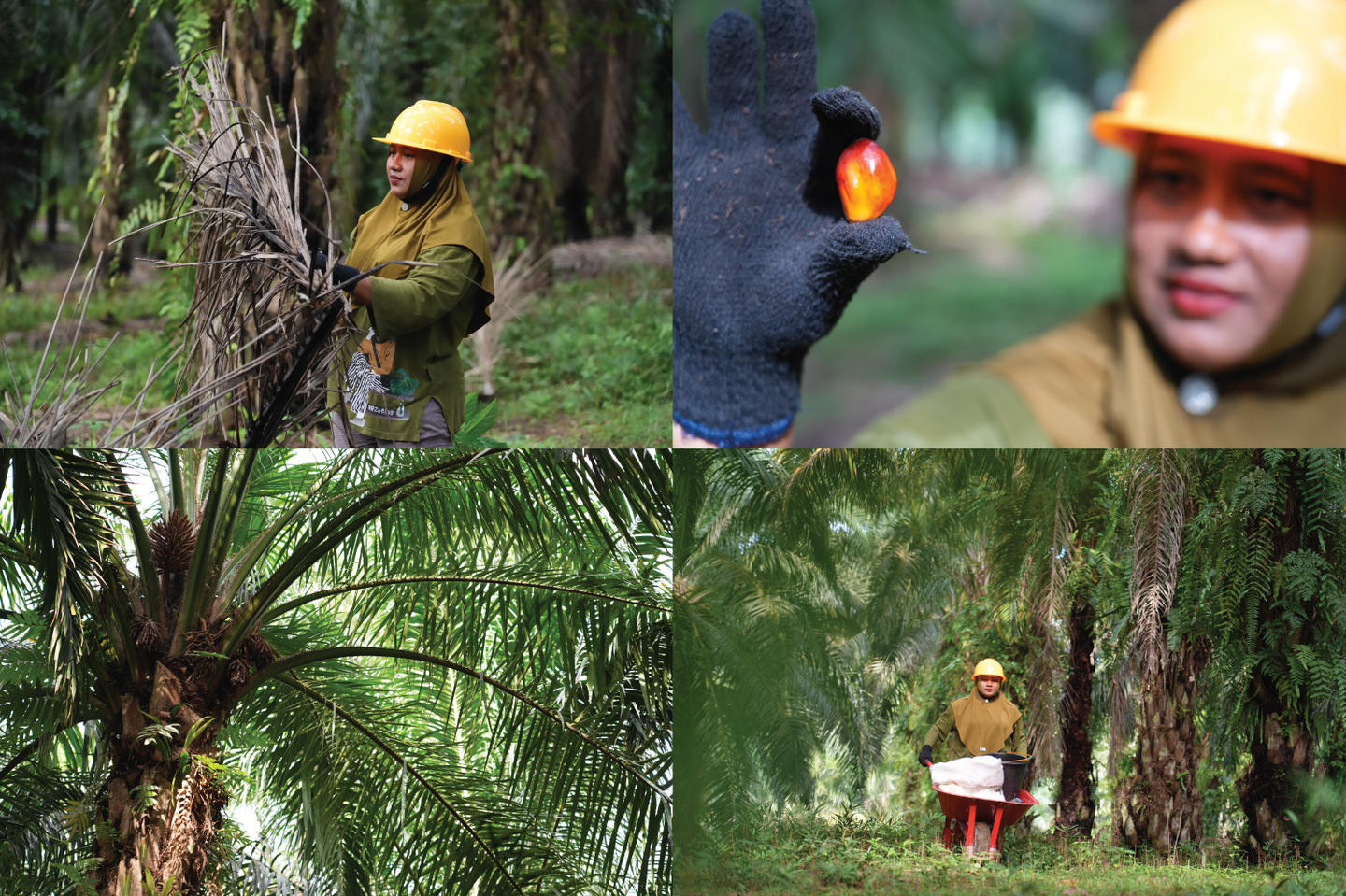
From soil to harvest, each step matters. In Jambi, smallholder farmers apply improved practices that support more sustainable palm oil production. (Photo credit: Andi Pratiwi/UNDP Indonesia)
That pride has been earned across roughly twenty years and several hard lessons about soil, about fairness, and about knowing how to read the soil properly.
Siti’s family arrived in Jambi through Indonesia’s transmigration program, one of the government’s largest rural development efforts to help families build new lives outside densely populated islands such as Java. Jambi was among the key destination provinces, receiving thousands of transmigrant families over several decades to support agricultural development and regional growth.
Like many families at the time, they first planted rubber. But when the trees aged and yields declined around 2002–2003, the community faced a difficult choice: continue struggling, or adapt. Together, many farmers shifted to oil palm. It offered what rubber no longer could, steadier income, less daily labour, and harvests that continued even during the rainy season. "With rubber, you have to go every single day," she explains. "With palm, harvest comes every two weeks."
For many farmers, that meant better earnings. For Siti, it meant something more profound: time. Time to manage the household, time to support her family, and time to participate more actively in decisions about their future. What changed in the field also changed the balance of power at home.
Still, the early years were far from easy. Her transition into oil palm farming did not come with formal training, only trial and error. Fertilizer was applied whenever money was available, often mixed in one batch and in the wrong amounts, gradually hardening the soil and reducing nutrients. She harvested without protective equipment. She pruned without knowing the right techniques. Yields remained below 800 kilograms per cycle.
“We were still learning,” she says. “We didn’t know anything yet.”
Then, in 2023, an opportunity arrived in her village through a training programme supported by Setara and UNDP under the Green Commodities Programme (GCP), funded by the State Secretariat for Economic Affairs of Switzerland (SECO).

In the heart of Jambi’s plantations, knowledge is shared hand to hand, where sustainable practices begin with people. (Photo credit: Nabilla Rahmani/UNDP Indonesia)
The invitation was originally intended for her husband, as many farming opportunities still are. But when he could not attend, Siti went instead.
She returned with knowledge that transformed her farm.

Clearing the piringan, a small technical shift that helped restore soil health and increase yields. (Photo credit: Andi Pratiwi/UNDP Indonesia)
She learned to apply fertilizers separately and in the right sequence. She learned to clear a circular ring, known locally as a piringan, around each tree so nutrients could properly reach the roots. She learned correct pruning techniques, safer harvesting practices, and the importance of protective equipment. Most importantly, she learned how to measure and apply the right fertilizer dosage.
“Before, I used too much (fertilizer),” she says. “The soil became hard and barren. After the training, I learned how to apply the correct doses for my farm. The soil softened again. The palms grew better.”
Her harvests rose from under 800 kilograms to more than one ton per cycle, sometimes reaching 1,200 kilograms. Her farm is now on the path toward Indonesian Sustainable Palm Oil (ISPO) certification. She also gained access to fertilizer assistance registered in her own name, proof that women farmers can and do qualify in their own right.
Siti didn't keep what she learned to herself. As head of her local Kelompok Wanita Tani (women's farmers' group), she encourages other women to join the group meetings with Setara. Her pitch was always practical. Come, get trained, get safety gear, see results. She also made it personal. Her own nephew, who now helps with the harvest, was told firmly that helmets, boots, and gloves are non-negotiable.
While Siti’s story reflects progress, her experience is not yet the norm.
Across Indonesia’s palm oil sector, women play vital roles in cultivation, harvesting support, and post-harvest work, and are estimated to make up 70% of the workforce, according to the Ministry of Women’s Empowerment and Child Protection. However, National Land Agency data also shows that only 24.2% of land in Indonesia is formally registered under women’s names, which can influence access to credit, training, and other economic opportunities. In many plantations, women also continue to face unequal access to protective equipment, contracts, and learning opportunities.
This is why Gender Equality and Social Inclusion (GESI) matters. Through the Green Commodities Programme (GCP), UNDP supports the integration of GESI into Indonesia’s National Action Plan for Sustainable Palm Oil (RAN KSB / NAP SPO), helping ensure women like Siti are recognized as farmers, contributors, and decision-makers. Because when women have equal access to knowledge, resources, and opportunity, they are better able to improve productivity, protect the land they depend on, and strengthen their families’ future. Siti’s own journey shows that inclusion and sustainability often grow together.

"Before, we used nothing," she says. "Now there are standards, and we follow them." (Photo credit: Nabilla Rahmani/UNDP Indonesia)
She speaks just as plainly about the pressure facing the industry. She believes the answer is not endless expansion, but better care for the land farmers already has. “We already have our two hectares,” she says. “That is ours, and we should make the most of it. Let the rest stay forest, other crops, space for the community.”
For Siti, this belief is deeply personal. She has two daughters, and when she talks about farming, she often uses one word: aman - safe. Safe soil, safe water, safe livelihoods, and a safe future for the children who will inherit the land after her.
She does not measure success by how far plantations can grow, but by how long the land can endure. To her, sustainable farming is not about always taking more. It is about caring better, producing wisely, and living side by side with nature so both people and forests can thrive. “We have to know when enough is enough,” she says.
It is a simple sentence, but also a powerful vision for the future: that prosperity does not have to come from endless expansion, and that true wealth is leaving behind land that is still fertile, forests that still stand, and opportunities that still exist for the next generation.

For Siti, sustainable farming is about something simple: keeping the future ‘aman’, safe. (Photo credit: Nabilla Rahmani/UNDP Indonesia)
On Kartini Day, Siti reminds us that women’s empowerment often begins with something simple: the chance to learn and be seen. She turned an opportunity not meant for her into greater confidence, better livelihoods, and a stronger voice in shaping her family’s future. In her hands, farming is not about taking more, but caring for what already exists so it can endure for generations. That is the spirit of Kartini today: when women are given equal opportunity, they create progress that strengthens families, communities, and the planet.
***
Writer: Andi Armia Pratiwi
This story was written based on field interviews conducted by Dian Yuanita Wulandari and edited by Nabilla Rahmani.