

 Locations
SMILE Digital Innovation Drives Cost-Effective Healthcare Logistics in Indonesia
December 29, 2025


In the remote district of Keerom, a four‑hour drive from Jayapura, Papua, pharmacist Oktovina Imbiri used to spend long hours sorting through stacks of paper records, trying to track which medicines were running low or close to expiry. Today, with just a few clicks, she can instantly see real‑time stock levels, receive alerts, and take action before shortages or wastage occur.
For Oktovina and thousands of healthcare workers like her, this shift is not just a convenience—it is transforming how essential health services are delivered. And the change is driven by SMILE, Indonesia’s Electronic Health Logistics Inventory Monitoring System.
“I used to be worried if we ran out of essential medicines such as anti-malarial drugs, especially during the rainy season when Malaria cases often surge in Yaffi community health center’s area. But that was in the past. Now using the SMILE app, I can monitor our drug stock in real-time, quickly order from the district pharmaceutical installation for restock, and then record the inventory. It is such a convenience that allows me to provide timely healthcare for patients and spend more time with my family at home instead of drowning in paperwork all day.” she said.

Oktovina Imbiri checks the drugs inventory at Puskesmas Yaffi using the SMILE app. (Photo: UNDP Indonesia/SMILE Project)
SMILE was born from a bold vision—to make healthcare logistics management smarter, faster, and more reliable. Developed in 2018 by the Ministry of Health and UNDP with support from GAVI, the Vaccine Alliance, and the Global Fund, SMILE was created with one goal: to build a smarter, faster, more reliable health logistics system. What started as a solution for routine immunization and the COVID‑19 response has grown into a nationwide digital backbone for essential health supplies. SMILE is more than just a software—it’s a lifeline for healthcare workers who often live in remote areas like Oktovina and thousands more serving across Indonesia’s archipelago.
The Economic Value of Digital Health Transformation
Over its eight-year journey, SMILE plays a pivotal role in strengthening Indonesia’s health system. Initially deployed to bolster the national effort in routine immunization and COVID-19 response, it has now surpassed the milestone of administering over 1 billion doses of vaccine. As of December 2025, SMILE has been recorded essential health commodities for HIV/AIDS, Tuberculosis, and Malaria (ATM) programs, delivering 191 million ARV drugs, 72 million TB medicines, 23.5 million anti-malarial drugs, 41 million testing kits and consumables, and over 174,000 bed nets. Beyond this, SMILE ensures the sustainable management of 11,450 tons of medical waste generated in 67 health facilities. Its recent scope has also been expanded to cover 12 additional programs, including non-ATM initiatives, key reagents, and consumables aimed at supporting the government’s flagship Free Health Check-up Programme.
The digitalization of health logistics through SMILE has proven to be more efficient and deliver significant economic benefits. SMILE’s user-friendly and adaptive system improves reporting accuracy, accelerates the planning process, and strengthens governance —positively impacting the control of HIV/AIDS, TB, and Malaria (ATM) logistics’ availability, equity, and affordability.
In 2025, the Ministry of Health, UNDP, and researchers from the Center for Economics and Development Studies (CEDS) at Padjadjaran University set out to answer a key question: How much difference does SMILE digital solution actually make?
To find out, they travelled across Yogyakarta, East Nusa Tenggara, and Papua, analysing the business process of the health logistics supply chain system in 100 Puskesmas. They sat with pharmacists who used to rely on handwritten ledgers. They observed the long, repetitive manual steps required before medicines could be restocked, distributed and reported. And they compared these experiences with their current usage of SMILE.
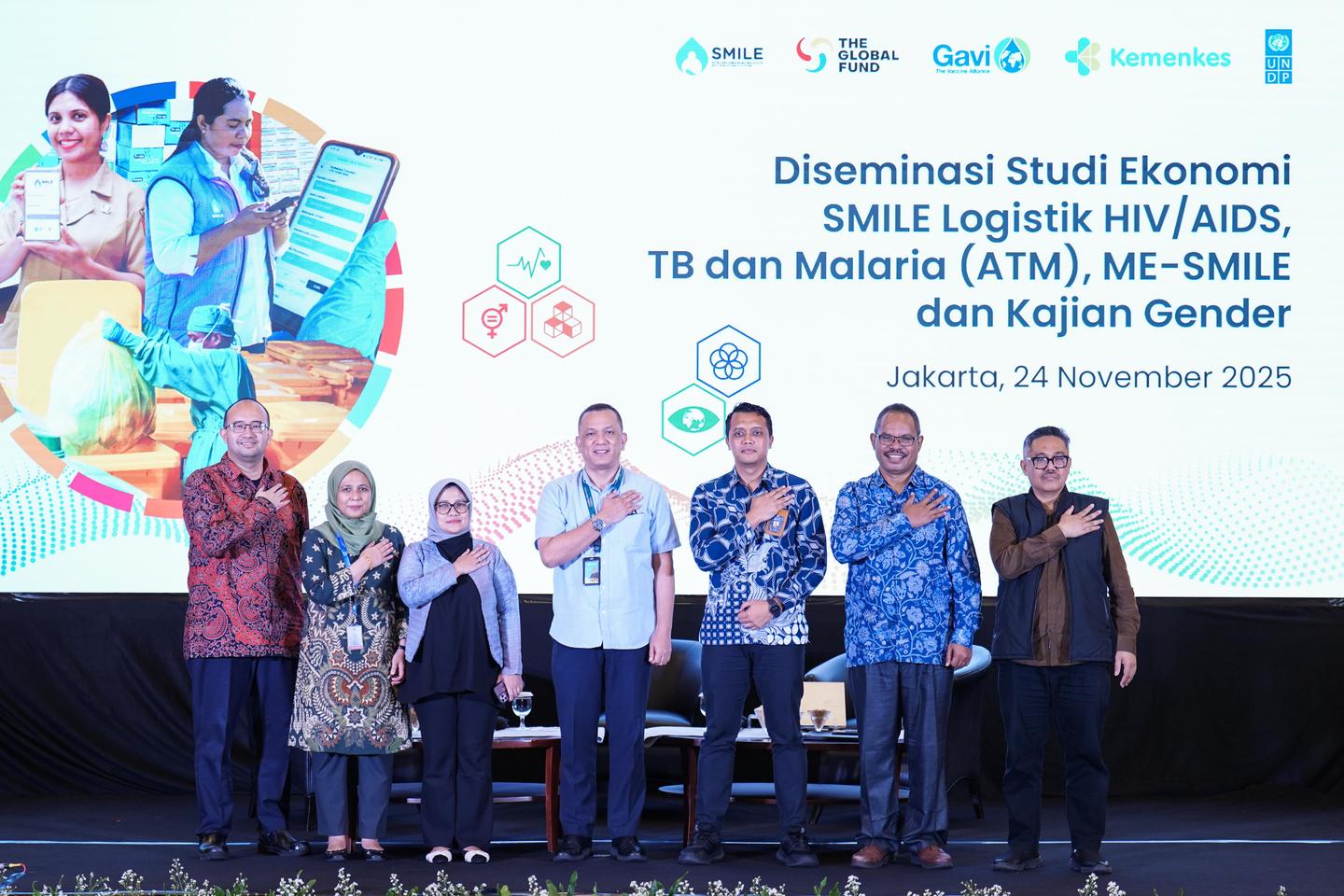
A national workshop to disseminate the results of economic study on SMILE ATM Logistics held in November 2025. (Photo: UNDP Indonesia/SMILE Project)
The analysis begins with costs calculation, including all operational components at each level of Puskesmas, District/City and Provincial Health Offices, and national-level support such as for system maintenance, helpdesk, training, app development, and servers. In Papua for example, manual recording cost about IDR 806.8 million, while using the SMILE system the cost was reduced to IDR 647.3 million. Lower cost was also reflected in Yogyakarta province with IDR 551.8 million (for manual recording) compared to IDR 372.4 million (using SMILE). The data shows that recording health logistics with the SMILE digital system is cheaper than manual methods in all three sample provinces. SMILE helps reduce repetitive data entry, making administration and reporting easier, faster and more accurate.
The major difference between manual and digital systems of logistic monitoring is marked at the national scale over five years by extrapolating localized sampling area data. Further calculation shows that SMILE's Return on Investment (ROI) is 0.831 and its Benefit Cost Ratio (BCR) is 1.831, indicating that SMILE provides greater economic benefits than manual recording. ROI reflects the net return on investment, so a value of 0.831 means that the SMILE investment generated additional benefits worth 0.831 rupiah beyond the initial cost. A BCR of 1.831 indicates that every rupiah of SMILE implementation costs generated 1.831 rupiah in benefits. In simple terms, every rupiah invested on SMILE generates nearly double the benefits compared to manual systems.
Meanwhile, the projected total benefits are estimated around IDR 167.3 billion (manual system) compared to IDR 608 billion (using SMILE). The BCR is used to compare total benefits and total costs. The benefits calculated in this analysis include potential savings from significantly reduced wastage or expiry of drugs and consumables, and the value of utilizing the SMILE to record and verify data which is faster than the manual system. Data shows that SMILE helps to minimize wastage of drugs and consumables through its expiry notification and real-time monitoring. Moreover, the use of SMILE data dashboard has also enhanced ATM drugs planning and allocation.
Preventing Loss, Protecting Lives
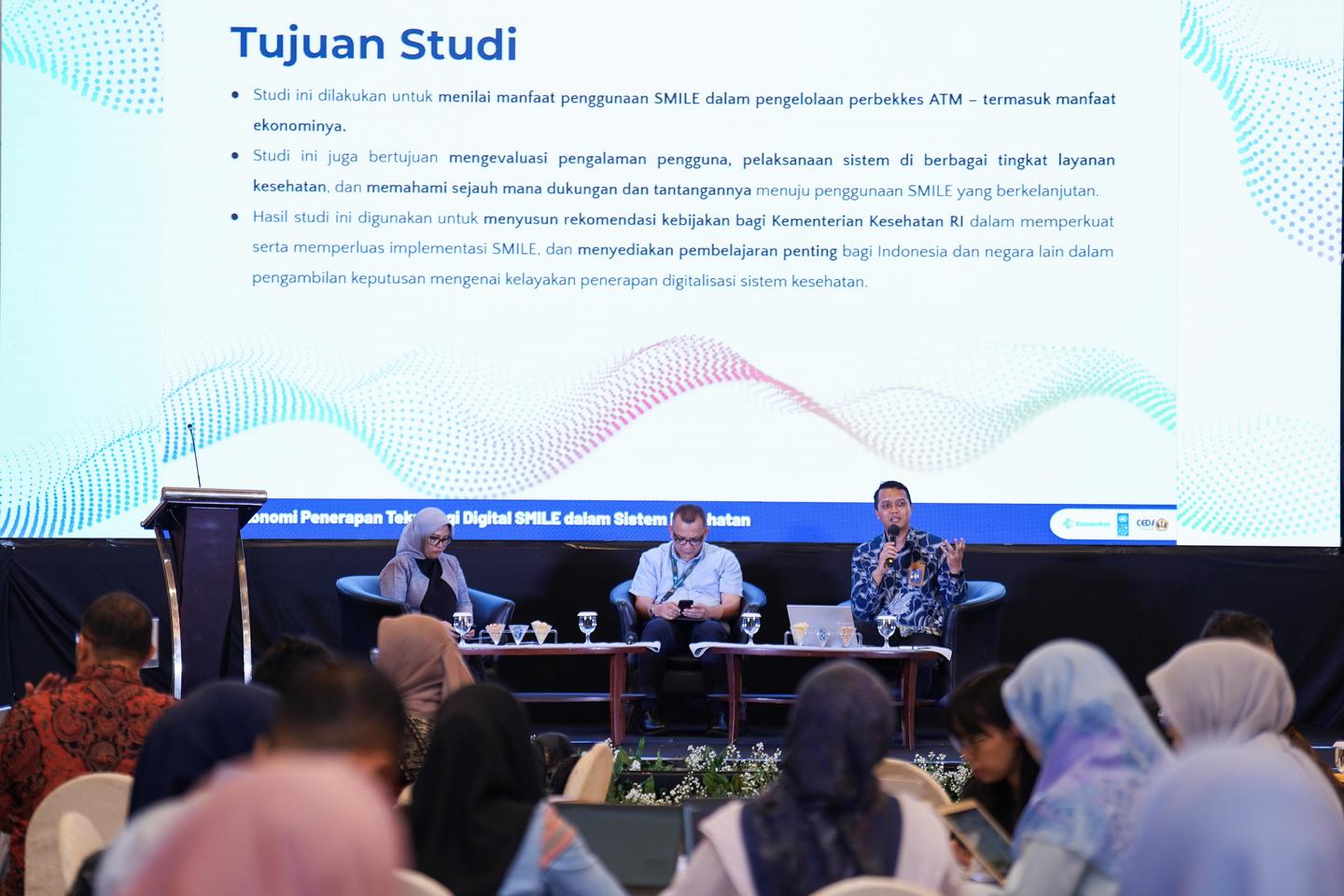
This economic study suggested that SMILE delivers benefits far exceeding its implementation costs. Its features and automated alerts generated by the system prevent minor issues from escalating into major loss—such as timely expiry notifications, quantity drop of any medicine to a predetermined low level, and real-time tracking while reducing administrative tasks so pharmacists can focus more on patient care. Ultimately, SMILE drives greater efficiency in health logistics management, modernizes data analytics using the Artificial Intelligence (AI) for accuracy, and reinforces governance of the ATM drugs supply chain. UNDP hopes that the result will inform policies to strengthen SMILE sustainability, and provide actionable insights for global health system digitalization, while promoting equity and affordability of essential health supplies in Indonesia and beyond.
What makes the difference is not just digital efficiency—it is anticipation.
SMILE alerts health workers when medicines are nearing expiry long before they must be discarded. It warns when stock levels are falling too quickly. It shows where supplies are abundant and where shortages loom. A problem that might have taken weeks to uncover through manual records now comes to light instantly, preventing small oversights from growing into systemwide gaps.
And as the system integrates Artificial Intelligence to strengthen forecasting, Indonesia’s health supply chain becomes not only more responsive but also more resilient—better prepared for emergencies, outbreaks, or sudden surges in demand.
A Smile Toward the Future
Back in Keerom, when Oktovina closes the SMILE app after updating her inventory, she knows exactly what her shelves hold—and what her patients can rely on. “This system makes our work lighter,” she says with a smile. “And when our work becomes easier, our service becomes better.”
Author: Virgi Fatmawati and Vidia Darmawi
Editor: Thomas Benmetan