

 Locations
Stories from IGA and Cooperative Group members in Eastern Equatoria Torit County
Success Stories: Peacebuilding and Preventing Violent Extremism (PVE) in East Africa Programme: Building Resilience and Community Empowerment for Peace #BRACE4PEACE
May 14, 2026
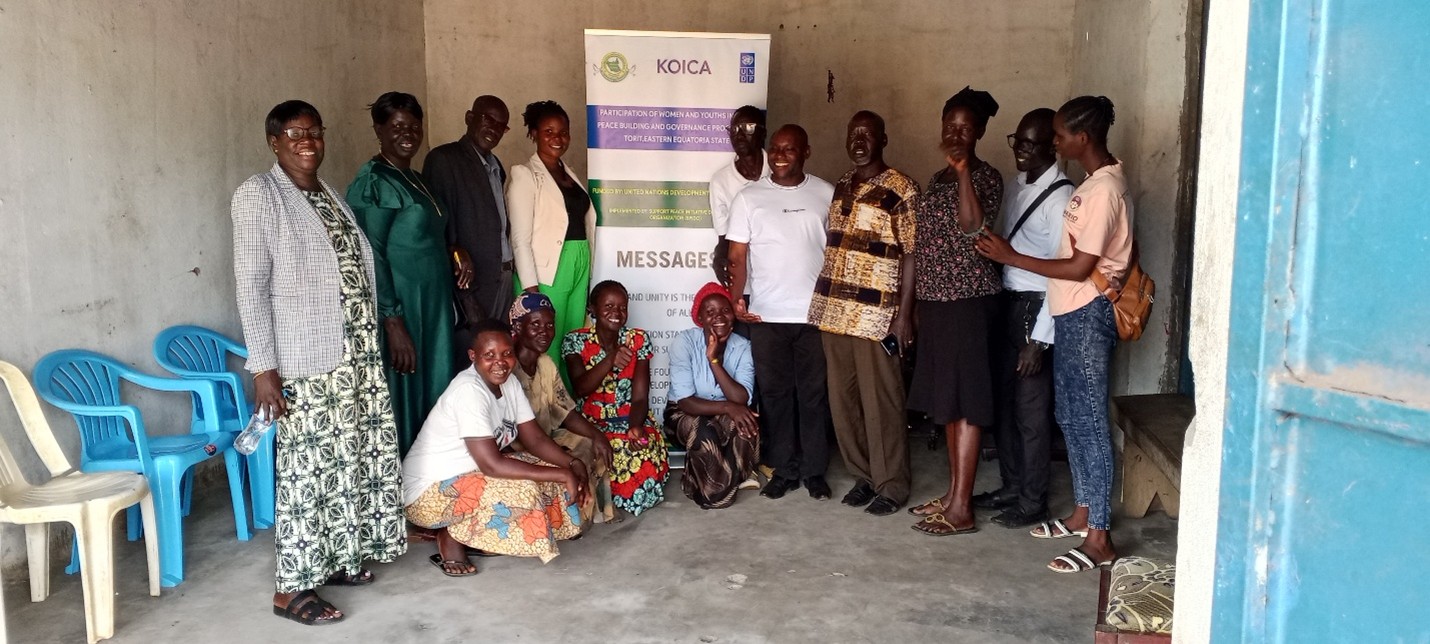
Group photo with community members
UNDP/2026
Context
Eastern Equatoria faced a difficult socio-economic context marked by widespread poverty, limited livelihood opportunities, and acute dependence on subsistence agriculture and informal, low-income activities. Many households, especially those headed by women and youth, struggled to meet basic needs: food insecurity was common, with some families unable to afford more than one meal a day, while school fees and medical costs posed severe financial barriers. In Torit County, access to affordable processing services for staple grains was limited, and women in particular often lacked the tools, skills, and capital to start or sustain income generating enterprises, leaving them economically vulnerable and excluded from more stable livelihoods.
In addition, the area was characterized by underdeveloped value chains and a weak local economy, with few opportunities for youth and women to translate their labor into productive or remunerative work. While there was potential in agriculture, tailoring, baking, and ICT related services, many individuals lacked equipment, training, and collective mechanisms such as cooperatives to scale their efforts. Without mechanized processing, start-up kits, or organized groups, activities remained small scale and often ad hoc, unable to generate sufficient income to pay school fees, cover health expenses, or build savings. This context made the population highly susceptible to economic shocks and constrained women’s ability to participate meaningfully in local economic and decision-making spaces.
I. Economic Empowerment and Livelihoods: KOICA’s economic empowerment and livelihood initiatives in Eastern Equatoria focused on strengthening women and youth led cooperatives and income generating activities through targeted start up kits, skills training, and mechanized support. The project equipped the Logire Agricultural Production Cooperative Society and the Hope Women Cooperative Society with grinding machines for grains and oilseeds, enabling them to process their own produce, reduce costs, and supply affordable food to local markets, while generating steady income for members. Tailoring, bakery, and ICT based printing and photocopying groups received specialized start up kits and basic entrepreneurship support, allowing women and youth to launch small scale enterprises that increased household incomes, enabled consistent school fee payments, improved food security, and built practical skills in fashion, baking, and ICT services, effectively transforming vulnerable households into active, income generating actors within the local economy. These success stories below clearly show how the context shifted from economic vulnerability and limited skills to organized, income generating enterprises, thanks to KOICA supported equipment, training, and cooperative based livelihood support.
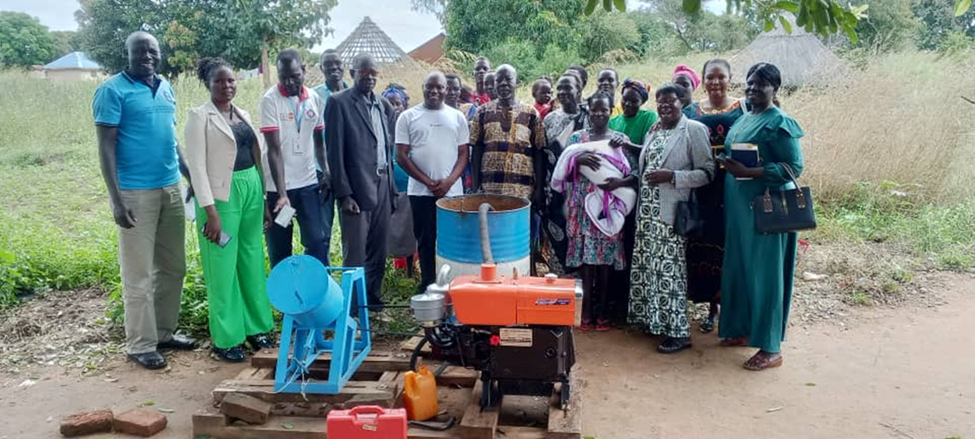
Beneficiaries of the Logire Agricultural Production Cooperative Society receiving their Sesame Grinding Paste Machine to boost agricultural value chain production and increase livelihood.
UNDP/2026
1. Logire Agricultural Production Cooperative Society: Before receiving support, members in Enyief relied on Torit town for grain grinding services, which were relatively expensive and posed a financial burden on poor households. The cooperative had limited capacity to process its own produce at scale, constraining its ability to generate income and make food affordable for members and the wider community. The KOICA supported project provided a sesame grinding paste machine and related support to the Logire Agricultural Production Cooperative Society, enabling it to grind its own grains and processed products at lower cost. The cooperative now processes larger quantities of cereals and oilseeds for local markets and nearby customers, reducing processing costs and increasing sales.
Romano Oguma, Chairperson – Enyief
Romano highlights how the KOICA-supported grinding machine has become a critical asset for both the cooperative and the wider community. According to him, the machine has significantly reduced the cost of grinding grains compared to services in Torit town, making staple foods more affordable for vulnerable families in Enyief.
He explains that the cooperative now processes its own produce in larger quantities, supplying Torit markets with affordable, good-quality products. The machine also grinds groundnuts and sesame at low prices, drawing customers from distant residential areas in Torit. Romano notes that, as a direct result of increased income, ten cooperative members have been able to pay their children’s school fees in various schools in Torit, which was previously a major challenge.

Victoria in black skirt shared with Support Peace Initiative Development Organization (SPIDO) – a CSO about the resilient transformation within the tailoring group
UNDP/2026
2. Tailoring Group in Torit: Before the project, households in the tailoring group often struggled with severe food insecurity, sometimes unable to afford even a simple breakfast. Many women had limited income earning options, and several families depended solely on unemployed or irregularly employed husbands, leaving them highly vulnerable to economic shocks. KOICA provided tailoring start-up kits (machines, fabric, tools, and basic materials) and entrepreneurship support, enabling the group to launch and sustain tailoring services. The project also fostered collective work practices, financial management, and savings, allowing women to generate steady income and become primary breadwinners for their households.
Victoria Peter, Finance Secretary
Victoria describes a profound shift in household wellbeing following KOICA’s provision of tailoring start-up kits. She recalls that there was a time when families in the group could not afford even a simple breakfast. Today, through their tailoring work, families begin the day with tea and bread, and most are now able to eat three meals a day—breakfast, lunch, and supper—rather than one or none.
She emphasizes that the group has learned to work collectively, manage income, and save for rent. The income generated helps members pay school fees for their children, at a time when many husbands are unemployed and the economic situation is deteriorating. Women in the group have effectively become primary breadwinners. Some members have also gained additional skills in fashion design, expanding their future livelihood prospects.


3. Bakery Group in Torit County: Before the intervention, many women and youth in the community had limited or no income earning opportunities, leading to high levels of idleness and economic dependence. Some members had little or no prior experience in baking or food processing, which constrained their ability to engage in value adding activities. Through KOICA, the project provided bakery start up kits (ovens, mixers, basic ingredients, and related tools) and basic training, enabling the group to establish regular bread production and sales. The support reduced idleness created a stable income stream, and equipped members with practical baking skills that enhance their future employability and business options.
Josephine Achiro, Finance Secretary
Josephine reports that the bakery start-up kits provided through KOICA have played a key role in reducing idleness among group members, particularly youth and women who previously had limited economic opportunities. Regular bread production and sales now generate a consistent income stream.
She notes that this income has improved members’ lives in several ways: they can now afford basic medication, clothing, food, and school fees for their children. Josephine also stresses that several members who had no prior baking experience have now mastered bread making, acquiring a practical skill that can sustain them beyond the life of the project.
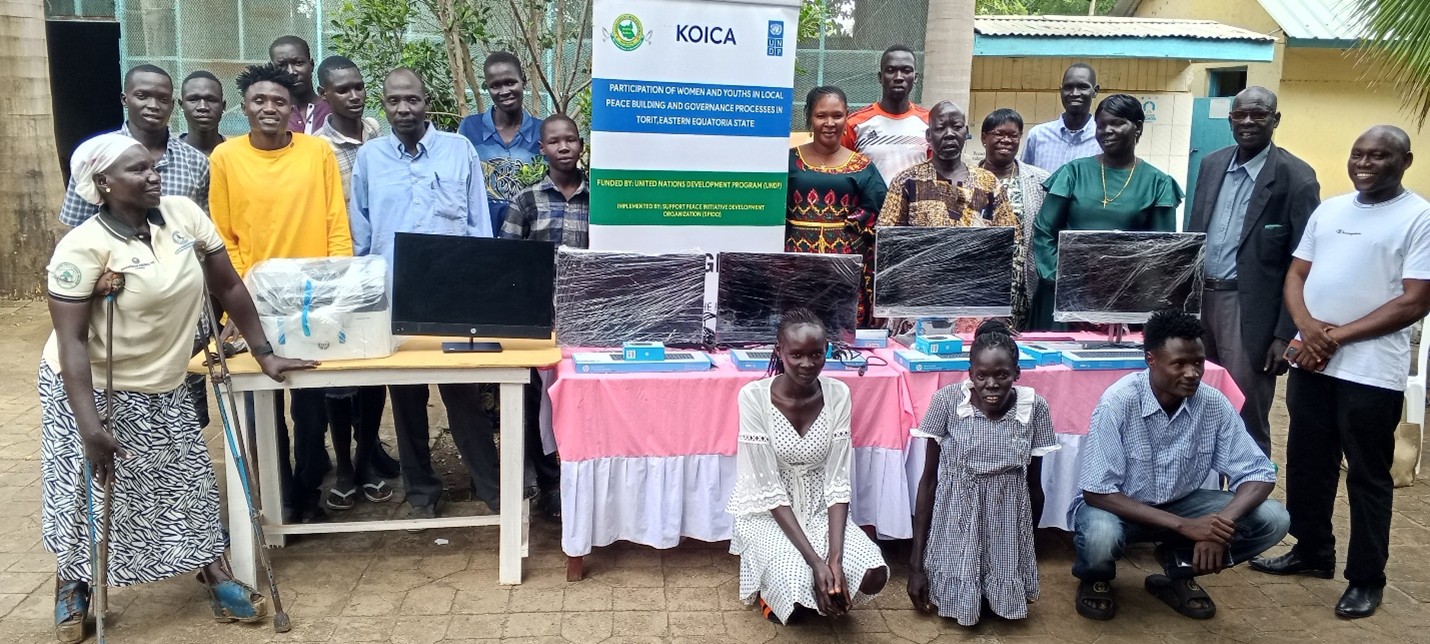
Patricia, the lady in Crutches appreciating KOICA at the initial stages of receiving the start-up kits
UNDP/2026
4. Information Communication Technology (ICT) Printing Group and photocopying services Group in Torit County: Before the support, many members—especially students and young people—had limited access to printing and photocopying services, or had to rely on expensive, informal vendors. Those engaged in ICT related work lacked equipment and business skills, limiting their ability to earn income from this growing demand. The project supplied printing and photocopying start up kits (printers, copiers, computers, and basic office equipment), along with introductory ICT and business skills training. This allowed the group to launch and run printing and photocopying services for schools, health institutions, and university students, generating steady income that supports education and household needs.
Success story of Patricia Laduma Egan, Group Member
Patricia explains that the income earned from printing and photocopying services has significantly improved the lives of group members, many of whom are students at the Torit Health Science Institute, primary and secondary schools, and Torit University of Science and Technology. The revenue is especially important for covering school fees and educational needs.
In addition, the earnings contribute to members’ medical expenses and support collective savings for rent and other operational costs. Patricia notes that through the project, members have acquired advanced skills in printing and photocopying, far beyond their initial knowledge, enhancing both their employability and capacity to manage ICT-based enterprises.
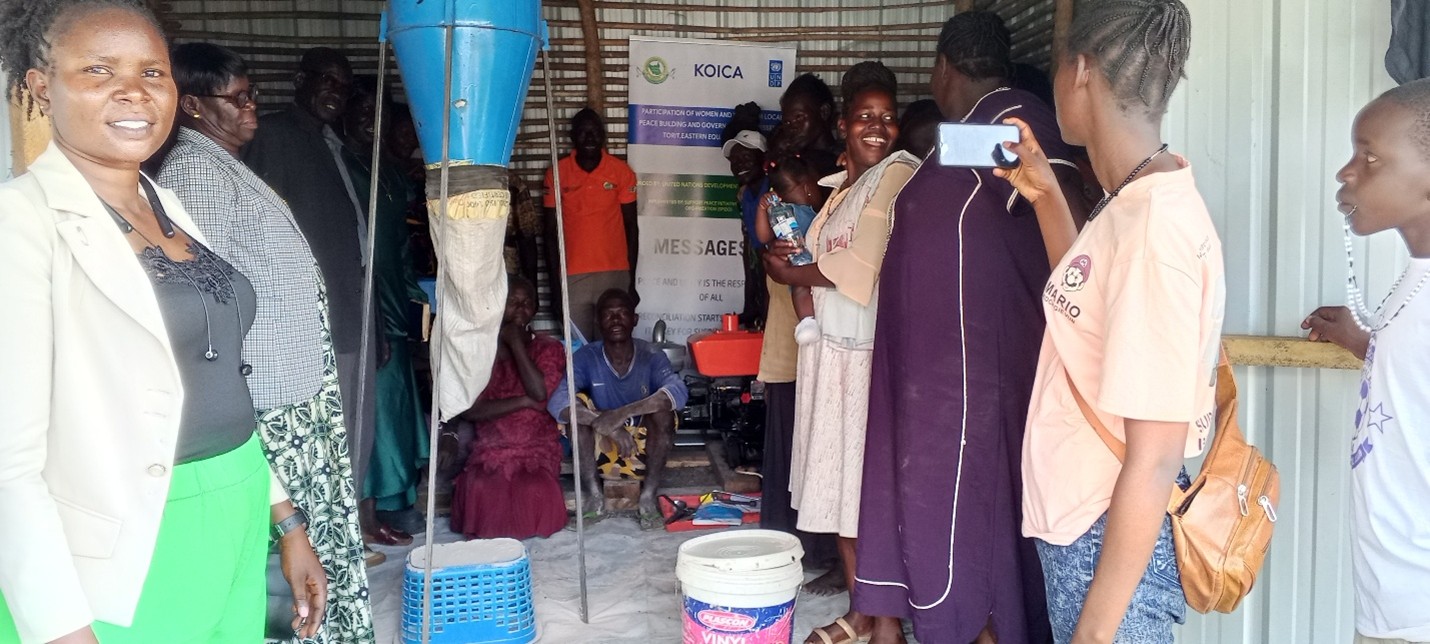
Flora Beda, showcasing with her group the Cassava Grinding Machine.
UNDP/2026
5. Hope Women Cooperative Society in Torit County: Before the project, the Hope Cooperative Group had limited access to mechanized processing, so members relied on time consuming manual methods or paid higher fees to external grinding services. As a result, household food consumption was irregular, and many families struggled to pay school fees or cover basic medical costs. KOICA supported the Hope Women Cooperative Society with a grinding machine for sorghum, cassava, and maize and related capacity building. This mechanized processing has enabled the cooperative to increase production, reduce processing costs, and generate higher, more reliable income. Members now enjoy three meals a day, can pay school fees for their children, and can meet essential medical expenses, significantly improving household resilience.
Story of Illam Flora Beda, Chairperson of the Hope Cooperative Group
Illam explains that the grinding machine for sorghum, cassava, and maize has greatly improved the cooperative’s financial position. The group is now able to save more income than before, strengthening both business sustainability and household resilience.
She notes that cooperative members and their families now eat three meals a day, compared to irregular or insufficient meals before the intervention. The machine’s success has also enabled members to consistently pay school fees for their children. Furthermore, with improved and more reliable income, many members and their families are now able to meet basic medical expenses, a change she attributes directly to KOICA’s support.
