Locations
Scaling-up of Glacial Lake Outburst Floods Risk Reduction in Northern Pakistan (GLOF-II Project)
Project Overview
Global warming has tremendous implications on the glaciers of Northern Pakistan, accelerating glacial melts and leading to Glacial Lake Outburst Floods (GLOFs). These floods put lives, livelihoods, and habitations at high risk, underscoring the devastating realities of climate change.
To address the threats posed by the climate crisis in the form of climate-induced disasters such as GLOFs, the Ministry of Climate Change & Environmental Coordination in Pakistan in partnership with the United Nations Development Programme (UNDP), is implementing the Scaling up of Glacial Lake Outburst Flood Risk Reduction (GLOF-II) Project, supported by the Green Climate Fund to enhance climate-resilience of communities in 24 valleys across ten districts of Gilgit Baltistan (GB) and five districts of Khyber Pakhtunkhwa (KP).
The Project’s multi-layered approach to improving climate resilience entails strengthening national and sub-national institutional capacities for climate responsive planning and development, scaling up of community-based Early Warning Systems, and introducing long-term climate adaptation measures through capacity enhancement trainings.
Objectives
This project is a scale-up of the GLOF-I project (2011-2016), which helped vulnerable communities prepare for and mitigate GLOF risks in two districts of KP and GB through early warning systems, enhanced infrastructure, and community-based disaster risk management. GLOF-II builds upon this work by aiming to improve community resilience across ten districts of GB and five districts of KP, with two key outputs:
- Output 1: Strengthened sub-national institutional capacities to plan and implement climate change resilient development pathways.
- Output 2: Community-based EWS and long-term measures are upscaled to increase communities’ adaptive capacity.
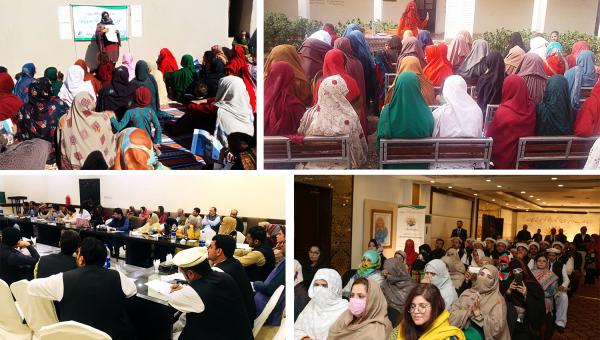
A comprehensive Gender Action Plan for the project ensures all interventions are inclusive and actively engage women through their representation, participation, and capacity-building.
Key Results and Impact
- 411 flood protection structures, extending 39,615 meters, constructed to shield homes and farmlands from the impact of GLOFs and floods.
- 317 irrigation channels, spanning 126,246 meters, constructed and indigenous adaptive solutions, such as ice-stupas, introduced to ensure consistent flow of glacial melt water for agricultural use and local livelihoods, ensuring water security for remote mountain communities.
- 23 Community-Based Disaster Risk Management Centres established, driven by community-based committees. These serve as hubs for enhancing community preparedness and climate-centric dialogues.
- 60 community evacuation shelters, or “safe havens”, built in high-risk valleys to enhance safety during emergencies.
- Slope stabilization interventions, now covering 760 hectares, introduced using bio-engineering techniques to reduce the risk of landslide and erosion.
- 254 Early Warning Systems (EWS) installed, with 174 live EWS across project valleys, with more underway. These systems provide real-time alerts to help communities act before disasters strike.
- 5,761 women trained so far in climate-resilient livelihood practices, ranging from livestock and poultry management to yak farming, kitchen and tunnel gardening, fish farming, and the cultivation of medicinal and aromatic plants. Women also participated in disaster risk reduction exercises, including mock-drills and climate change awareness sessions, equipping them with the knowledge and skills essential for long-term adaptation and resilience.
Collectively, these measures directly benefit over 605,000 people (295,176 women and 309,971 men) across KP and GB, reducing their exposure to climate hazards, building long-term resilience, and reinforcing pathways to achieving Pakistan’s Nationally Determined Contributions.
Project Brief