

 Locations
Energy Project Brings Change at All Levels in Larimaat
December 21, 2025

Elisa Tamaraka with her child and team of community workers from Larimaat community, Northeast Pentecost Island
In Larimaat, a remote community in Eastern Central Pentecost, women are leading the way in showing what resilience, empowerment, and collective determination look like. Their story is proof that access to electricity is not only about infrastructure—it’s about people, dreams, and the will to create change.
Several years ago, a pilot electrification project in Larimaat failed, leaving the community’s hopes for light and opportunity on hold. Now, through an initiative —funded by the Government of Japan under the UN Development Programme’s regional Pacific Green Transformation Project and as part of the Vanuatu Green Transformation Project—those hopes have been revived.
Once the project is complete – expected by the end of this year - communities in Larimaat will have 24/7 access to electricity, powered by clean energy.

Micheline Molsambak and Jocelyn Matan from Pentecost Island together with (from left to right) First Secretary of the Embassy of Japan in Vanuatu, Mr. Munetoshi Ishida, UNDP Pacific Multi-Country Office Resident Representative, Tuya Altangerel, Acting Director of Energy from the Ministry of Climate Change Adaptation, Meteorology and Geo-Hazards, Energy, Environment and Disaster Management, Abraham Nasak, and VGET Project Manager, Mr. Imran Khan. Photo: UNDP Pacific Office in Fiji/Daniel Calderon Gonzalez
Reaching Larimaat is no easy task. From the end of the nearest road from the town of Melsisi, it takes a grueling three to four hours on foot, trekking through muddy trails, flooded paths, and the scars left behind by frequent cyclones.
Yet the community’s remoteness has also forged a strong sense of solidarity and tradition. When the new pico-hydro power station began construction, the women of Larimaat resolved that they would not let this chance slip away.
Energy will be especially transformative for the Larimaat community, given its deep remoteness in northeast Pentecost and the long-standing challenges of accessing essential services. Under the new GX pico-hydro project, a total of 147 connections will be established across four communities—Le Vitlis, Larimaat, Vanrasini, and Jimberke—linking 121 households, 18 businesses, and 8 institutions, including schools and health facilities, through a 5.2-kilometre electrical network.

Community workers team from Larimaat including (from left to right) Chief Pierre Chanel Vireyal, Gina Wakret, Doris Savu, Micheline Molsambak, Imelda Virey, Noelia Molwai, and Elisa Tamaraka. Photo: UNDP Pacific Office in Fiji/Daniel Calderon Gonzalez
This reliable and clean energy supply will completely reshape daily life: children will be able to study safely at night, health workers can store medicines and vaccines within a proper cold chain, women and youth can develop new livelihoods such as sewing, cooking enterprises, refrigeration-based businesses, and technology-enabled services, and families will save precious time previously spent searching for firewood.
In practical terms, this transition means a future where opportunities are no longer limited by daylight or distance. Electricity will unlock learning, expand economic choices, improve health and safety, and strengthen resilience—setting Larimaat and its neighboring communities on a new pathway toward dignity, prosperity, and sustainable development for the next generation. Given the promising opportunities ahead—and mindful of a past project that once failed—the community has come together with renewed determination. They have organised themselves, contributed labour and resources, and worked tirelessly to ensure that this new energy project succeeds. This time, the community sees the project as truly theirs—a collective investment in their future—and they are firmly committed to not letting it fail again.
At the heart of this effort is Micheline Molsambak, 45, mother of six, and the wife of the community’s chief. Micheline speaks four languages—Atma, Bislama, French, and English—and embodies the spirit of willingness. She proposed that the women take an active role in supporting construction.
Since transporting building materials into Larimaat is expensive and logistically difficult, the women collect and carry heavy buckets of sand and coral from the rough, wild coastline. Each bucket weighs about 18 kilos and earns each of them 200 vatu. The work is exhausting, but Micheline and her peers have turned it into a lifeline of income and have established a sense of ownership in the project.

Team work exercise at the Green Skills Training. Photo: Photo: UNDP Pacific Office in Fiji/Daniel Calderon Gonzalez
Among those working beside her today is Elisa Tamaraka, 29, a mother of three children aged two, five, and eight. The money she earns from hauling buckets helps feed and clothe them.
Then there is Gina Wakret, 50 years old, who lives alone. She saves her earnings carefully in case of illness, determined that she will not burden others. They are among a clutch of women who understand how access to energy will transform lives in their remote communities.
For Imelda Virey, 32, the work is not just about money—it is about relief from the long nights of dim kerosene lamps. “Until now we are using kerosene,” she explains. “It is expensive, and fuel is hard to find. Solar lamps only last one or two years, then we must go all the way to Vila (the capital) or Santo to buy another.”
The women are also digging trenches for the 4-kilometer electricity network that will connect Larimaat with nearby communities of Vanrasini, Jimbeke, and Le Vitlis. With no machines on-site, every meter of the trench—one meter deep and half a meter wide—is dug by hand. For every meter they plow through, they earn 150 vatu.
Doris Savu, 51, mother of seven and grandmother many times over, who laughs at herself for losing count of her grandchildren, shrugs at the difficulty of trenching. “Some ground is easy,” she says, “but when we reach rock we must break it slowly, piece by piece, to keep moving forward.”
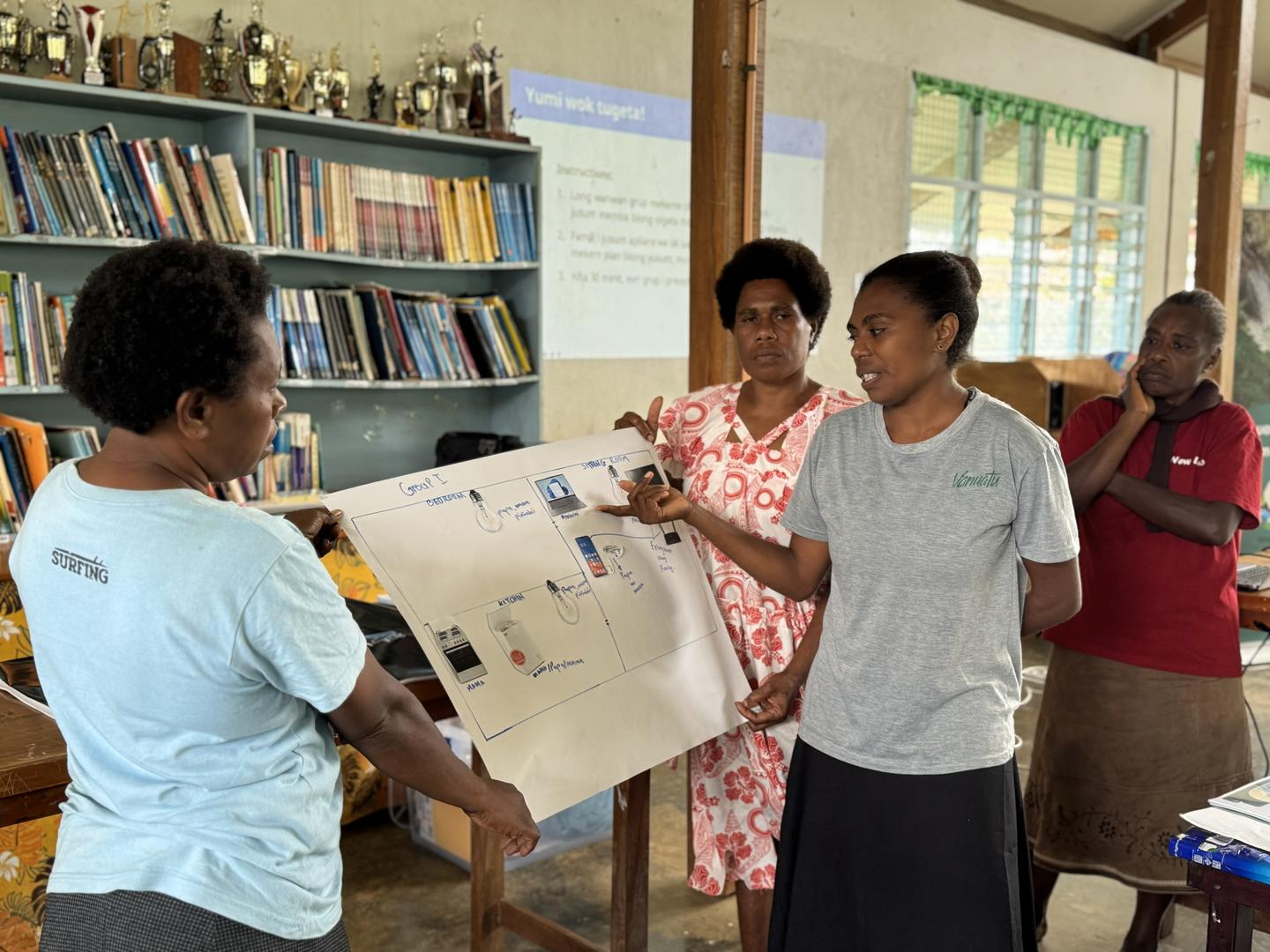
Practical exercise presentation at the Green Skills Training. Photo: UNDP Pacific Office in Fiji/Daniel Calderon Gonzalez
The income the women earn pays for school fees, uniforms, books, and household necessities. They also dream of stronger homes built with cement, that will be able to withstand cyclones. Traditionally, women in Larimaat weave mats and baskets from pandanus leaves. With electricity, they look forward to weaving well after sunset, increasing production and in turn boosting income.
“Electricity will be a big change,” Micheline says. “We can’t wait with crossed arms. We must bring the change, produce the change. We are the change.” Micheline’s husband, Chief Pierre Chanel Vireyal, proudly acknowledges the role of women: “I am proud of their decision to help build the hydro power station,” he says. “To be honest, I could not stop them even if I wanted to.”

Micheline attending the Green Skills Training. Photo: UNDP Pacific Office in Fiji/Daniel Calderon Gonzalez
The Larimaat pico hydro station is small, but it will be transformative. It will deliver reliable electricity to 121 households, enabling refrigeration, sewing, baking, and better conditions for children to study past sunset. They say having electricity will allow them to bake, sew uniforms, and preserve fish in fridges, and most of all to save time.
So far, they have transported around half the boxes, but still 10,000 are needed before completion. Each box, each trench, each step brings Larimaat closer to its long-awaited brighter future.
The journey may be long, muddy, and hard, but the destination is a shining light. For Larimaat, this project is not just about electrification—it is about dignity, empowerment, and a community proving that they themselves are an integral part of the change.

Group photo Green Skills Training. Photo: UNDP Pacific Office in Fiji/Daniel Calderon Gonzalez