

 Locations
Innovative Czech-supported project empowers women farmers in Zambia to fight drought through science and circular economy
Women farmers in Zambia test Czech innovation to combat drought and grow circular forest economies
February 2, 2026

In Southern Province, women farmers are working with UNDP and Czech partners to test hydrogel that can restore drought-hit forests, with 1,500 seedlings planted and women-led products turning restoration into income.
Photo by: Alicja Karpinska/UNDP Zambia
An innovative project supported by the Ministry of Foreign Affairs of the Czech Republic and UNDP is helping women farmers in Zambia adapt to worsening drought conditions while strengthening sustainable, forest-based livelihoods.
Implemented under the Czech Challenge Fund, the project Women Scientist to Women Farmers: Hydrogel Innovation for Green Future brings Czech scientific expertise together with women-led community action to test hydrogel technology for climate-smart tree planting and to promote circular economy solutions rooted in local natural resources.
The initiative is implemented by Kamila Hejlikova Tembo in partnership with Mendel University in Brno and the Booma Women Cooperative in Mukuni Village, Southern Province. It aims to plant at least 400 native and oil-bearing trees using hydrogel technology while supporting the cooperative to develop new value-added products from forest resources.
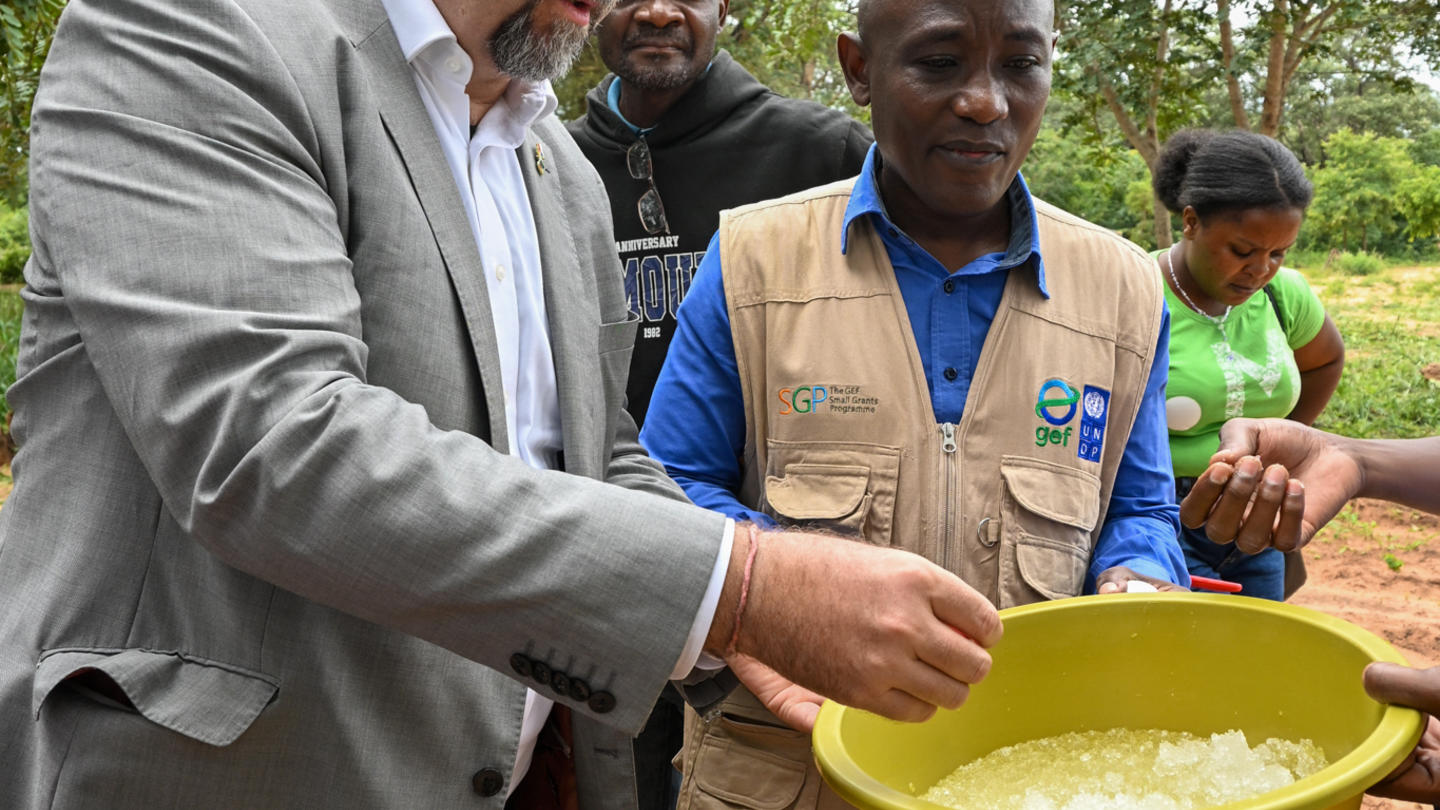
Hydrogel is a water-retaining material that slowly releases moisture to plant roots, significantly improving seedling survival in dry conditions. Introduced by Czech researchers from Mendel University, the technology offers an affordable and sustainable solution for smallholder farmers facing prolonged drought.
Monitoring visit highlights women-led innovation
As part of the project’s monitoring activities, a field visit was held in Livingstone and Mukuni Village, with the participation of H.E. Ambassador of the Czech Republic to Zambia Jiří Kyrian, and Lenganji Sikaona, Project Coordinator at UNDP Zambia, alongside local authorities, community members and national media, including ZNBC, ZANIS, Radio Maria and FM Radio. The programme began with a courtesy call at the Mayor’s Office, underscoring the project’s contribution to local development and climate resilience.
At the Livingstone Museum, participants visited the exposition on mongongo, which traces the long history of women’s use of forest resources in the region. Research indicates that knowledge related to mongongo harvesting and processing has been passed down among women for at least 12,000 years (Robbins, 1990).
The delegation then visited the Booma Women Cooperative shop, where members produce natural cosmetic products from locally sourced forest ingredients, using processing equipment such as oil presses and industrial blenders to turn raw materials like mongongo into cosmetic oils and butters. The shop also functions as an information point for hydrogel, where visitors can learn how the technology is used in tree planting and how it helps retain moisture in dry soils.




From tree planting to circular economy
At the Booma Women Cooperative farm, participants observed a tree nursery and plantation site established through the project. To date, over 1,500 seedlings of eight tree species have been sown, with more than 1,000 seedlings successfully germinated by early November 2025. The cooperative jointly manages the planting and nurturing of six indigenous species and two introduced species, strengthening both biodiversity conservation and livelihood opportunities.
Demonstrations showed how hydrogel retains and gradually releases water to seedlings, supporting tree survival in drought-prone conditions. The visit also highlighted ongoing research activities, including environmental monitoring and data collection using sensors and field equipment to track tree growth and local conditions.
Local women demonstrated traditional skills alongside scientific methods, underlining their central role across the value chain — from tree planting and forest management to processing and product development.
The monitoring visit concluded with discussions on scaling up the initiative to further strengthen the socio-economic impact of the Booma Women Cooperative, which currently has 15 members and aims to expand its activities and membership.
Background
The Czech Challenge Fund supports innovative solutions addressing specific development challenges in six partner countries: Bosnia and Herzegovina, Georgia, Moldova, Ethiopia, Cambodia and Zambia. It is implemented through the Czech-UNDP Partnership for Sustainable Development Goals, which connects partner countries with innovative solutions from academia, civil society, the private sector and public institutions. The implementation of projects is financially supported by the Ministry of Foreign Affairs of the Czech Republic.
Disclaimer
The project Women Scientist to Women Farmers: Hydrogel Innovation for Green Future is implemented by the United Nations Development Programme (UNDP) through the Challenge Fund, with the financial support of the Ministry of Foreign Affairs of the Czech Republic. The content of this material does not necessarily represent the official views of the Ministry of Foreign Affairs of the Czech Republic, or of the United Nations, including UNDP, or UN Member States.
Related
content
content


