

 Locations
The round table discussion aims to prompt public-private sector dialogue to better understand the challenges of energy transition
UNDP in partnership with MARENA and the British High Commission support a round table discussion on Energy Transition – Goal 1 of COP 26
February 12, 2022
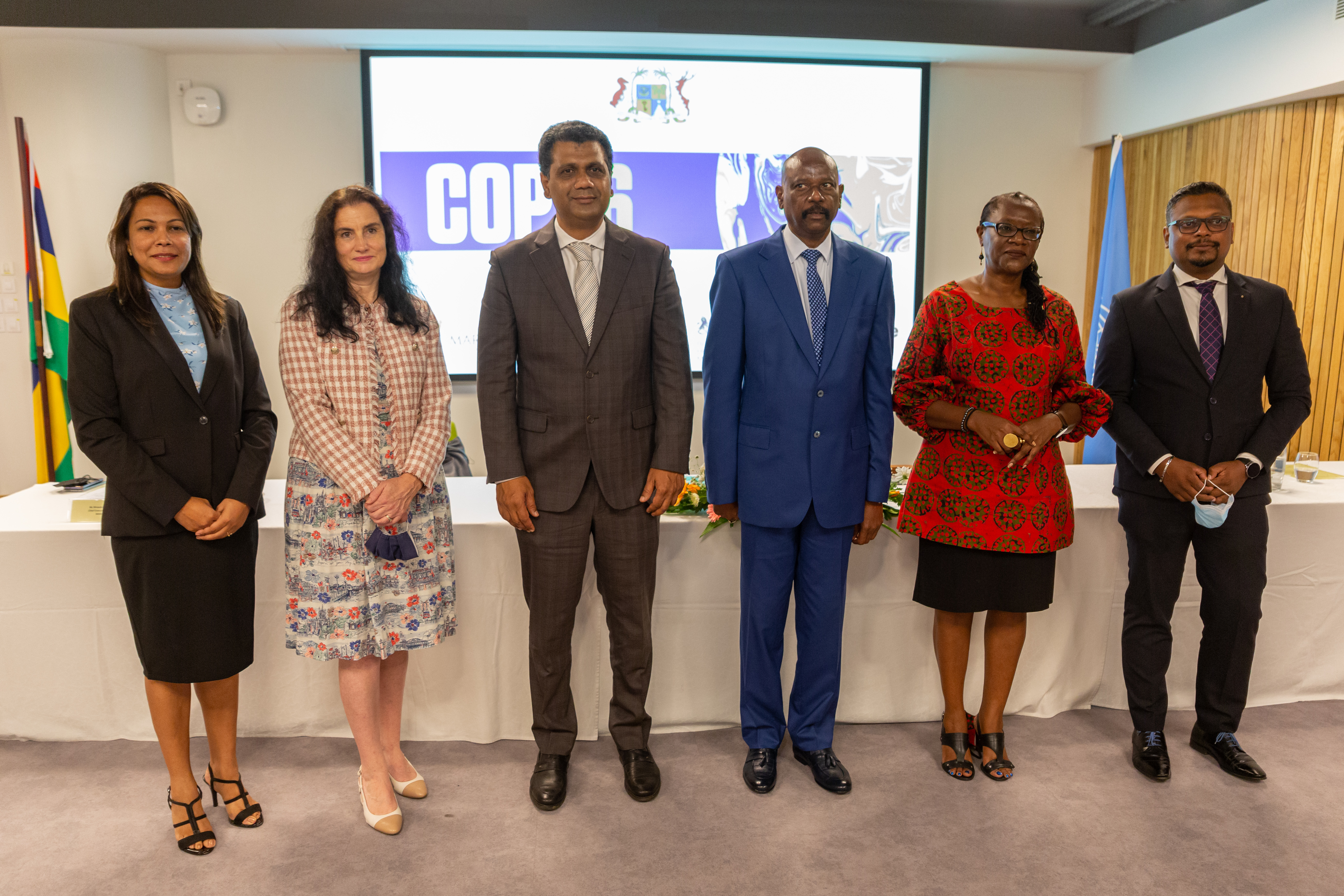
From left to right: Ms. Mreedula Mungra Chief Executive Officer of MARENA; Mrs. Sally Harrison, Deputy High Commissioner of the UK to the Republic of Mauritius; Honorable Kavydass Ramano Minister of Environment, Solid Waste Management and Climate Change; Honorable Georges Pierre Lesjongard, Minister of Energy and Public Utilities; Mr. Danen Beemadoo, Chairperson of MARENA, and Ms. Amanda Serumaga, UNDP Mauritius and Seychelles Resident Representative. Photo : Stéphane Bellerose @ UNDP Mauritius and Seychelles
A Round Table Discussion on energy transition was organized by the Mauritius Renewable Energy Agency (MARENA) in association with the British High Commission and the United Nations Development Programme (UNDP) on 10 February in Port-Louis. The event was aimed at discussing policy decisions pertaining to the targets set by Mauritius to reduce its overall carbon emissions by 40% and achieve 60% of renewable energy in its energy mix by 2030.
COP26, hosted by the United Kingdom in 2021, has generated the Glasgow Climate Pact and set four goals to (i) secure global net-zero by mid-century and keep 1.5 degrees within reach; (ii) adapt to project communities and natural habitats; (iii) mobilise finance, and (iv) work together to deliver. Under Goal 1, countries are encouraged to phase out coal, curtail deforestation, switch to electric vehicles, and invest in renewable energy sources.
Along these lines, the Government of Mauritius has designed schemes to promote electric transportation; set a National Biomass Framework; increase the share of renewable energy to 60% in the local energy mix and phase out coal by 2030. With presently only 20 % of the local electricity mix provided by Renewable Energy (RE) in Mauritius, there is a pressing need for rapid expansion of RE, which is also one of the main mitigation activities in Mauritius’ Nationally Determined Contributions (NDC).
MARENA, which is tasked with leading the transition to 60% of RE by 2030, is currently spearheading the review of the RE Roadmap 2030. The round table discussion aims to prompt public-private sector dialogue to better understand the challenges of energy transition and pave the way for a green recovery and a decarbonized future. Four themes were addressed during this event: (i) deploying clean power generation and energy efficiency measures (ii) scaling up technologies and policies to phase out unabated coal power generation (iii) ceasing issuance of new permits for new unabated coal-fired power generation projects and (iv) strengthening efforts to provide a robust framework of financial, technical, and social support to ensure a just and inclusive transition away from unabated coal power.

Participants to the table discussions organised during the event. Photo:Stephane Bellerose @ UNDP
Creating a regulatory and enabling framework for RE
In his opening speech, Honourable Georges Pierre Lesjongard, Minister of Energy and Public Utilities, stated that Mauritius is endowed with Renewable Energy resources which have to be leveraged to support the achievement of the country’s environmental, social and economic goals. He stressed that RE has the potential to contribute to climate action and to become a driver of job creation in the coming decade. Minister Lesjongard also emphasized that “We are undergoing a clean energy revolution, and we policymakers need to see how we can stream and accelerate this process efficiently by creating the right regulatory and enabling framework”.
The Honourable Kavydass Ramano, Minister of Environment, Solid Waste Management and Climate Change stated that notwithstanding challenges “COVID-19 and Climate Change Emergency present us with a formidable opportunity to better shape our .” Honorable Ramano noted the upcoming Master Plan for the Environment and its targets to achieve ecological transition by 2030 and to reach zero emissions by 2070. He also acknowledged the initiative of MARENA and stressed that his Ministry “will follow very closely the outcomes of the round table and ensure that the recommendations are mainstreamed as far as possible in the environmental planning and management mechanisms.”
Mrs. Sally Harrison, Deputy British High Commissioner to Mauritius congratulated the Government for the efforts done to curb the country’s GHG emissions by 40% before 2030. Mentioning engagements taken at COP26, she stated that “By working together and by aligning efforts internationally, countries can accelerate the pace of technological change, increase incentives for investment, and innovate faster. As environment partners, we can heal our economies, while building a more secure, more prosperous and cooperative future for all.”
Ms. Amanda Serumaga, UNDP Mauritius and Seychelles Resident Representative stressed that UNDP has been a partner of the Government and the people of Mauritius in the effort to shift to a less carbon-intensive economy since 2009. She cited a Green Climate Fund project to strengthen RE in Mauritius and improve the grid absorption capacity, and the current collaboration with the Economic Development Board to generate an SDG Investor Map to encourage private sector investment. The UNDP Resident Representative noted the SDG Investor Map will help “to identify investment opportunities and business models that have significant potential to advance the SDGs, including investment in the Renewable Energy Sector.”
Observations and recommendations from the round table will be compiled to provide insight into the country’s RE targets set for the Electricity Sector and prepare implementable Action Plans.

Plenary sessions and discussions allowed to share observations on the challenges to face on the way to a decarbonized future. Photo : Stéphane Bellerose @ UNDP Mauritius and Seychelles
Related Content


