Locations
Integrated Water Resource Management and Ecosystem-Based Adaptation in Xe Bang Hieng River Basin and Luang Prabang City (IWRM & EbA)

Integrated Water Resource Management and Ecosystem-Based Adaptation in Xe Bang Hieng River Basin and Luang Prabang City (IWRM & EbA)
Development Challenge
Lao PDR is extremely vulnerable to climate change, particularly the impacts of floods and droughts. Since the 1960s, the country has experienced an increase in the frequency and severity of these events, resulting in increased impacts on and risks to vulnerable communities in Lao PDR. These impacts include, for example, crop damage, thereby decreasing food and financial security.
The increasing frequency and intensity of floods and droughts resulting from climate change are putting livelihoods and water resources in the rural headwater and lowland communities of the Xe Bang Hieng River Basin in Savannakhet Province at risk, in addition to threatening assets and infrastructure of urban communities in Luang Prabang city. Anthropogenic drivers such as increasing urbanisation, ecosystem degradation, and deforestation exacerbate the vulnerability of these communities to climate hazards — specifically floods and droughts. As ecosystems are destabilised by unsustainable use, impacts from extreme climate events disrupt the delivery of ecosystem services and further reduce natural hazard protections these ecosystems provide.
Project Background
In alignment with the 9th National Socio-Economic Development Plan, outcome 4, output 1 - Natural resources sustainably used and managed, the project aims to strengthen the climate resilience of communities in two particularly vulnerable areas of Lao PDR – namely Savannakhet Province and Luang Prabang City – particularly focussing on the impacts of floods and droughts.
This improved resilience will be achieved through three complementary project components, specifically: i) Developing national and provincial capacities for Integrated Catchment Management (ICM) and integrated urban Ecosystem-based Adaptation (EbA) for climate risk reduction; ii) Ecosystem-based Adaptation (EbA) interventions, with supporting protective infrastructure and livelihood enhancement; and iii) Knowledge management and Monitoring and Evaluation (M&E).
Expected Results
- Enhanced national and provincial capacities for integrated catchment management and integrate water resource management in target rural and urban communities.
- Reduced flood risk through headwater conservation, restoration, and protective infrastructure, supported by climate-resilient and alternative livelihoods.
- Effective knowledge management and monitoring and evaluation (M&E) through awareness/advocacy and monitoring of climate change impacts and adaptation opportunities in target rural and urban communities.
Key Achievement
- Strengthened climate resilience and water security for over 500,000 people (233,905 female), including 17,856 direct beneficiaries (8,392 female) and 483,456 (233,905 female) indirect beneficiaries, covering 75% of the population in targeted districts of Savannakhet and communities in Luang Prabang.
- Strengthened disaster preparedness through the deployment of 13 megaphone sets, 10 motorboats, and 250 life jackets, and trainings on flood evacuation preparedness for flood risk villages.
- Improved access to clean water and disaster preparedness through the installation of 29 drinking water filtration systems, 22 solar-powered wells, 4 solar-powered irrigation pumps, 1,216 water tanks, and flood preparedness equipment, benefiting 15 target villages.
- Expanded climate-resilient land and water resource management across 775,300 hectares, far exceeding the original target of 200,000 hectares, while supporting conservation zones, participatory land use planning, and sustainable management of forests, watersheds, and agricultural landscapes.
- Enhanced institutional capacity by training 350 government officials from national, provincial, and district levels on IWRM, Ecosystem-based Adaptation (EbA), climate risk-informed planning, GIS, and flood management, with 80% demonstrating improved competency.
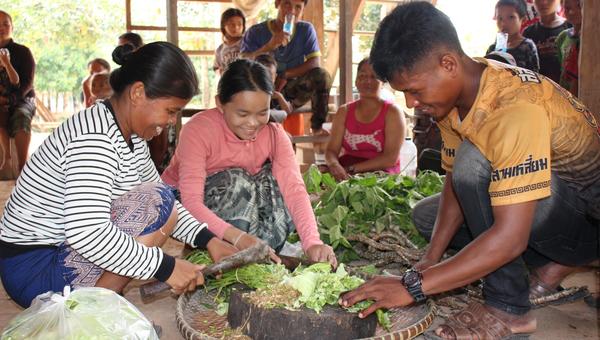
- Strengthened community resilience and livelihoods through community-based monitoring systems, conservation agreements, and climate-resilient livelihood activities, benefiting more than 3,000 people across target communities.
- Promoted inclusive governance and knowledge sharing by supporting participatory decision-making, women’s representation in local monitoring structures, awareness campaigns, knowledge exchanges, and the establishment of an IWRM-EbA knowledge hub.
Project details:
- Status: Ongoing
- Duration: November 2022 – December 2026
- Geographic coverage: Savannakhet Province and Luang Prabang City
- Project Office: Department of Water Resources (DWR), Ministry of Agriculture and Environment (MAE)
- Focus Area: Climate change, Disaster Risk Reduction, Natural Resource Management
- Implementing Partners: Department of Water Resources (DWR), Ministry of Agriculture and Environment (MAE)
- Total project budget: 5,579,452USD
Donors:
GEF: 5,329,452 USD
UNDP: 250,000 USD
Contacts:
United Nations Development Programme
Lane Xang Avenue
P.O. Box 345 Vientiane, Lao PDR
Email: info.la@undp.org
Tel: +856 (0) 21 267 777
Fax: +856 (0) 21 267 799