

 Locations
Investing in Resilience: Innovative Financing Models for Sustainable Development in the Sahel
Event Report: TICAD9 Thematic Event, Special Edition, AFRI CONVERSE 2025 #3
October 6, 2025

On August 21st, 2025, the TICAD 9 Thematic Event titled the Special Edition, AFRI CONVERSE 2025 #3, convened under the theme “Investing in Resilience: Innovative Financing Models for Sustainable Development in the Sahel.” Co-organized by the United Nations Development Programme and the Japan International Cooperation Agency, the session spotlighted the promising opportunities as well as the urgent development priorities within the Sahel region.
Bringing together a diverse group of Japanese and African experts, the event served as a vibrant platform to explore innovative, practical financing strategies designed to tackle the Sahel’s complex and multifaceted issues.
Opening the session with purpose: Unlocking Sahel’s promise through local solutions and impactful partnerships
Mr. Toshiyuki Nakamura, Special Advisor to the President of JICA, opened the session and presented JICA’s “Cluster Strategy for Peace and Stability in the Sahel Region”, structured around three core pillars: governance and safety, resilience and human development, and socio-economic infrastructure development. Within these pillars, he emphasized sub-strategies such as strengthening governance functions, enhancing trust between the government and the population, fostering social cohesion and community empowerment, and promoting partnerships. He also highlighted the JICA-led project which focuses on developing human resources within local administrations to enhance relations between local governments and communities. Mr. Nakamura concluded by calling for sustained engagement and collaboration through innovative financing models to achieve lasting peace and solid development in the Sahel.
Right after that, Ms. Elsie Attafuah, UNDP Resident Representative in Nigeria, underscored the immense potential of the Sahel, particularly its youthful population and abundant renewable energy resources. She emphasized that financing the Sahel’s future requires investing in its youth and local solutions, noting that traditional aid alone cannot meet the scale of the region’s challenges. Ms. Attafuah highlighted UNDP’s efforts to deploy blended finance models and innovative projects, including the Africa Credit Rating Initiative. She stressed the importance of governance reform and institutional readiness in advancing human security, public-private partnerships, and grassroots innovation. Key joint initiatives between UNDP and Japan include the Sahel Human Security Project, climate adaptation and disaster risk reduction efforts in Mauritania and Nigeria, the Local Governance for Peace program in Burkina Faso and Mali, and the UNDP’s Timbuktoo innovation platform. She concluded with a strong call for bold action to finance the Sahel’s future, urging that this moment be a turning point to transform fragility into resilience.
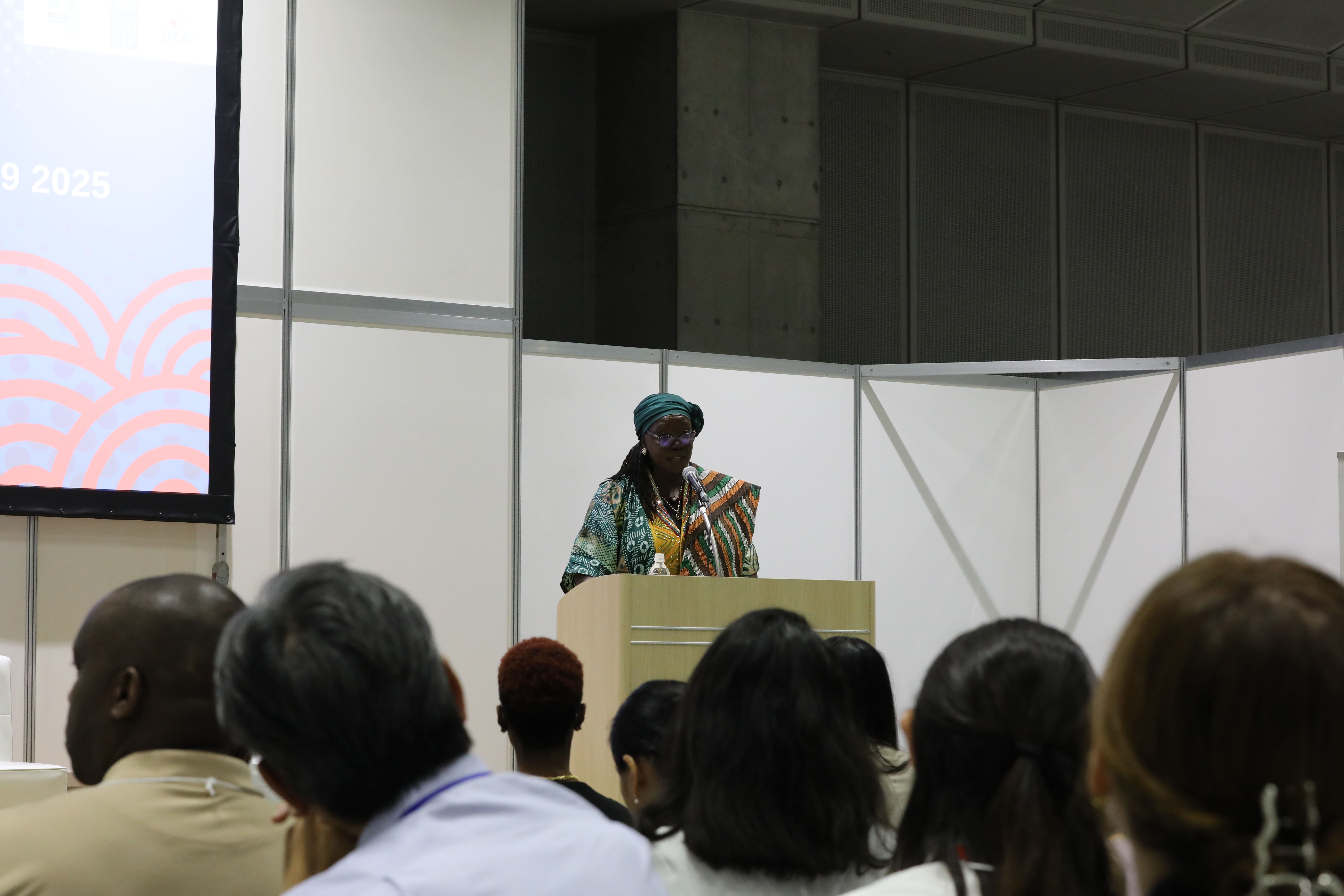
Elsie Gyekyewaa Attafuah, Resident Representative in Nigeria, UNDP, delivering her opening remarks.
Fueling the Future: Panel Discussion on Scaling Innovation through collaboration
The panel discussion titled “Scaling Innovation through Collaboration” was moderated by Ms. Folly Bah Thibault, journalist and education advocate. The discussion focused on real-world success stories of innovative financing in fragile settings, highlighting how multi-actor partnerships, including governments, the private sector, development partners, and local communities, had unlocked scalable and impactful solutions. It also served as a platform for dialogue among stakeholders committed to building resilience in the Sahel. Furthermore, the panel positioned TICAD and Japan’s development philosophy as key enablers of sustainable financing in fragile and conflict-affected regions. The Panel discussion featured the participation of Ms. Kaoru Kojitani, Deputy Chief Advisor, Project for Consolidation of Peace and Stability through the Human Resource Development of the Local Administration in the Sahel Countries (PCSRA), JICA, Ms. Soraya Diallo, Senior Vice President, Bloomfield Investment Corporation and Ms. Elsie Attafuah, Resident Representative, UNDP Nigeria Country Office,
Varied Approaches, Common vision
The first segment of the panel focused on how different organizations, such as JICA, UNDP, and the private sector, are working together to drive sustainable development, innovation, and resilience in the Sahel region.
Ms. Kaoru Kojitani, Deputy Chief Advisor for the Project for Consolidation of Peace and Stability through the Human Resource Development of the Local Administration in the Sahel Countries (PCSRA) at JICA, shared successful examples of how JICA’s approach has been applied in the Sahel and the tangible outcomes it has delivered, particularly in the areas of resilience and community building.
She explained that JICA’s strategy in the Sahel is rooted in a community-based development approach, which focuses on strengthening the capacity of local administrations. This includes improving coordination with local ministries and enhancing the management of development plans, especially in regions heavily affected by displacement and limited access to public services. A key part of this strategy involves building the capacity of local facilitators and community access points through technical transfer from sectoral ministries. This process is carried out in close collaboration among municipalities, local facilitators, and government institutions, ensuring a well-integrated and locally driven approach.
Ms. Kojitani also highlighted JICA’s efforts to promote both social cohesion and economic resilience at the community level. This is achieved through initiatives such as training youth as “social cohesion ambassadors” and supporting their entrepreneurship and business development. By combining social and economic initiatives, JICA aims to strengthen the fabric of local communities and create more sustainable, inclusive development outcomes.
In closing, Ms. Kojitani emphasized the importance of cross-sector collaboration —specifically, between basic service sectors like water and health, and the youth sector—and integrating social activities into technical and administrative capacity-building efforts. This integrated approach helps establish a replicable development model and ensures that technical transfers and institutional support are tailored to the needs and realities of local administrations.
Sharing the private sector’s perspective, Ms. Soraya Diallo, Senior Vice President at Bloomfield Investment Corporation, introduced her company as a Pan-African rating agency with a strong presence in West and Central Africa, and clients extending beyond the continent. She explained that Bloomfield’s role goes beyond issuing credit ratings, it also provides vital market and economic intelligence to guide sound investment decisions. Reflecting on the Sahel region’s economic landscape, Ms. Diallo emphasized its vast potential, particularly its abundance of arable land and natural resources. However, she noted a critical challenge: the region often exports raw materials without adding value locally. To address this, she stressed the need for strategic investments in agro-processing industries that can transform these raw materials into finished products, keeping more economic value within the region. She also underscored the urgent need to develop renewable energy infrastructure, particularly mini-grids, to tackle the widespread lack of energy access across many parts of the Sahel. Beyond energy, Ms. Diallo highlighted the role of robust logistics and digital payment systems in formalizing the economy and advancing financial inclusion. She concluded by affirming that targeted investments in agriculture, renewable energy, and logistics could not only attract further investment and build resilience but also generate meaningful employment opportunities for the region’s growing youth population. While Ms. Elsie Attafuah, Resident Representative of the UNDP Nigeria Country Office, shared the organization’s strategic approach to driving innovation and development in the Sahel through dynamic partnerships with the private sector. She explained that UNDP is actively working with governments to create the right policy and regulatory environment needed to attract private investment. This includes supporting blended finance initiatives and developing SDG investor maps to help identify high-potential, impact-driven projects. Ms. Attafuah highlighted a significant shift in the region’s development model—from a traditional reliance on aid to a growing emphasis on investment, trade, and the implementation of more investor-friendly policies. She also drew attention to the rising importance of remittances and diaspora investment, noting their role in strengthening local economies. Furthermore, she emphasized the need to facilitate trade by helping small and medium-sized enterprises (SMEs) prepare for export opportunities. Crucially, she stressed that development strategies in the Sahel must be context-specific and involve close collaboration with a wide range of private sector actors to ensure sustainable and inclusive growth.

Ms. Soraya Diallo, Senior Vice President, Bloomfield Investment Corporation, Ms. Kaoru Kojitani, Deputy Chief Advisor of the Project for Consolidation of Peace and Stability through the Human Resource Development of the Local Administration in the Sahel Countries (PCSRA) at JICA, Ms. Elsie Gyekyewaa Attafuah, Resident Representative in Nigeria, UNDP and Ms. Folly Bah Thibault, Journalist and Education Advocate
Building Trust and Innovation
The second segment of the panel discussion centered on the critical question of how to create an enabling environment that fosters investor confidence and supports the effective implementation of innovative financing models in the Sahel. Panelists explored the policy and institutional reforms needed to attract sustainable investment, as well as the transparency and governance signals that can help mitigate perceived risks and encourage greater private sector participation in the region’s development. Ms. Kaoru Kojitani, Deputy Chief Advisor of the Project for Consolidation of Peace and Stability through the Human Resource Development of the Local Administration in the Sahel Countries (PCSRA) at JICA, emphasized the need for policy and institutional reforms to effectively adapt innovative financing models in the Sahel. She highlighted the crucial role of the public sector in developing infrastructure and creating an enabling environment for private and emerging sectors to thrive. Ms. Kojitani stressed that revitalizing economic activity at the community level requires a clear, step-by-step approach and advocated for a dual strategy—pursuing macro-level reforms alongside the development of localized, community-based models. She also underscored the importance of establishing strong support systems and partnerships to help local actors evolve into small and medium-sized enterprises, which can serve as a solid foundation for long-term, sustainable development in the region. In response to the question related to the requirements of investors before investing in a region, Ms. Soraya Diallo, Senior Vice President at Bloomfield Investment Corporation, emphasized that investors in the Sahel, like anywhere else, require transparent, reliable data to make informed decisions. She explained that Bloomfield Investment Corporation, as a Pan-African rating agency, plays a key role in providing this transparency by analyzing national development plans, public finances, debt ratios, and governance reforms to produce financial ratings for countries in the region. Ms. Diallo stressed that understanding both the opportunities and the risks is essential for investors, and that countries must be open about their challenges and the steps they are taking to improve their risk profiles. This openness, she noted, is crucial for building investor confidence and supporting sound investment decisions. She pointed out that, in West Africa, for instance, countries are expected to maintain a debt-to-GDP ratio below 70%, and Bloomfield’s evaluations assess whether these standards are met and if governments generate sufficient revenue through taxation. The resulting credit reports highlight both the strengths and weaknesses of each country, as well as the measures being implemented to address areas of concern.
Emphasizing the importance of addressing risk perception, Ms. Elsie Attafuah, UNDP Resident Representative in Nigeria, highlighted the importance of improving data accuracy to attract investment in the Sahel. She highlighted UNDP’s work through the Africa Credit Ratings Initiative, which helps countries present objective, investor-relevant data, and stressed the value of collaboration with partners like Bloomfield to shift the narrative toward the region’s opportunities. She also noted Japan’s role, through JICA and TICAD, in helping optimize development resources and promote resilience, particularly in fragile contexts where effective partnerships are essential. Examples like the Regional Stabilisation Facility (RSF) in the Lake Chad Basin Region shows how stabilization in previously distressed communities can draw in private investment. Attafuah highlighted digitalization, trade, and technology as key areas for innovation and deeper collaboration.
On climate and energy, she called for large-scale private sector investment, using Nigeria’s energy transition plan as a model. She pointed to de-risking tools, fiscal incentives, and innovative insurance schemes as ways to attract capital. Ultimately, she urged a move beyond traditional aid toward equal partnerships that make energy investment a driver of development and resilience in the Sahel.
Forging the Future: Strengthening Partnerships for Sustainable Development in the Sahel
The third segment of the panel discussion focused on the future of partnerships and collaborations for the Sahel, exploring how coordinated efforts between governments, international organizations, the private sector, and local communities can drive sustainable development and resilience in the region. Panelists highlighted the importance of innovative, inclusive partnerships to unlock new opportunities and address the Sahel’s complex challenges. Ms. Kaoru Kojitani, Deputy Chief Advisor of the Project for Consolidation of Peace and Stability through the Human Resource Development of the Local Administration in the Sahel Countries (PCSRA) at JICA, emphasized that the next phase of Japan’s partnership with the Sahel should prioritize youth engagement. She highlighted the importance of showcasing positive stories and the contributions of Sahelian youth to social development, while also fostering collaboration between Japanese and Sahelian youth. She stressed that JICA’s expertise in human resource development can play a key role in this effort. In discussing the return on investment from Japan’s involvement in the Sahel, Ms. Kojitani clarified that the goal is not charity, but the creation of a stable environment that enables economic recovery and encourages private sector investment. She cited community-based projects, such as infrastructure maintenance using sandbags, as examples that both build resilience and create short-term employment for youth. These initiatives help nurture small and medium enterprises, strengthen social cohesion, and lay the foundation for innovation and long-term investment in the region. While the representative of the private sector, Ms. Soraya Diallo, Senior Vice President at Bloomfield Investment Corporation, highlighted both the opportunities and challenges that the Africa Continental Free Trade Area (AfCFTA) presents from a private sector perspective. She noted that while AfCFTA offers a vast unified market, Africa’s financial markets remain fragmented, limiting cross-border financing and forcing countries and businesses to rely on external funding. Ms. Diallo suggested that developing regional and continental financial markets would enable more effective exchange and utilization of African resources. She also pointed out the need for greater precision in allocating and tracking financial resources, as funds are often absorbed into general budgets rather than targeted at specific projects, making it difficult to measure their real impact.
Building on this, Ms. Elsie Attafuah, Resident Representative of the UNDP Nigeria Country Office, explained that while transferring money across diverse African currencies remains a major challenge, it is being addressed through the Pan-African Payment and Settlement System (PAPSS), developed by Afreximbank. PAPSS enables seamless currency conversion and payments for intra-African trade, thereby promoting financial integration across the continent.
Questions from the audience
The panel discussion concluded with questions from the audience, focusing on Sahel’s significant mining resources and the need to improve governance in the sector to ensure sustainable and equitable management. One key point raised was the potential role of sovereign funds in achieving this goal. Ms. Soraya Diallo, Senior Vice President at Bloomfield Investment Corporation, explained that many countries’ revised mining codes require mining companies to contribute to mining funds through taxes or royalties. She highlighted Burkina Faso as an example, where Bloomfield is working with a mining company operating under such a framework. In Burkina Faso, the mining code establishes a sovereign wealth fund financed by royalties and fees from mining operators, intended to support both the mining sector’s development and broader national priorities, with independent management by the country.
In response to a question from a member of the audience, Ms. Elsie Attafuah emphasized that although the private sector may not be directly involved in managing sovereign wealth funds, these funds are subject to governance mechanisms such as boards and audits, which ensure accountability and transparency on the part of government. She pointed out that limited private sector involvement does not equate to an absence of transparency.
When asked about a Sahel country that could serve as a model, Ms. Kaoru Kojitani, Deputy Chief Advisor of the Project for Consolidation of Peace and Stability through the Human Resource Development of the Local Administration in the Sahel Countries (PCSRA) at JICA, pointed to Burkina Faso and Mali for their strong commitment to accountability and transparency in community development, which helps build trust between local governments and communities. Regarding plans to expand these strategies, Ms. Kojitani mentioned PCSRA (JICA Technical Cooperation Project) involving seminars and workshops designed to share lessons learned and knowledge across sectors in Sahel countries to maximize impact and attract international funding.
In conclusion, the event brought together a dynamic mix of Japanese and international specialists, creating a rich forum for examining innovative and actionable financing strategies to address the Sahel’s intricate challenges. Engaging discussions highlighted key enablers of sustainable development, from mobilizing diverse funding streams and promoting governance improvements to strengthening community engagement and encouraging economic diversification. These exchanges aimed not only to share insights but also to translate them into concrete steps forward, laying the groundwork for a more resilient and thriving Sahel region.
Related
content
content


