

 Locations
The stories of Arummi Foods and Seoul Labs
Expanding plant-based milk choices with local cashews and financial access with blockchain
August 18, 2026

Global ImpactPreneur 2026—co-hosted by the UNDP Seoul Policy Centre and the Hyundai Motor Chung Mong-koo Foundation, in partnership with CVC Capital Partners and implementation support from Impact Square—is a global acceleration program launched this March to discover and nurture Asia-Pacific impact startups contributing to the UN Sustainable Development Goals. This year, 20 teams completed the acceleration program, and 10 finalists took the stage at Demo Day on 7 July in Seoul.
Interview with Nacitta Kanyandara, CEO of Arummi Foods
Founder's voice: The story behind the mission
Q1. Could you introduce Arummi Foods and explain the issue your solution aims to address?
Hi, I'm Nacitta from Arummi Foods. We make plant-based milk from Indonesian-grown cashews. Southeast Asia has one of the highest rates of lactose intolerance in the world, and Indonesia is no exception—a 2015 study by researchers at Universitas Indonesia's medical school found that the share of children unable to properly absorb lactose rises from 21% among 3-5 year-olds to 73% among 12-14 year-olds. The problem is that most plant-based milk available in Indonesia is imported, which makes it expensive and limits people's options.
Q2. When did you first recognize this issue, and what motivated you to address it?
My daughter used to cry inconsolably every night. When I finally took her to the hospital, I learned it was lactose intolerance. We had to replace every dairy product in our home with alternatives—and that's when I realized just how expensive those alternatives were. I quickly understood this wasn't just my daughter's problem. Oat- and almond-based milk typically sell for two to three times the price of regular milk in Indonesia, and the gap shows up across other dairy alternatives too—a local yogurt might cost 9,500 rupiah (about US$0.50), while an imported vegan yogurt runs 35,000 rupiah (about $1.90). I founded Arummi Foods in 2022 to close that gap using an ingredient Indonesia already has in abundance: cashews. According to 2023 FAO data, Indonesia is the world's sixth-largest cashew producer, so sourcing and manufacturing entirely within the country lets us avoid the cost pressures of tariffs and currency fluctuation that come with imports. Cashews are also a familiar, well-loved ingredient for Indonesian consumers, which gave us a real advantage—we could lower the barrier to plant-based milk not just on price, but on taste people already know.
Arummi Foods: Solution and Impact

Source: Arummi Foods
Q3. How does Arummi Foods work? What makes your solution different from existing alternatives?
We currently sell three product lines: Cashew Milk Classic, Cashew Milk Barista (developed specifically for coffee), and Cashew Milk Chocolate—five product variations in total across 200ml and 1L formats. Our prices undercut the major imported brands. Our 1L Classic and Barista products retail for 39,900 rupiah (about $2.20), roughly 32% cheaper than the equivalent product from Oatly, the leading plant-based milk brand in Indonesia, which sells for 58,500 rupiah (about $3.20).
Q4. Could you share a concrete example of how your solution has made a difference for consumers or local communities?
Rather than launching straight into major retail, we chose to build awareness through cafés and baristas first, letting people discover the taste and versatility of cashew milk before scaling distribution. Today, Arummi products are used in roughly 4,000 stores nationwide, including about 3,400 Indomaret Point Coffee outlets and 400 FamilyMart cafés—Indonesia's largest convenience-store café chains. Visibility grew quickly from there: 2024 World Barista Champion Mikael Jasin used Arummi cashew milk in his championship drink. By December 2025, Arummi ranked third in Nielsen's brand sales ranking for Indonesia's plant-based beverage category, with net revenue of about $510,000 that year. We've since expanded into general retail as well, now selling our three flagship products through Alfamart, Indonesia's largest convenience store chain with roughly 20,000 outlets nationwide.
Global ImpactPreneur: A turning point

Q5. What was the most impactful part of the Global ImpactPreneur experience for you?
Arummi Foods has grown with the support of the impact ecosystem from early on—we previously received a grant through Partnerships for Forests (P4F), a UK government-backed program. In Global ImpactPreneur, we focused specifically on developing a sustainable sourcing model built around direct partnerships with smallholder cashew farmers. Through the mentoring sessions, we were able to sharpen our early-stage supply chain plans and explore potential partnerships with agricultural cooperatives. We also strengthened how we measure our social impact and communicate it externally.
Q6. How did this programme serve as a turning point in Arummi Foods' growth journey?

Going through the programme, I came to understand something more deeply: what an early-stage company needs isn't just capital—it's a network of people who share their trial-and-error experiences and help you find solutions together. Being able to talk through our sourcing model with mentors and other founders facing similar challenges gave us clarity and confidence to move our next phase of growth forward.
Founder's voice: Looking ahead to global impact
Q7. What is your vision for Arummi Foods moving forward?
Our goal goes beyond offering an affordable alternative for people with lactose intolerance—we want to build a supply chain that raises income for local farmers and women too. Cashews that are irregular in size or slightly broken are still perfectly good as raw material, so there's real opportunity in sourcing directly. Right now we rely on externally processed raw materials, but going forward, we plan to purchase raw cashews directly from farmers and build our own processing facilities. Once we have direct sourcing and in-house processing in place, we can also create more jobs for local women—cashew shelling and cleaning is labor-intensive work that's largely done by women in our region, and we want to turn that labor into stable, formally contracted employment.
Q8. As a founder, what personal meaning does this programme hold for you?
Our next challenge isn't just about selling more cashew milk — it's about how solidly we can build our local production base. By sourcing raw materials directly from farmers and bringing processing in-house, we want to strengthen both our price competitiveness and our social impact at the same time. I want to build a company that grows sustainably, rooted in Indonesia's own resources and people.
"We want to build a sustainable business model powered by Indonesia's own resources and people."
Interview with Dohee Jang, CEO of Seoul Labs
Seoul Labs co-received the CVC Innovation Award, sponsored by CVC Capital Partners, for its solution addressing gaps in financial infrastructure. By turning digital identity into a foundation for financial access, Seoul Labs shows how blockchain can bring the financially excluded into the formal economy.
Founder's voice: The story behind the mission
Q1. Could you introduce Seoul Labs and explain the issue your solution aims to address?
Hi, I'm Dohee from Seoul Labs. For an economy to grow, people need to be able to access financial services—to borrow money and start businesses. But without proof of identity, there's no way to even evaluate someone's creditworthiness. Since founding Seoul Labs in 2023, we've been building blockchain-based digital identity technology to lower the barriers to finance in developing countries. We currently operate a mobile decentralized identity (DID) service on the ground in Laos.
Q2. When did you first recognize this identity gap, and what motivated you to address it?
We saw the scale of the problem clearly in Laos. According to 2021 World Bank data, only about 38% of adults in Laos have a financial account, and roughly 45% of adults lack a government-recognized form of ID. At the same time, mobile phone penetration is relatively high, with around 87 mobile subscriptions per 100 people. Without proof of identity, people are locked out not just of bank accounts, but of public welfare services too. Paper documents are easy to forge and scattered across different institutions, making it nearly impossible to assess someone's income or creditworthiness. That gap between people's real needs and their ability to prove who they are became our starting point.
Seoul Labs: Solution and Impact

Source: Seoul Labs
Q3. How does Seoul Labs' solution work? What makes it different from existing alternatives?
Our core product is Super Wallet, a decentralized identity (DID) platform that lets people store their digital identity—along with student IDs, certificates, and diplomas—in a mobile wallet, and present them whenever needed. Super Wallet runs on our own blockchain mainnet, with transaction processing in about one second and transfer fees under $0.0000007. We designed it to be modular, so each country can adopt only the functions it needs based on its own financial regulations, payment infrastructure, and government requirements. That flexibility to adapt to local systems and infrastructure is Super Wallet's core strength.
Q4. Could you share a concrete example of how your solution has made a difference on the ground?
Through Korea International Cooperation Agency's Creative Technology Solution (CTS) program, we're rolling out digital student IDs and certificate issuance systems at two universities in Laos. We're finalizing partnership agreements now, with a first goal of issuing digital student IDs to 1,000-1,500 university students by the fourth quarter of next year. In Laos today, getting something as simple as a transcript or graduation certificate means visiting the university in person, applying, and returning two to three days later to pick it up. With digital certificates, students can request and receive documents online in real time—saving them both time and transportation costs.
Global ImpactPreneur: A turning point
Q5. What was the most impactful part of the Global ImpactPreneur experience for you?
The most valuable part was learning how to organize a complex technology and business model into something we could explain clearly and persuasively to the outside world. Over three months of training and mentoring, we sharpened both our business strategy and our IR materials. In the beginning, mentors helped us structure the overall flow and sequence of our IR deck—and once we had a draft, they gave us detailed, slide-by-slide feedback. Learning how to explain the value of our business logically will be a huge asset for future fundraising and pitching.
Q6. How did this programme serve as a turning point in Seoul Labs' growth journey?
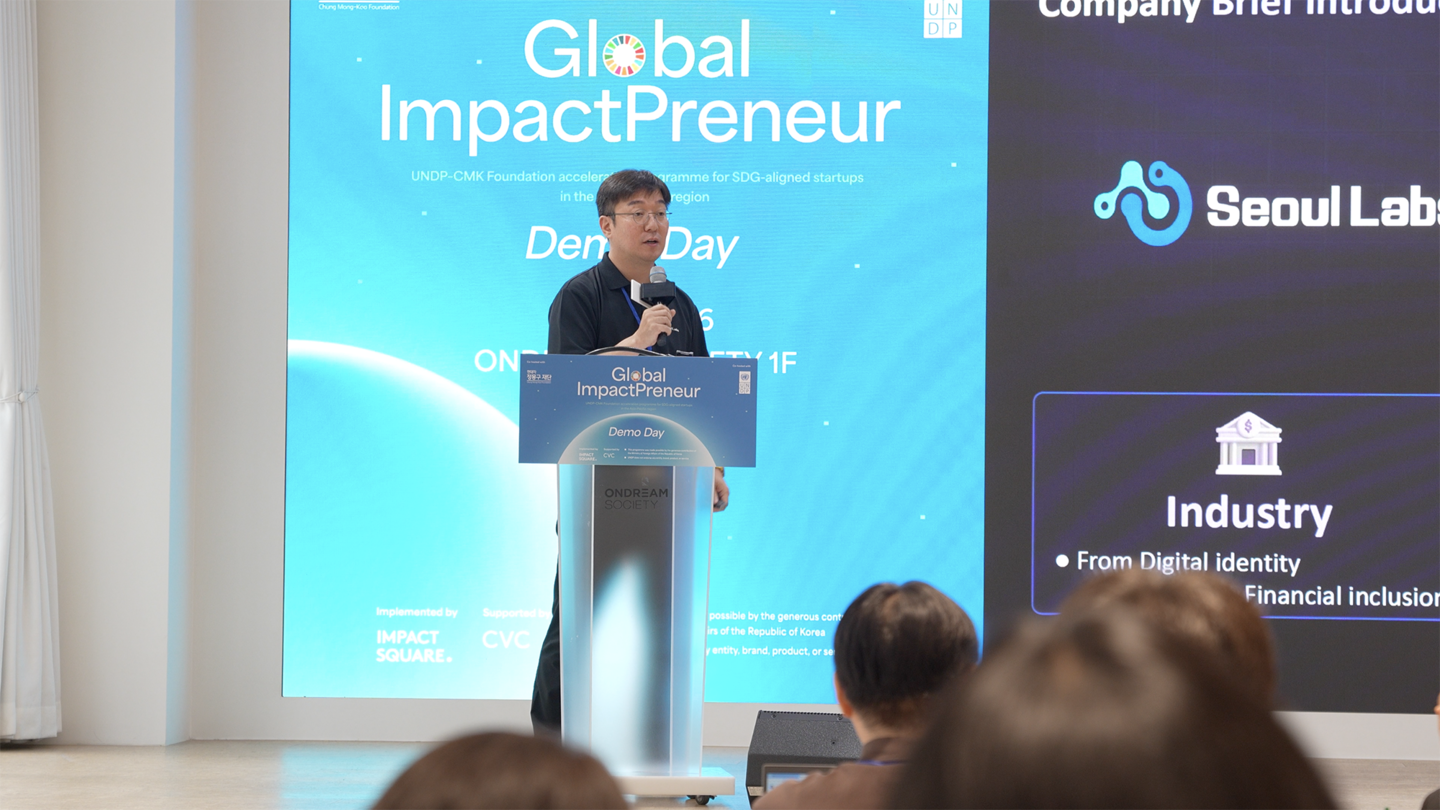
Seoul Labs didn't start out with financial inclusion as its explicit goal—early on, we were focused mainly on growing our own blockchain mainnet and achieving business results. But as we applied our technology to the real identity and financial exclusion challenges we saw in Laos, our perspective on the business itself began to shift. Building financial success is important, but our team now shares a bigger goal: using technology to help more people move forward together. We hope every record created through digital identity issuance and credit evaluation becomes a meaningful transaction—one that connects someone, for the first time, into the formal system.
Founder's voice: Looking ahead to global impact
Q7. What is your vision for Seoul Labs moving forward?
Starting next year, we plan to expand the number of partner universities in Laos, and over the longer term, work with the Lao government to grow our digital identity system from a student-focused solution into a nationwide digital ID—a B2G model built in direct partnership with government and public institutions. Our business model gives digital student IDs and DID for free, while generating revenue from certificate issuance fees, so the service can continue to operate locally even after ODA funding ends. As we build a track record in Laos, we're also exploring expansion into other Southeast Asian markets, including Vietnam and Indonesia.
As our digital identity system matures, we also plan to use the transaction history accumulated through Super Wallet to build alternative credit scoring for people who currently lack any financial track record—turning everyday digital activity into a pathway to real financial access.
Q8. As a founder, what personal meaning does this programme hold for you and your team?
This programme has been extremely meaningful for us as social entrepreneurs. In Seoul Labs' early days, impact startups weren't taken very seriously in Korea—a lot of people simply didn't believe in the model. But having built this company for the past few years, I've seen the market grow, and programmes like Global ImpactPreneur are a big part of what's helping impact businesses thrive. I'd encourage any impact startup to join a programme like this—you connect with other social entrepreneurs, and it opens the door to potential investment from overseas.
Global ImpactPreneur reaffirmed why we started Seoul Labs in the first place—to build technology that creates real, lasting change.
"We want every digital identity record to become a meaningful connection — one that brings someone, for the first time, into the system."
Source: The Better Future, July 31, 2026 “Building a Growth Ladder for Startups Tackling Asia-Pacific’s Toughest Challenges: International Organizations, Foundations and Investors Join Forces”
Written by: Yebin Chae, The Better Future journalist
Related
content
content


