

 Locations
An Honest Account on Leadership
Leadership Insight | Two Years in South Africa as Resident Representative
March 2, 2026
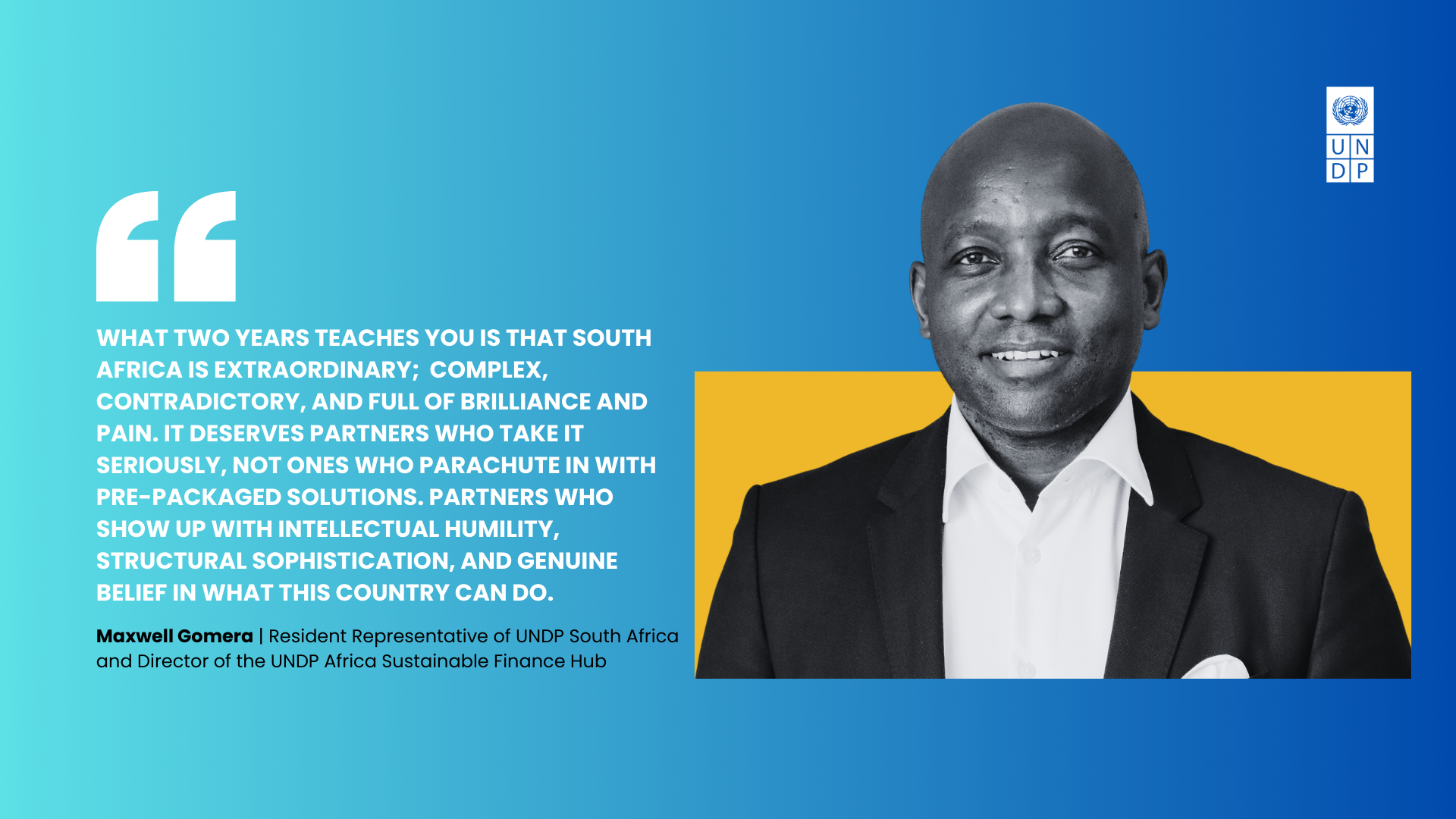
Maxwell Gomera, UNDP Resident Representative in South Africa and Director of the Africa Sustainable Finance Hub.
UNDP South Africa
Bt Maxwell Gomera
Two years ago around this time, I landed in South Africa with a mandate, a suitcase, and the quiet confidence of someone who had absolutely no idea what was about to hit him.
Today, I am pausing - not to only reflect on my journey, but also to celebrate what a remarkable team, a generous government, a patient UN family, and a country full of possibility have built together.
Here is an honest account.
UNDERSTANDING SOUTH AFRICA'S UNIQUE CHALLENGE
Not a Poor Country. An Unequal One.

There is something that does not get said enough in international development circles: South Africa is not a poor country. It is a profoundly unequal one. And that distinction matters enormously - because the wrong diagnosis leads to the wrong prescription.
This insight is one I could only have arrived at by walking the streets of the townships and traversing the high-rises of Sandton and Cape Town. South Africa is not only a tale of two cities. It is a tale of two economies - sharing the same geography, but not the same access to capital, networks, or opportunity.
Most global development frameworks were designed for low-income economies - countries that need grants, technical assistance, and concessional lending to get off the ground. South Africa has sophisticated financial markets, a capable state, world-class universities, and a private sector of real depth. By the standard metrics, it is classified as an upper middle-income country.
And yet there is nothing upper middle-income about many of its rural areas and townships. That classification - meant to signal progress - often means falling through the cracks of development finance, ineligible for the very mechanisms designed to close the gaps that persist. South Africa finds itself caught in a structural trap: too developed for concessional finance, too unequal to close the gap on its own. It is the enduring dichotomy of this country: sophisticated financial markets alongside persistent structural inequality. If left unaddressed, those who live furthest from the formal economy will continue to fall further behind.

Too developed for concessional finance. Too unequal to close the gap on its own. Caught between two worlds, adequately served by neither
That is not a failure of South Africa. It is a failure of the global development architecture to reckon honestly with the complexity of middle-income contexts.
South Africa does not need charity. It needs better capital architecture - instruments that can sit between the grant world and the commercial world, crowd in private finance, de-risk bold investments, and direct flows toward the entrepreneurs, communities, and sectors that the market persistently overlooks. That understanding has shaped everything we have tried to build here.
AN UNCOMMON ADVANTAGE
Running the Hub - A Strategic Gift

Maxwell Gomera at the Carbon Market Africa summit
I want to be honest about something that has shaped my effectiveness here in ways I did not fully anticipate when I arrived.
The Africa Sustainable Finance Hub is housed here - and that proximity has been a direct asset to South Africa's work. The continental knowledge the Hub generates flows into everything the country office designs. What is being tested in Lesotho informs what we structure in South Africa. What we learn from carbon markets in Kenya sharpens our nature finance work here. What development banks are doing across the continent shapes how we approach risk layering in Gauteng. South Africa, in that sense, benefits from being the home of a continental institution - and we have tried to make sure the continent benefits equally in return.
ASFH exists to serve the whole continent, and that knowledge belongs to all. Every Representative and government across Africa can access what we build - and that is exactly as it should be. The point is not personal proximity. The point is that South Africa's communities, entrepreneurs, and institutions benefit from a country office that is connected to the frontier of what development finance can do.
I am grateful for that. And I am conscious of the responsibility that comes with it - to make sure the continent benefits as much as South Africa does.
YOUTH AND THE FUTURE ECONOMY
Preparing the Next Generation - Deliberately
Youth unemployment in South Africa is not a standalone problem. It is the most visible expression of the structural inequality we have been describing - shaped by unequal access to quality education, digital connectivity, economic opportunity, and networks. Our programming has deliberately addressed these systemic gaps by preparing young people for the growth sectors shaping South Africa's future: the green and digital economy.
South Africa's green and digital economy will generate the jobs of the next decade. The question is not whether those jobs will exist. The question is who will be positioned to claim them - and whether young people from townships and underserved communities will be in that number, or watching from the outside again.
Over two years, more than 200 young people have been equipped with green skills linked to the energy transition, and nearly 1,000 with practical digital competencies spanning entrepreneurship, employment, and professional upskilling. These are not training statistics. They are the early signals of a generation being deliberately prepared to compete - on their own terms, in their own country.


THE TOWNSHIP ECONOMY
Visible at Scale - Finally
If there is one conviction I hold more firmly now than when I arrived, it is this: the township economy is not a social problem. It is an investment opportunity hiding in plain sight.
DIME - our digital marketplace for the independent economy - now tells that story with data that is impossible to dismiss. Across 15 townships in Gauteng, the census has registered 12,107 shops with formal digital identities, profiled 12,135 shop owners, and completed 35,832 AI-powered inspections with an 88% compliance rate. In Soweto alone, 2,556 shops are now on the map. In Tembisa, 1,567. In Pretoria, 1,265. In Diepsloot, 1,128.


These are not estimates. This is census-level visibility of an economy that has been invisible to the formal financial system for decades. Of those registered, 22% are women-owned businesses - people who have been creditworthy all along, simply never treated that way.
DIME is not an app. It is an economic map - and that map is now the foundation for something more ambitious.
Township Spark builds directly on this architecture, bringing UNCDF, African Bank, DBSA, SEDFA and others into a blended finance facility designed to unlock lending at scale. The logic is deliberate: de-risk the entry point, crowd in commercial capital, and let leverage do the work. In blended structures like this, catalytic capital can mobilise three to five times its value in commercial finance. This is what development finance should look like - not charity, but architecture.
PARTNERSHIPS
Unlikely Allies - By Design


One of the things I am most proud of is the range of institutions that now sit around our table - and not all of them are the usual suspects.
Over two years, we have built active working relationships with MTN, Standard Bank, African Bank, DBSA, and Microsoft. With the University of Johannesburg and TVET colleges across the country. With the City of Cape Town and the City of Johannesburg. With multiple ministries of government at national and provincial level.
MTN is not a typical UNDP partner. Microsoft is not a traditional development actor. But that is precisely the point. If UNDP is to be relevant in a middle-income economy with the sophistication of South Africa, we cannot limit ourselves to the usual development ecosystem. We have to be credible in rooms where business decisions are made, where city budgets are set, where technology is deployed at scale.
That credibility takes time to build. It requires showing up prepared, following through on commitments, and demonstrating that a development organisation can be a genuine strategic partner - not just a source of grants. I believe we have started to earn that reputation. These partnerships are proof of it.
PROGRAMME PERFORMANCE
A Journey of Growth
Programme delivery has grown from under 70% to 93% over the past two years - a trajectory that reflects a team deepening its capabilities, systems maturing, and an institution accelerating. By the end of year one it had reached 89%. As of December 2025 it stands at 93%. That momentum belongs to every member of this team, not to any single hand.
The foundations that enabled this acceleration were built together: governance systems that matured through collective discipline, partnerships that deepened through shared relationship-building, financial rigour that strengthened through team-wide accountability, and an institutional culture that increasingly values conversion as much as ambition. These are not corrections. They are the natural evolution of an office finding and extending its stride - together.

Under 70% to 89% to 93% - an institution accelerating, a team growing into its full capability.
The financial story mirrors the delivery story. In 2024, the office closed in a negative net position of -$433K. In 2025, revenue exceeded target by 48%, generating $700K above plan, and we closed with a positive net position of $276K. That momentum reflects stronger partnerships our team built, deeper financial governance our leadership team embedded, and a collective effort to convert engagement into sustained income.
Workforce capacity grew from 43 to 49 staff across contract modalities - a deliberate investment in execution capacity at a time when many offices were contracting. It will grow again. In one of the toughest fiscal environments the multilateral system has faced in years, we moved in the opposite direction. Both choices - to invest in people and to grow the programme - were made with full awareness of the moment. I stand behind them.
And yet strong delivery figures are not the finish line. The next imperative - and the one I am most focused on as we enter year three - is ensuring that institutional performance translates into measurable, lived improvement on the ground. Numbers on a dashboard matter. What matters more is whether a township entrepreneur can access capital, whether a family can afford a home, whether a young person can start a business. That is the conversion we are working toward.
THE CENTRAL SHIFT
From Policy to Capital - An Institutional Repositioning

This is the part of the story I want to tell clearly, because it is easy to miss.
When I arrived, we implemented programmes. Today, our team mediates capital and shapes financial systems. That is not a semantic distinction. It is a fundamental repositioning - and one our leadership team drove deliberately, understanding that South Africa's sophisticated financial context demands partners who can sit where capital moves, not just where projects are implemented.
Critically, this was not an individual shift. It was a deliberate institutional choice - aligned with global UNDP reform - to position our office where capital decisions are made. The whole team made that shift together. A country with South Africa's financial depth does not need another organisation writing policy papers. It needs partners who can sit at the table where capital actually moves - and that is where our colleagues have been showing up.
Over two years, our team has designed or advanced multiple innovative financial instruments - each targeting a structural gap that grants alone cannot close. In Rwanda, we piloted a mortgage insurance reform model - drawing on that experience to shape thinking on how to de-risk the deposit barriers that lock millions of Africans out of home ownership. Our colleagues advanced a climate risk pooling mechanism for flood-exposed communities - combining parametric modelling, public-private insurance layering, and fiscal risk transfer. The SME Disruption Lab uses guarantee layering and catalytic capital to reach enterprises caught in the valley of death between microfinance and commercial banking. And through our Biodiversity Investment Portal, we have begun securing nature investments - connecting conservation assets to capital flows that recognise, for the first time, the economic value of the ecosystems communities have stewarded for generations.
And at the centre of it all: a $100 million capital mediation deal - structured by the South Africa country office team - now in the final stages of closure. That single transaction reframes what UNDP is in this country - not a grant agency, but a financial architect.
Over two years, we moved from managing projects to structuring capital - advancing instruments worth over $100 million in catalytic financing.
G20 AND CRITICAL MINERALS
Setting the Agenda - Not Just Joining It

South Africa's G20 Presidency - the first ever led by an African nation - was a once-in-a-generation moment. Our team leaned in hard, and the collective effort showed.
Our contribution spanned six G20 working groups and task forces - covering sustainable finance, AI and data governance, gender equality, climate resilience, and disaster risk reduction. Our team seconded high-level expertise and provided substantive drafting support that shaped the G20 Leaders' Declaration, strengthening the reflection of African priorities on debt, financing, and the energy transition.
Critical minerals governance was a particular focus. Africa holds many of the world's most valuable minerals - the very materials the global green energy transition depends on. For too long, the continent has exported raw value and imported finished products, capturing almost none of the economic upside. We worked to change that: embedding frameworks into continental policy that ensure Africa benefits from its own resources rather than simply providing them at discount.
The conversation has shifted. Africa is no longer just the topic on the table. In many rooms, Africa is now setting the agenda. South Africa's G20 leadership was central to making that happen, and I am proud of the role our team played in it.


BEYOND SOUTH AFRICA
Continental Architecture - The ASFH Story
South Africa is where I am based. But the work of the Africa Sustainable Finance Hub extends across the continent - and that story belongs alongside the domestic one.
Over the same period, through ASFH, we have supported sovereign bond structuring in Lesotho - helping a smaller economy access capital markets with credibility by getting the risk structure right. We have strengthened Integrated National Financing Frameworks across more than ten countries - moving these from planning tools into active investment deployment mechanisms, directly linked to bonds, guarantees, and blended finance facilities.
On climate and nature finance, the team has built something with real continental reach. Through CARTA - a $29 million programme with the Swedish Energy Agency running to 2031 - we convened the first Carbon Markets Africa Summit, bringing together governments, investors and communities to shape the rules of a market Africa must lead, not simply join. We have selected seven Article 6 projects in Kenya and Zambia for ITMO delivery, and provided technical support on carbon market policy and regulatory frameworks to countries including Cameroon, Botswana, Sierra Leone, Liberia, Cote d'Ivoire and Uganda. The pipeline is real. The platform is built. Watch this space ahead of COP30.
With the China Development Bank, we are advancing a model that could reshape SME finance across the continent - CDB lending at scale to commercial banks, UNDP providing catalytic grants and technical assistance, the guarantee structure crowding in capital that would otherwise stay on the sidelines.
The bottom line for ASFH: we are no longer just shaping the conversation. We are structuring deals, mobilising capital, and building the financial architecture Africa needs to finance its own development.
INNOVATION
You Might Not Have Heard of These
UniPods and T-Pods - bringing innovation infrastructure directly to university campuses and TVET colleges, turning students into entrepreneurs before they graduate. T-Pods are homegrown - built right here in Mzansi, the first of their kind anywhere in the world. No other UNDP country has done this. The best time to build the habit of creation is before the world tells you it is not possible.
The Creatives Hub - because Africa's creative economy is a serious economic sector, not a footnote in a development report. Music, design, film, fashion - these are industries that deserve the same strategic attention as mining or manufacturing.
CARTA and carbon markets - finally connecting conservation and climate action to real financing flows. Nature is not free. We are helping to price it properly, and in doing so, opening new revenue streams for communities that have stewarded it for generations without recognition or reward.
Digital Public Infrastructure and AI Governance - we have embedded UNDP in South Africa's most consequential emerging policy conversations. Through Digital Public Goods partnerships and the MyMzansi dialogues, our team has been at the table as government shapes its approach to artificial intelligence, digital identity, and the infrastructure of the digital economy. These are not peripheral conversations. They will determine who benefits from the next wave of economic growth and who gets left further behind.
Innovation is not a programme. It is a posture. Either you believe something different is possible, or you do not.


A STRATEGIC MILESTONE
Country Programme Document - Approved
After months of rigorous preparation and genuine consultation with government, our Country Programme Document was approved. This is not a bureaucratic achievement. It is a five-year strategic mandate - a formal, nationally owned framework that grounds everything we are building in South Africa's own priorities and plans. I am grateful to the government colleagues who engaged with it seriously
A CONTINENTAL FIRST
Hosting the World - Right Here in Mzansi

In our very first year, South Africa hosted the UNDP Global Leadership Retreat - bringing together the organisation's senior leaders from across the world for a convening that had, until that moment, never taken place outside of New York. The first time on African soil. That is not a logistical footnote. It is a statement about where the centre of gravity in global development is shifting.
Hosting that retreat was a privilege and a responsibility. It required our team to perform at the highest level under full global visibility - and they did. More importantly, it positioned South Africa as a serious intellectual and institutional home for the conversations that will shape UNDP's future direction. We did not just host the meeting. We shaped part of the agenda.
A NEW HOME
15 Years in the Making
After almost 15 years of negotiation, false starts, and bureaucratic patience that would humble a saint, the UN family in South Africa is finally moving to a new, modern, dignified home. A space befitting the work we do and the country we serve.
Getting this over the line required the sustained leadership of our UN Resident Coordinator, Nelson Muffuh, whose persistence, institutional authority, and diplomatic skill moved this from a perennial agenda item to actual reality. My UNCT colleagues - the broader UN family in South Africa - showed exactly the kind of collective purpose that the Resident Coordinator system was designed to produce. This was genuinely a family effort.
This one felt personal to me too. I am glad I was here to see it over the line.
PEOPLE
First, Always
Staffing levels have grown. In a period when many UN offices contracted, we invested in people. That is a deliberate choice and I stand behind it.
Of course, change at pace is difficult. Not everyone experiences the same transition the same way. Some thrive in it. Others find it genuinely hard. Both responses are human, and I own my part in that as the leader setting the direction and the speed.
What I can say is this: watching colleagues step into new confidence, new capability, new leadership over these two years has been one of the most rewarding parts of this role. That growth is theirs. I just tried to create the conditions for it.
We have also invested beyond the immediate team. Over two years, our office and ASFH hosted around six fellows - emerging African leaders who came to learn, contributed substantially, and left better equipped to shape the continent's development future. Staff were coached in writing opinion pieces, supported in developing their public voices, and given the kind of leadership development that is rarely prioritised in the day-to-day. Building the next generation of African thinkers and practitioners is not a side activity. It is part of the mission.
The best thing a leader can do is get the right people around them - and then get out of their way. My team deserves far more of the credit than I do. Full stop.
REFLECTIONS
What Two Years Teaches You
That South Africa is extraordinary - complex, contradictory, full of brilliance and pain - and it deserves partners who take it seriously, not ones who parachute in with pre-packaged solutions.
That governance must be explicit. Ambition without internal conversion capacity is noise. Communication must be continuous. Financial controls are non-negotiable. And the pace of leadership must be calibrated - not slowed, but calibrated.
That a middle-income country like South Africa does not need saving. It needs investment, respect, and the right architecture. Partners who show up with intellectual humility, structural sophistication, and genuine belief in what this country can do.
I have tried – imperfectly – to contribute to that.
Two-Year Snapshot
| INSTITUTIONAL PERFORMANCE | |
| Programme delivery - two years ago | Under 70% |
| Programme delivery - end of year one | 89% |
| Programme delivery - December 2025 | 93% |
| Revenue net position 2024 | -$433K |
| Revenue net position 2025 | +$276K |
| Revenue target exceeded (2025) | 48% above target |
| Workforce growth | 43 to 49 staff |
| Country Programme Document | Approved |
| UN premises - years to resolution | 15 years - Done |
| TOWNSHIP AND INCLUSION | |
| Shops with digital identities - DIME | 12,107 |
| Shop owners profiled | 12,135 |
| AI-powered inspections completed | 35,832 |
| Compliance rate achieved | 88% |
| Townships covered - DIME | 15 townships in Gauteng |
| Women-owned businesses registered | 22% |
| CAPITAL AND CONTINENTAL ARCHITECTURE | |
| Catalytic capital advanced | $100M+ (in closure) |
| ASFH country reach | 10+ countries |
| Article 6 ITMO projects selected | 7 - Kenya and Zambia |
| CARTA programme value | $29M to 2031 |
| First Carbon Markets Africa Summit | Convened ahead of COP30 |
| Lesotho sovereign bond | Supported |
| Private sector partnerships | MTN, Microsoft, Standard Bank, DBSA, African Bank, SEDFA and others |
| T-Pods at TVET colleges | First of their kind globally - built in Mzansi |
Two years. Much done. More to do.
Thank you to the Government of South Africa, our partners, our donors, our UN family - and above all, my team.
On to year three.
Maxwell Gomera serves as UNDP Resident Representative in South Africa and Director of the Africa Sustainable Finance Hub, leading work across the continent on capital mobilisation, blended finance, and development architecture reform
Related
content
content


