

 Locations
Consultancy Services on Terminal Evaluation of the “Adaptation Fund Project Phase II: Building Climate and Disaster Resilience Capacities of Vulnerable Small Towns in Lao PDR” (2019 – 2025)
TERMS OF REFERENCE RPS_253_2025
December 21, 2025
1. INTRODUCTION
This Terms of Reference (TOR) form the basis and provides direction for a terminal evaluation of the “Adaptation Fund Project Phase II: Building Climate and Disaster Resilience Capacities of Vulnerable Small Towns in Lao PDR” in Savannakhet province (Sayphouthong and Sethamouak).
In October 2019, UN-Habitat signed an agreement with the Adaptation Fund to implement the project on the “Building Climate and Disaster Resilience Capacities of Vulnerable Small Towns in Lao PDR” in Savannakhet province (Sayphouthong and Sethamouak towns). It was funded by the Adaptation Fund Board with a total budget of US$5,500,000. UN-Habitat implemented the project with other executing entities including Ministry of Public Works and Transport, Ministry of Natural Resources and Environment, Provincial Department of Public Works and Transport in Savannakhet Province, and Department of Natural Resources and Environment in Savannakhet Province.
The project was approved with the evaluation framework of mid-term and terminal evaluations. The mid-term evaluation was conducted by a team of individual consultants in Feb 2023. In line with the Evaluation Policy of the Adaptation Fund 2022, this terminal evaluation will assess project performance, support learning and accountability, and inform future climate change adaptation interventions. The target audiences for the evaluation results are the Adaptation Fund Board, UN-Habitat and other implementing partners, intended project beneficiaries and participants and other relevant stakeholders.
2. BACKGROUND AND CONTEXT
Climate change is a major impediment to the attainment of national development goals. Lao People’s Democratic Republic (PDR) has been increasingly affected by extreme weather events. This is particularly problematic due to its high sensitivity, resulting from dependence on climate-sensitive natural resources and its low adaptive capacity. The impacts of extreme weather events have been severe to the point that in 2013 Lao PDR was named the 7th most severely affected country in the world by climate change, with 23 deaths and absolute losses of US$ PPP 263,510,000[1]. Irregularity in rainfall has led to both floods and droughts, with a variation in severity from year to year. Not only does Lao PDR have a high exposure to extreme weather events, particularly floods, but recent reports by the INFORM Global Risk Index show a low ability to cope with these events[2]. In addition to extreme events, variation in the seasons has disrupted cropping, causing food insecurity.
The high degree of climate change vulnerability in Lao PDR is due to several factors, including the physical geography, low coping capacity and reliance on the agriculture sector. Geographically, the country can be separated into several regions, each of which is susceptible to different hazards. A trend of increasing rainfall is especially apparent in the south and central regions, leading to widespread flooding[3]. In rural areas, this damages or destroys food crops. In the rapidly growing small and emerging towns, there is significant damage to physical infrastructure, hindering economic development and disrupting livelihoods. Low coping capacity is a result of both the low institutional capability and the infrastructure. Currently, Lao PDR is showing a lower coping capacity than neighbouring countries and also of countries which are at a similar income level.
In 2018, unusually heavy rains and flooding caused a dam to break nearby Attapeu Province, leading to dozens of deaths and thousands of people displaced. Meanwhile, roads, bridges and other critical infrastructure throughout the country have been severely impacted by heavy rainfall, which is, in turn, caused by the early onset of tropical storms in the South China Sea. Such infrastructure damage has affected the provision of basic services such as water supplies. These events have once again heightened the focus in Laos on the impacts of climate change and the serious risks they pose to life, livelihoods, infrastructure and sustainable development.
Looking forward, there is an increasing risk of severe weather events. There is a need for adaptive actions to be taken to mitigate the effects of these events, which have the potential to severely derail the Government’s development agenda. There has been a long-term goal of graduating from Least Developed Country (LDC) status by 2020 with a vision of achieving upper-middle income status by 2030. To achieve this, the 8th National Socioeconomic Development Plan focused on economic growth, sustainable development and strengthening human resource capacity. Recent indications suggest that Laos will probably miss the 2020 graduation target. It is imperative, therefore, that steps are taken to ensure the predicted climatic changes do not prevent Lao PDR from moving forward according to its development aims. UN-Habitat is already working with the government to this end on the Adaptation Fund-funded project entitled, “Enhancing the climate and disaster resilience of the most vulnerable rural and emerging urban human settlements in Lao PDR.” The National Designated Authority has requested UN-Habitat to build on this initial project with a continued focus on small and emerging towns in highly vulnerable provinces. This proposed project is in different provinces than the initial project but caters to the government’s ongoing need to build resilience in these small urban settlements.
The project’s main objective is to build climate resilience in small towns along the east-west economic corridor in the central region of Lao PDR. This will be achieved through the provision of climate resilient water infrastructure and the mainstreaming of climate change into urban planning. The targeted towns align with the government strategy to promote economic growth and build infrastructure in emerging and small towns.
To achieve the objective, a rapid vulnerability assessment has been carried out in each of the target settlements. This has formed the basis of an action plan. The vulnerability assessment will also feed into master plans which will be developed for each of the two towns. The master plans will demonstrate how to mainstream climate action into urban planning.
The planning and design of resilient systems will be carried out in a participatory manner, with input from all sectors of the community, from government officials to marginalised groups such as women and minority ethnic groups. The process will include capacity building for authorities to work in a participatory and inclusive manner. A key component of the project is the construction of climate and disaster-resilient infrastructure systems. An additional focus is climate action mainstreamed urban planning.
3. PROJECT FRAMEWORK
The project is comprised of 3 components, 4 outcomes and 6 outputs under the responsibility of UN-Habitat and Executing Agencies (MPWT, MoNRE, NPSESavannakhet).
| Expected Result | Indicators | Baseline data | Targets | Responsibility |
|---|---|---|---|---|
Project component1: Developtown level master plans whichintegrate climate change adaptation intosocially inclusive infrastructure, spatial planning and land-use management in and beyond theproject area. Capacity built at District, Provincial and National level to plan for climate-resilient infrastructure development and to maintain and manage infrastructure. | ||||
Outcome 1.1 40 government staff, at least15 of whom female, have increased capacity to design climate resilient urban infrastructure in small towns | Level of capacity at the subnational level increased | Capacity to autonomously planadaptation projects at the sub-national level is limited | 5 New adaptation projects prepared by sub-national staff | Executing entities (MPWT) |
Output 1.1.1 Training provided to district, provincial and National government staff on resilient infrastructure design. Female government staff mustbe represented | Number of government staff trained, disaggregate d by sex | There is constrained capacityfor government staff to plan fornew resilient infrastructure | 40 government staff trained, 15 of whom are female. | Executing entities (MPWT) |
Outcome 1.2
60 government staff, at least 20 of whom are female, have capacity to develop climate resilient town master plans and two master plans approved, that support the development of resilient infrastructure, serving 57,144 people, 53.5% of whom are female. | Comprehensive adaptation actionplans in place for Sayphouthong and Sethamouak Towns | No such plans developed or in place | Sayphouthong and Sethamouak Towns have comprehensive adaptation action plansin place that consider infrastructure, as well as economic, social and environmental adaptation actions beyondthe life of this project. | Executing Entities (MPWT) and UN-Habitat |
Output 1.2.1
Training provided to district, provincial and national government staff on climate action mainstreamed urban planning. Female government staff must be represented | No. of staff trained disaggregate d by sex | There is very limited capacity at all levels to plan for climate change adaptation actions | 60 staff, 20 of whom female, trained | Executing entities (MPWT) |
Output 1.2.2 Two master plans developed, using knowledge generated by the project, to both provide sustainable adaptation benefits to the infrastructure designed under this project and to enable the government to better plan for adaptation in other infrastructure, beyond that in the project area | Developed adaptation plans | There are currently no adaptation plans and no training has been provided on developing such plans | 60 staff trained, 20 of whom female. 2 masterplans developed. The master plans will include specific provisions for the development and climate change resilience of women | Executing entities (MPWT) |
Activities 1.1.1 Define trainee group 1.1.2 Baseline knowledge/training needs assessment 1.1.3 Prepare the exact nature of the training materials based on the specific requirements of the trainee group 1.1.4 Provide the trainings and mentorship of the trainee group through a mixture of training workshops and ‘on the job’ type training 1.1.5 Monitor the achievement of the output of the training 1.2.1 Define trainee group (note that this is a different group from that trained under Output 1.1) 1.2.2 Baseline knowledge/training needs assessment 1.2.3 Prepare the exact nature of the training materials based on the specific requirements of the trainee group 1.2.4 Provide the trainings and mentorship of the trainee group through a mixture of training workshops and ‘on the job’ type training 1.2.5 Monitor the achievement of the output of the training 1.3.1 Identify key vulnerabilities by re-confirming those presented in this proposal 1.3.2 Define objectives for the planning process 1.3.3 Define shortlist of proposed future adaptation actions through further multi-criteria analysis, cost-benefit analysis and applying environmental and social safeguards, considering the specific needs of women and indigenous people 1.3.4 Write up draft plans for review and approval 1.3.5 Approve draft plans | Milestones Activities begin by month 6 All trainings complete by month 24 Plans developed by month 30 Complete by month 36 | |||
| Project Component 2: Socially inclusive infrastructure built in target towns that protects people from climate change-related impacts and provides continuous services despite current and anticipated future changes in the climate | ||||
Outcome 2.1 57,144 people,53.5% of whom are female, who currently have inadequate water and/or protective infrastructure, have access to year-round, clean water and protective infrastructure despite current climate hazards and future changesin climate | The target population has access to clean, year-round water supply, which is able to withstand currentand anticipated futureclimate extremes | Neither town has access to reliable watersupply, nor capacity to adapt to future changes in climate conditions | 57,144 people,53.5% of whom are female, have access to affordable, clean and climate-resilient watersupply | UN-Habitat, NPSE Savannakhet |
Output 2.1.1 New resilient infrastructure constructed in response to climate change impacts, including variability | Physical infrastructures and connections in place | There is no adaptive water supply infrastructure in placeat present in the twotowns | 2 water supply systems constructed thatare able to continue functionality in present and anticipated future climateconditions | UN-Habitat, NPSE Savannakhet |
Activities
| Milestones
| |||
| Project component3: Knowledge and awareness enhanced from national to local levels along the economic corridor, ensuring sustainability and potentially leadingto policy changes at the national level | ||||
Outcome 3.1 Project implementation is fully transparent. All stakeholders, including women, are informed of products and results and have access to these for replication. | Level of awareness at the local and national levelof climate change adaptation actionsand potentialfor replication | Awareness of the need to take adaptation actionsand the potential for replication remains very low asidefrom specialists in climate change adaptation | At least 100, including at least 35 women, government staff are awareof the project’s activities and haveimproved knowledge and capacity to replicate its benefits | UN-Habitat, NPSE Savannakhet |
Output 3.1.1 Project activities and results are captured and disseminated through appropriate information for the beneficiaries, partners and stakeholders and the publicin general. | No. of knowledge products generated by the project (knowledge productscould be newspaper articles, published case studiesand tools or guidelines). | Information- sharing is typically limited, and thereis no institutionalised mechanismto capture project results | At least 20 knowledge products generated by the project by its end (see indicators column) | MoNRE |
Output 3.2.1 Climate policy– especially the National Adaptation Plan and post-Paris agreement reporting– influenced to reflectthe challenges of climate change adaptation in basic service andprotective infrastructure, including the provision of infrastructure in a way that benefits women | NAP and post- Parisclimate policies and reporting reflect urban adaptation and basicservice provision priorities, and issues relating to women | National Climatechange related policies show some consideration of urban infrastructure adaptation | NAP and all post- Paris climate policy thoroughly reflects urban and basic service adaptation priorities | MoNRE |
Activities 3.1.1 Develop case studies, and other appropriate good practice documentation. 3.1.2 Establish contact with national newspapers and write semi-regular articles about project successes 3.1.3 Based on training, develop local language guidance and tools. Where guidance is produced for communities it should be usable as oral materials, for the benefit of indigenous and illiterate sections of the community. 3.1.4 Develop video, fliers and other KM products, as appropriate and under the guidance of the PMC 3.2.1 Engage in regular dialogue with NAP stakeholders and those engaged in Post-Paris work 3.2.2. Conduct alignment workshops with NAP Stakeholders 3.2.3 Provide support to NAP team and other stakeholders involved in Post-Paris policy work to integrate urban and basic service adaptation considerations | Milestones • Activities under 3.1 will be implanted regularly throughout the project • Activities under output 3.2 will be implemented on-demand, in alignment with the NAP and climate policy process | |||
The organigram of the project was organized as follows: at the national level, a Project Management Committee (PMC) supports the Project. The PMC was formed to oversee project progress and facilitate its implementation, including overseeing and cooperating with the project team, the technical assurance group and the technical advisory group. The PMC is chaired by MPWT/ MoNRE and co-chaired by UN-Habitat (including secretariat). While the Project Team (PT) has the responsibility of day-to-day management of project activities, monitoring and evaluation and learning, a Provincial Execution Unit (PEU) contributes through the provision of technical backstopping and quality control throughout the project period at provincial level.
Further details can be found in the figure below.
4. PURPOSE, OBJECTIVES AND SCOPE OF THE EVALUATION
4.1 Purpose
The final evaluation serves both accountability and learning purposes. Regarding accountability, it is intended to provide independent evidence on the performance of the project and what it achieved at objectives, expected accomplishment (outcomes) and output levels. It is also intended to enhance learning by generating insights, lessons learned and recommendations to inform management decision-making for future programming and funding, and implementation modalities. More specifically, the evaluation will inform the development of the future portfolio, with specific attention to identifying opportunities and areas of future action that will strengthen the results and contribute further to enhance the climate resilience in Lao PDR and to leverage influence strategies, opportunities for scaling-up and replicating the implementation approach used.
4.2 Objectives
The evaluation objective is to assess, as systematically and objectively as possible the relevant, efficiency, effectiveness, sustainability impact outlook and coherence of the project. The sharing of evaluation results from this evaluation will inform the Adaptation Fund Board, UN-Habitat and local implementing partners and other stakeholders on what worked well, what did not work well and why.
The specific objectives of the evaluation are:
- To assess the performance of the project in terms of achievement of the results at objective, expected accomplishment (outcome) and output levels;
- To assess the relevance, efficiency, effectiveness, sustainability, impact, and coherence of the project in improving conditions of the target communities in terms of climate resilience building;
- To assess project management modalities, appropriateness of partnerships, working arrangements, adequacy of resources and how these may have impacted on the effectiveness of the project;
- To assess how cross-cutting issues such as gender equality, youth and human rights were integrated in the project;
- To identify lessons learned and make strategic, programmatic and management recommendations on what further needs to be done to effectively promote and improve climate resilience in targeted settlements.
4.3 Scope of the evaluation
The evaluation will focus on the life cycle of the project, covering the entire implementation period. It will assess the planning, funding, implementation and, monitoring and reporting on the project. It will assess achievements of outputs and expected accomplishments (outcomes) and processes that influenced the achievements, including readiness, ownership, stakeholder involvement, financial management, supervision and backstopping. Evaluate the monitoring, evaluation and reporting systems. Identify and analyze constraints, challenges and opportunities. Further, it will include assessment on how cross-cutting issues of gender equality, human rights, climate and youth have been integrated in the planning and implementation of the project.
5. EVALUATION QUESTIONS
Apart from evaluating performance of the project focusing on achievements in terms of outputs, outcomes and objective, the evaluation will seek to answer evaluation questions, which are organized around the evaluation criteria of relevance, effectiveness, efficiency, impact outlook, sustainability, coherence as well as assess the integration of cross-cutting issues. The following questions are the minimum requirement but not limit the analysis made in the report of terminal evaluation.
| Criteria | Evaluation question and sub-questions. |
|---|---|
Relevance
| Did the project do the right things? To what extent were the projects objectives and design relevant to beneficiaries, Adaption Fund, UN-Habitat, country, institutions’ needs?
|
Effectiveness
| To what extent did the project enhance the climate change resilience of the targeted settlements?
|
Efficiency
| How well were resources used?
|
Impact
| What difference has the project made?
|
Sustainability
| To which extent will the benefits and achieved outcomes of the project continue or are likely to continue when funding from the Adaption fund ends?
|
| Coherence | To what extent did other projects, support or complement the project?
|
| Cross-cutting issues | To what extent were cross-cutting issues of gender, human rights, environment and disability considered and integrated into UN-Habitat Programme design and implementation? |
The evaluator may refine or expand on the evaluation questions, as necessary, in order to carry out the objectives of the evaluation.
6. EVALUATION APPROACH AND METHODS
6.1 Approach
The evaluation will be conducted as systematically and impartially as possible and in line with the United Nations Evaluation Group (UNEG) Norms and Standards for evaluation in Nations System Evaluation policy of the Adaptation Fund[4] (2022), UN-Habitat Evaluation Policy[5] (2024). The evaluation consultant finally decides on the concrete approach and methodology. However, it suggested that the evaluation should apply a results-based approach (Theory of Change/TOC), in assessing the extent to which the project contributed to the observed achieved results , assessing how activities and outputs contributed to the expected accomplishments (outcomes). The TOC building on the logic framework of the project form the basis for the evaluation, serving as a tool for assessing the project’s performance. The evaluation should also use participatory and utilization focused approaches, to enhance engagement of the stakeholders in the evaluation process and the utilization of evaluation results.
The main emphasis should be placed on project delivery, achievement of results; lessons learned, critical gaps; and recommendations. Findings in the evaluation should be evidence based. The report should be presented in English. Any information and materials in Lao language needs to attach the translation in English.
6.2 Evaluation Methodology
A variety of methodologies will be applied to collect data to answer the evaluation questions. By triangulating available data sources, the evaluation will seek to establish a strong evidence base and maximize the credibility of its analysis. Where relevant, applicable and feasible, the data will be disaggregated by gender.
Taking into account the time, resources and data availability constraints, the following methods will be used in this evaluation:
- Desk review: The evaluation consultant should conduct a structured desk review of relevant documents to the project. Documents to be provided by the UN-Habitat country office including project documents, progress reports, mid-term evaluation, final deliverables, budgets, etc.
- Key informant interviews and consultations: The evaluation should interview Key stakeholders involved in the planning, implementation, and reporting on the project as well as beneficiaries of the project. Interview questions may be derived from the evaluation questions.
- Focus group discussions; The evaluation should, in addition to interviews, conduct focus group discussions will executing entities and other partners to obtain their views, experiences and assessments regarding the project.
- Surveys: If deemed necessary the evaluation will conduct online surveys with implementing entities, and beneficiaries.
- Field visits to assess selected activities, as feasible within the budget of the evaluation, should provide insights into the scope (time), depth and range of activities of the project.
The evaluator will describe expected data analysis and instruments methodologies to be used in the mid-term review report. Presentation of the evaluation findings should include: evaluation purpose and objectives, evaluation methodology and approach, findings (achievements and performance rating assessments), conclusions, lessons learned, recommendations.
7. STAKEHOLDER ENGAGEMENT
The evaluation should be participatory, involving key stakeholders. The evaluation will seek to make deliberate efforts to consult vulnerable beneficiaries. Key Stakeholders will be kept informed of the evaluation processes including design, information collection, and evaluation results dissemination to create a positive attitude for the evaluation and enhance its utilization. Stakeholders may be involved either directly through interviews or focus group discussions, surveys, or given opportunity to comment on the evaluation products. UN-Habitat will facilitate the evaluator for the engagement with main stakeholders. A stakeholder analysis should be prepared by the evaluator at the inception phase of the assignment.
8. EVALUATION CONSULTANT’S SKILLS AND WORK EXPERIENCES
The evaluation will be conducted by an independent evaluation consultant. He/she must have strong evaluation experience in evaluating project/programmes, should have knowledge of Results-Based Management, requisite expertise in climate change and experience in economic and social development issues. In addition, the consultant should:
8.1 Competencies/ Interview – 30 scores
- Professionalism: Demonstrates professional competence and mastery of subject areas. Good research, analytical and problem-solving skills. Conscientious and efficient in meeting commitments, observing deadlines and achieving results.
- Communication: Excellent and effective written and oral skills. Ability to convince people through constructive argumentation and to present information in a concise and accurate manner. Negotiating skills and ability to enable good communication and understanding between different interest groups, organizations etc.
- Planning and Organizing: Proven ability to plan, coordinate and monitor own work and that of others. Ability to work under pressure and use time efficiently. Identifies priority activities and assignments, and adjust priorities as required.
- Teamwork: Works collaboratively with colleagues to achieve organizational goals. Solicits input by valuing ideas and expertise of others and is willing to learn from others.
8.2 Work experience and other requirements – 20 scores
- At least 5 years of work experience in climate change issues.[SS1]
- Knowledge in Adaptation Fund operations and strategy, and about relevant in UN system and its accountability framework.
- Knowledge and understanding of UN-Habitat mandates and its operations.
- Knowledge and understanding of Lao context.
- Proven record of evaluation experience with ability to present credible findings derived from evidence and putting conclusions and recommendations supported by evidence of findings.
- Experience of evaluation on Adaption Fund project would an added advantage.
8.3 Education – 10 scores
- Bachelors degree in political sciences, communication, information technology, sociology, engineering or another relevant field.
8.4 Language requirement – 10 scores
- Fluency in English language is required
8.5 Financial Proposal – 30 scores
- The financial proposal shall present an all-inclusive cost, professional fees, travel, subsistence/ per diem, other direct costs, and any taxes, if applicable.
9. EVALUATION MANAGEMENT AND RESPONSIBILITIES
9.1 Selected evaluation consultant
Impartiality is an important principle of evaluation because it ensures credibility of the evaluation and avoids a conflict of interest. For this purpose, officers responsible for design and implementation of the project should not manage the evaluation process. The selected evaluation consultant will manage the evaluation process, ensuring that the evaluation is conducted by a suitable evaluator, providing technical support and advice on methodology, explaining evaluation standards and ensuring they are respected, ensuring contractual requirements are met, approving all deliverables (TOR, Inception Reports; draft and final versions of evaluation reports), sharing the evaluation results, supporting use and follow-up of the implementation of the evaluation recommendations.
The selected evaluation consultant will be established as a consultative arrangement and representatives of the projects to oversee the evaluation process and maximize the relevance, credibility, quality, uptake and use of the evaluation.
9.2 UN-Habitat
UN-Habitat Lao PDR project team will be responsible for supporting the evaluation processes by providing information and documentation required as well as providing logistics and contacts of stakeholders to engage.
10. PROVISIONAL WORK SCHEDULE
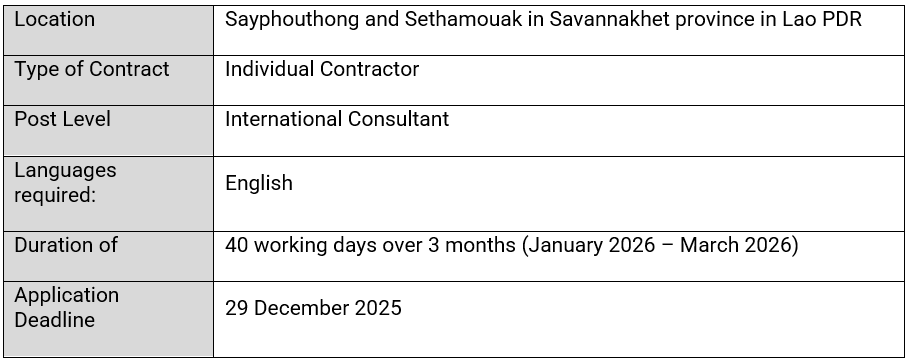
The duration of the evaluation exercise is 40 working days (over 3 months between January 2026 to March 2026). The exact start date will be negotiable with UN-Habitat and partners. The evaluation consultant will be paid a negotiated professional fee for 40 working days. The work schedule for the assignment is summarized in the table below.
| SL.No. | Task Description | Jan 2026 | Feb 2026 | Mar 2026 | |||
|---|---|---|---|---|---|---|---|
| 1H | 2H | 1H | 2H | 1H | 2H | ||
| Meeting with UN-Habitat team to discuss the work plan | X | X | |||||
| Submit/discuss the inception report, including tentative table of contents of the evaluation report (Deliverable 1) | X | X | |||||
| Review the project document and contract and evaluate project outputs (planning documents/reports) | X | X | |||||
| Organize interviews, consultations, and discussions with key relevant stakeholders and communities aiming to evaluate the capacities built and future needs while on mission to project towns | X | X | |||||
| Draft project evaluation report and submit for comments (Deliverable 2) | X | X | |||||
| Produce the final document project evaluation report including final comments and feedback (Deliverable 3) | X | X | X | ||||
11. KEY DELIVERABLES
The following three (3) deliverables are expected.
11.1 Deliverable 1: Inception report
Inception report with evaluation work plan, and a stakeholder analysis. Once approved, it will become the key management document for the evaluation, guiding evaluation delivery in accordance with UN-Habitat’s expectations and standards for evaluation reports. The inception report shall include background and context, evaluation purpose and objectives, theory of change, evaluation matrix, approach, and methods to be used, limitations or constraints to the evaluation, proposed outline of the evaluation report, as well as work schedule and delivery dates of key evaluation deliverables.
11.2 Deliverable 2: Draft version of the evaluation report
Draft evaluation report. The evaluator will prepare draft evaluation report to be reviewed by UN-Habitat Independent Evaluation Unit. The draft should follow UN-Habitat’s standard format for evaluation reports (the format will be provided). The format is intended to help guide the structure and main contents of evaluation reports formulated by UN-Habitat.
11.3 Deliverable 3: Final version of the terminal evaluation report
Final evaluation report including executive summary and appendices following UN-Habitat’s standard format of an evaluation report. The report should not exceed 40 pages, excluding the executive summary and annexes. The report should be technically easy to comprehend for non-evaluation specialists.
12. RESOURCES AND PAYMENT SCHEDULE
The evaluation consultant will be paid a professional evaluation fee based on the level of expertise and experience including travel, required by the consultant to collect data from the field during the mission outside duty station of the consultant. It is anticipated that 5-days visits to two project towns will be required for on-field data collection and assessment. The financial proposal should include the cost of 5-days field visit under this assignment.
The payments for undertaking the evaluation assignment shall be paid to the consultant as follows;
| Installments | Expected Outputs | Expected No. Days[SS2] | Payment |
| 1st Payment | Upon signing contract and finalizing the kick-off meeting | 5 | 40% |
| Final payment | Upon submission of the Deliverable 1 and 2 i.e. inception report and draft version of the evaluation report approved by UN-Habitat. Upon submission of the Deliverable 3 i.e. final version of terminal evaluation report and all deliverables (documents and reports) and approval by UN-Habitat | 35 | 60% |
How to Apply
Interested and qualified candidates, please submit your application to the following email address lao.procurement@undp.org
The supporting documents required forthe application are as follows:
- UN Personal History Profile (P11 Form)
- Recent Curriculum Vitae (CV)
- Offeror’s Letter
Any questions and clarification, please email to lao.pu@undp.org
Your email subject should indicate: “RPS_253_2025 UN-HABITAT Terminal Evaluation Consultant”
[1]Global Climate Risk Index, 2015, p.7. Online at https://germanwatch.org/en/download/10333.pdf
[2] Index for Risk Management (INFORM) Country Risk Profile for Lao PDR, 2018. Online through
http://www.inform-index.org/Countries/Country-Profile-Map
[3] CLEAR: Consolidated Livelihood Exercise for Analysing Resilience. A special report prepared by the Ministry of Natural Resources and Environment’s Department for Disaster Management and Climate Change (DDMCC) and the World Food Programme with technical support from the USAID Mekong ARCC project.
[4]https://www.adaptation-fund.org/document/evaluation-policy-of-the-adaptation-fund-graphically-edited/
[5]https://unhabitat.org/sites/default/files/2024/07/un-habitat_evaluation_policy_2024.pdf
[SS1]Please indicate the minimum years of experience on related fields
[SS2]On the title it indicates 40days, but not captured in the output part. We could insert a column here
Related
content
content


