

 Locations
Forty kilometers from Asunción, in Yaguarón, there is a cluster of garment workshops that for decades have provided the main source of livelihoods for many families.
The city of Yaguarón, its importance in the garment sector and its basis for the development of the flexible manufacturing system
19 de Abril de 2022

Garment workshop in Yaguarón
UNDP Paraguay
The development of clusters and new production systems is key for industrial competitiveness. However, Paraguay’s position in the Global Innovation Index (GII) for 2020, shows a lag in the development of clusters and highlights the challenge of achieving "a better understanding and development of clusters" and greater intersectoral articulation of the national innovation system.
This is why Wendá, the National Innovation Strategy and the UNDP Accelerator Lab are promoting a learning loop about flexible manufacturing, which seeks to identify tools, strategies and interventions to improve the competitiveness of SME clusters through innovation and formalization of enterprises.
Forty kilometers from Asunción, in Yaguarón, there is a cluster of garment workshops that for decades have provided the main source of livelihoods for many families. These characteristics make the city a potential development pole and an important site for experimentation and learning.
What then makes Yaguarón particular to the research and to the central challenge?
With 31,500 inhabitants according to the last census, the city is one of the oldest in the country. Originally, its inhabitants worked in the garment industry without electricity, using pedal-powered machines, coal-fired irons and transport with donkey or horse traction. In the 1960s, the city's garment manufacturers began a slow process of modernization that started with the "Crisvil" factory and its use of more than a hundred micro-workshops.
"Thanks to the work in the workshop, I was able to support my family and help many relatives to study, today I have a daughter who is a pediatrician and another son who is a teacher and when there is a need for work in the workshop they also sit to sew or direct in the workshop with me ... I remember my beginnings when we lived in a settlement far from Yaguarón, we had to walk several kilometers to bring the garments to our clients who came from Asunción or to receive the materials, we didn't have electricity either, we sewed with a pedal machine and we sewed with a charcoal iron...".Yaguarón garment maker
Today production has been modernized, but many families maintain this trade and live and grow around sewing machines. In a preliminary study we characterized 20 garment workshops and the collection of life stories and testimonies of garment makers in the city of Yaguarón, mapping them on the Wendá platform (See Figure №1).
In this preliminarily study, we sought to identify industrial districts with potential for the application of flexible manufacturing systems, such as those used globally in the textile and apparel sector to generate greater responsiveness to changes in demand, provide a quick response to customer needs, and permit efficiency and flexibility in manufacturing, distribution logistics, and the application of technology (Bellandi and Caloffi, 2010).
Survey of garment production units in Yaguarón and companies during 2021 within the Wendá platform.
The city of Yaguarón, a city in the interior of the country, with high production quality, and a territorial specialization of its population and economy in garment manufacturing, stood out as a case study. This district has important assets for a flexible manufacturing system, such as networks of contracting and subcontracting of manufacturing and related services, “multifunctional” workers that can change tasks depending on demand, and a local Association of Garment and Related Industries with recent experience in coordinating local response to national demands such as the National Agreement for the Provision of Hospital Gowns. Yaguarón alone produced close to 10% of the total production national production of hospital gowns at one point during the pandemic.
What did we discover in Yaguarón?
The preliminary study revealed that there are barriers to strengthening competitiveness. These barriers are not only related to their capacity to produce or make garments, but are found in three different dimensions:
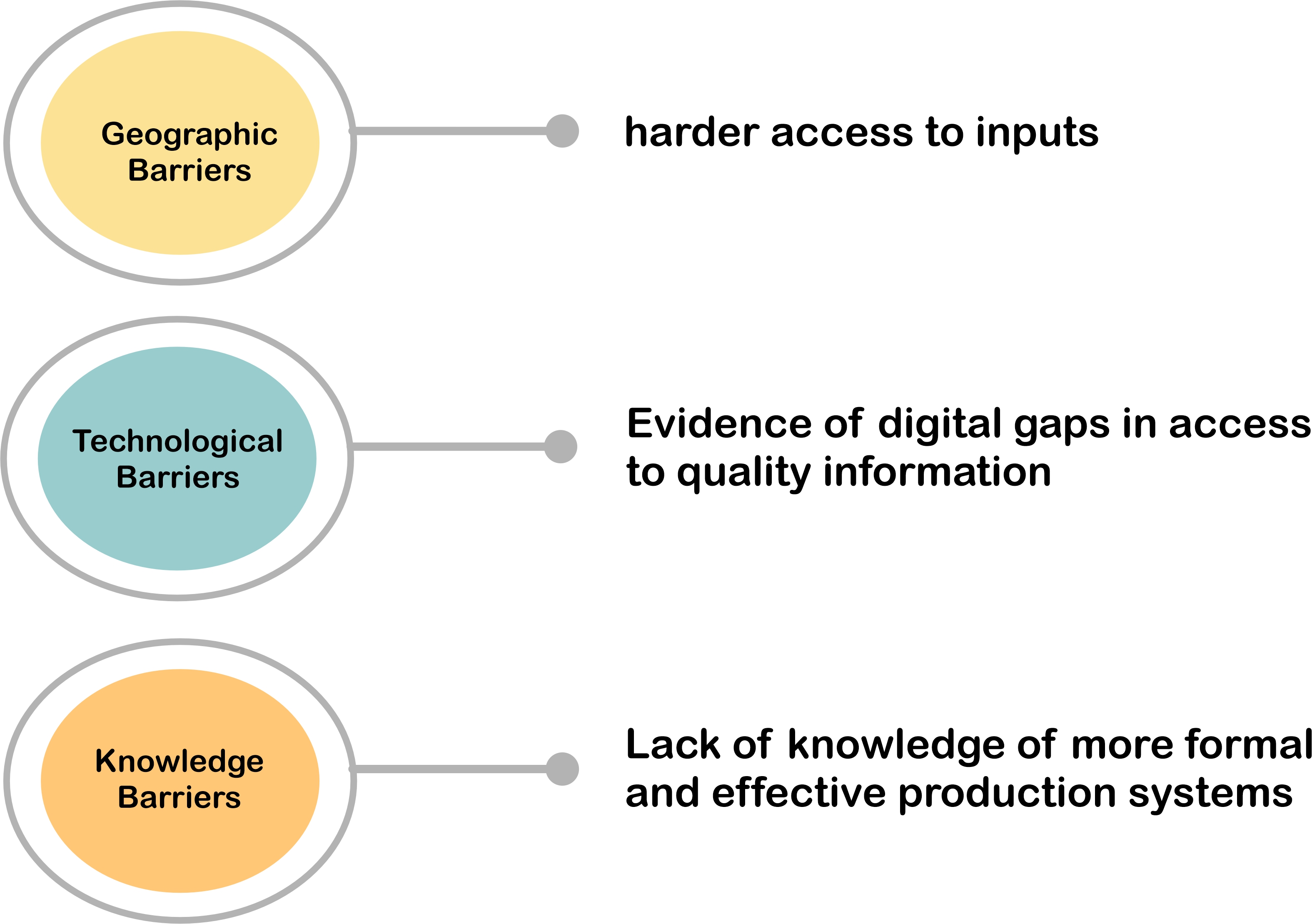
Dimensions of the barriers detected in Yaguarón. Prepared by the authors based on Yaguarón Fashion and Apparel Cluster Analysis and Characterization Report (2021)
A second stage of our learning loop consisted of action-research strategies to explore and experimental with potential solutions for these barriers. For the exploratory stage, we identified inefficient production and quality management as a specific knowledge barrier and made this the basis of an intervention we tested in the learning loop’s experimentation phase, which investigated the potential for training and knowledge transfer from a national apparel brand, to improve productive efficiency (time/cost/quality) in the Yaguarón cluster, as a step toward improving competitiveness and employment formalization.
What will we do during the experimentation?
For the experimentation we will develop a new product and accompany the apparel workshops in Yaguarón in a short production cycle of a novel product that tests their flexibility. First, we will diagnose response time and the quality of garments through the development of prototypes. Second, after classifying the workshops into control and treatment groups, we will provide technical training and support to the workshop owners and their workers to learn and collect data on the dynamics of operations, production management and the existing capacity for cluster-wide collaboration in real production situations.
In our next blogpost we will describe the details of the intervention, as well as the most relevant data and preliminary analysis of the results and lessons learned to support the development of this potential industrial pole, which, with stitches and needles, maintains the noble trade of garment making.
Written by Eva Torales, Carmen Gauto, Ana Lucía Giménez, Jorge Garicoche and the UNDP Paraguay Accelerator Lab team.
-
This blogpost was published on the National Innovation Strategy Paraguay page. To access the original blogpost, click here.
Para leer este blog en español, click aquí.