

 Locations
Ensuring climate funds reach the people who need it the most
How local budgets are securing Indonesia’s climate future
April 25, 2025
In the villages of Kayupuring and Tlogohendro, Central Java, Indonesia, the climate crisis is not an abstract forecast—it is an economic reality. For decades, the rhythm of the seasons dictated the local economy, but that rhythm has broken. Violent rains now wash away beehives, and prolonged droughts have halved the yields of staple crops like cardamom and coffee.
The primary challenge in climate action is often the "last mile" of finance. While funds are pledged globally, funding frequently stalls in national bureaucracies, failing to reach the villages where it is needed most. The UNDP Climate Finance Network (CFN), supported by the UK Foreign, Commonwealth & Development Office (FCDO) and in partnership with Relung Indonesia Foundation, is working to bridge this gap by localizing climate finance.
Changing climate, changing lives
In recent years, unpredictable weather has decimated local livelihoods—beekeepers like Cahyono watched their hives wash away in violent rains, and farmers like Saumi saw their coffee and cardamom yields drop by half due to prolonged heat.
For Saumi, a 52-year-old farmer, the lack of climate-resilient infrastructure forced her into the dangerous, back-breaking work of sand mining. "During the dry season, the cardamom harvest fails, and sand mining becomes the only way to survive," Saumi explains. "I had never been asked for my opinion before, but we needed a way to support ourselves beyond the river. We needed new skills and a voice in our own future."
Similarly, Cahyono, a lifelong beekeeper, watched 20 years of tradition evaporate."Extreme heat and unpredictable seasons have devastated honey production," he says. "The flowers don't bloom when they should, and the bees are confused. We needed more than just luck; we needed a plan."

Cahyono tends to his beehives near his home in Kayupuring. As changing weather patterns affected flowering plants, he began adapting his practices to protect the bees and sustain his family’s income.
From awareness to action
The intervention in these villages shifted the focus from top-down solutions to a participatory budgeting process. Residents were not just informed about climate change; they were empowered to lead the response. Through "Rembug Dusun" (village-level discussions), farmers, youth, and women—many of whom had never been included in governance—identified their most urgent vulnerabilities.
This process transformed personal struggles into official policy. For Saumi, who had been forced into the dangerous work of sand mining to supplement her failing farm income, the priority was clean water and new skill-building. For Cahyono, it was securing market access and adapting beekeeping techniques to a warmer climate.
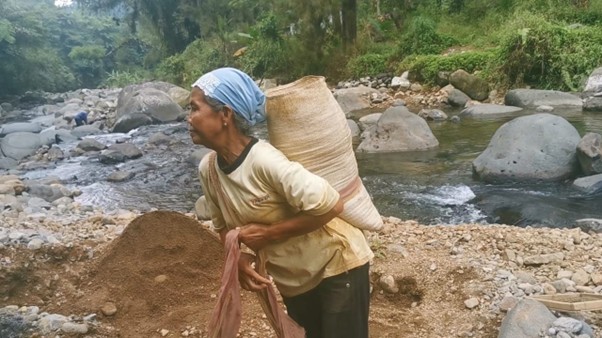
Saumi carries a sack of sand along the riverbank in Tinalum. With fewer farming options due to drought, sand mining became one of the only sources of income for women like her.
Measuring the impact
The success of the CFN-supported initiative is visible in the structural shift of village governance. By integrating climate resilience into the 2025 Village Work Plans (RKPDes), these priorities are now legally tied to funding. In Kayupuring, the proposed budget allocation for climate-related projects rose to 35%, while in Tlogohendro, it surged to 72%.
These percentages represent more than just numbers on a spreadsheet; they signify a fundamental change in how resources are used. The funding is now directed toward:
- Infrastructure: Improved irrigation and clean water systems to combat drought.
- Economic Diversification: Training for women to create sustainable income streams outside of sand mining.
- Agricultural Resilience: Better transport and storage for honey and cardamom to reduce post-harvest losses.

Residents of Kayupuring gather during a village-level discussion. For many, it was the first time they were asked what climate challenges they faced—and what support they needed.
A regional blueprint for change
While the success in Central Java provides a powerful proof of concept, the CFN’s value lies in its comprehensive regional approach. This is not an isolated project; it is part of a systemic effort across the Asia-Pacific to reform how public finance serves the planet.
The CFN’s regional impact is built on three pillars:
- Scaling local success: By documenting the participatory budgeting model in Indonesia, the CFN creates a scalable framework that can be adapted by other member nations, from Thailand to Fiji, ensuring that local governments are not just "recipients" of aid but architects of resilience.
- Integrating climate into national systems: Beyond the village level, the CFN works with Ministries of Finance across the region to integrate climate change into national tax and budget systems. This ensures that climate action is a permanent feature of public spending.
- Ensuring social inclusion: A core tenet of the CFN approach is that climate finance must be inclusive. In Indonesia, the CFN ensured that one in three participants in the planning process were women. Regionally, this focus on gender and social inclusion ensures climate finance is inclusive.
From policy to practice
By bridging the gap between national climate commitments and local budgetary reality, the CFN is proving that resilience is built from the ground up. As the successes in Kayupuring and Tlogohendro are shared across the network, they serve as a blueprint for the entire Asia-Pacific.
As Saumi reflects, the goal is long-term stability: "If we protect our resources now, our children will have opportunities we never had." Through the CFN’s regional architecture, that hope is becoming a funded reality.
This story is part of a series of initiatives supported by the UNDP Climate Finance Network (CFN), a flagship programme supporting Asia-Pacific countries to bridge the gap between climate goals and the investment needed to reach them. As a regional platform, CFN provides technical and policy support to integrate climate into public finance, mobilize private and innovative capital, and create the enabling environment required for lasting impact. Supported by the UK’s FCDO flagship CARA programme and Sweden (Sida), CFN ensures climate action is transparent, coordinated, and fully funded.