

 Locations
“The international partners who stood with us in our most fragile days, must now strengthen their support as we enter this decisive phase:” Hon. Aden Mohamed Nuur Madobe
‘We’ve come far, but greater support is needed to consolidate gains in state-building’
September 17, 2025

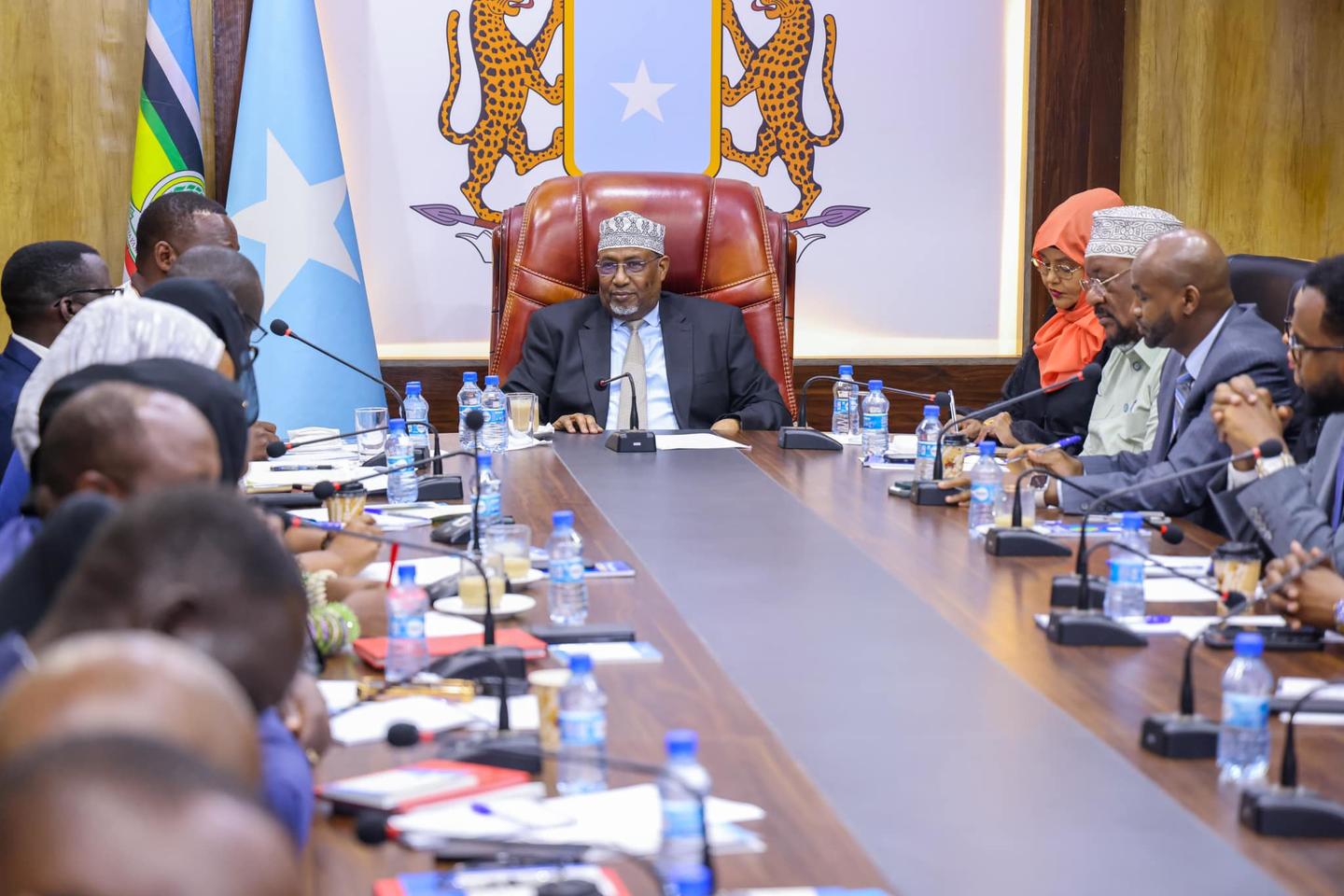
Right Honorable Sheikh Adan Mohamed Nur Madobe, the Speaker of the House of the People, Federal Parliament of Somalia.
Photo: Federal Parliament of Somalia
Over the past few years, Somalia has made critical strides in rebuilding its governance systems while facing persistent challenges in its state-building journey. Few are better positioned to explain this complex transition than Hon. Aden Mohamed Nuur Madobe, who has been at the helm of affairs during Somalia's most pivotal moments. As someone who has experience organizing community defense militias during the civil war to serving as Minister of Justice, Deputy Prime Minister, and now Speaker of Parliament, he has become known for his wisdom, profound understanding of the working of the Somali society and unparalleled expertise in accommodation and reconciliation.
In this interview at the Speaker's Office in Mogadishu, UNDP's Kamal Sigdel and Mohamed Hadi interact with Speaker Nuur about Somalia's progress on state-building, including constitutional review, federalism, stabilization, and electoral preparations and his instrumental role in these developments. He reflects on Somalia’s unfinished business in state-building, the urgency of "one-person, one-vote" elections, and why global partners must "stay until the job is done”.
Excerpts from the interview:
Hon. Speaker, you have been at the forefront of Somalia’s political development and transition right from the very beginning. Could you tell us how you started your political journey?
Speaker: I would say I didn’t enter politics, rather circumstances forced me into it, while I was running a business. Politics was not part of my plan at that time.
“When we first started building the government, we were in a situation where we had nothing to get it moving. It was like a car without tires. But now, we’ve reached a point where the issue is just a weak battery. All we need is a jump-start."
When Somalia’s military government collapsed, threatening our security, I mobilized my community in Bakool for self-defense.
At that time, I was living in Bakool of Southwest region. When the people in my community saw the positive movement I had started, they recognized the efforts and said, “You’ve started something good; let’s save ourselves.”
The uprising involved many rebel groups of varying strength. The strongest was the faction led by General Aidid, which had captured numerous regions—and eventually reached us as well. After that, we told them that we need guidance and advice but not to be overpowered or forced.
It was then, I and many others—some of whom have since passed away—organized a militia we named Is Difaac (“Self-Defense”). Most of the members came from the local Digil Mirifle community. That marked my first step into politics. We left our business. We organized to defend ourselves, safeguard our people’s lives and property, and that commitment was necessary.
I was not among those who committed abuses, attacked other regions, or exploited the government’s collapse. We were a self-defense militia for the Somali people who were residents of the region and others who sought refuge. Even during the civil wars, when we captured fighters from other militias, we would protect them. We truly did not kill anyone. We established many good systems.
After that, we became the Somalis who led the reconciliation efforts and the process of establishing the federal system that we have today. Many people supported the federal system, but there were others who were discontent and opposed.
Destroying something is always very easy—even if it’s just a single house—but building something is truly difficult. Likewise, the destruction of the country came too easily—indeed, there is deep regret that the state collapsed and all those hardships followed. But rebuilding and bringing people back together has taken a long time, and it is still ongoing.
So that’s how I started politics. I was among those who earned recognition and became leaders in the rebuilding—not among those who led the country to destruction.
Although the country has not yet reached the level of development we had hoped for, it has made significant and encouraging progress that we can be proud of today.
I initially became the Speaker during the 8th Parliament. Someone else had been elected before me, but shortly afterward, a change occurred—that person was removed, and I was then elected.
During the 8th Parliament, under the administration led by the late President Abdilahi Yusuf, I also served as the Minister of Justice.
I also served as Speaker of that 9th Parliament, but later resigned when the country was going through a period of intense turmoil. After I resigned, I became the Deputy Prime Minister and also served as the Minister of Ports.
During the 10th Parliament, I served as an ordinary member of parliament and did not hold any other position. When the change came during the 11th Parliament, I ran for the position of Speaker of Parliament and, Alhamdulillah, I won. Thanks to the Somali Members of Parliament, who deemed me worthy of being elected as Speaker once again.
What has been achieved so far has not been reached by any previous governments in Somalia: all the conditions for debt relief have been met, the sanctions on the country have been lifted, the national debt forgiven, and preparations for a one-person, one-vote election are underway, which is a goal we now have real hope of achieving. These achievements come despite the many challenges faced in appointing members of Parliament, building the institution, and walking the difficult paths required to get here.
We are hopeful that during the 11th Parliament’s term, the country will hold a one-person, one-vote election.
"Destroying a nation takes a day; rebuilding it takes generations. We’ve come far, but the 11th Parliament must finish what we started."

During your journey, you faced several obstacles, challenges, ups and downs. There must have been moments of joy and happiness. Can you tell us about one such moment when you felt most accomplished and happy?
Speaker: You know, when a person is deeply engaged in serious and various work, they will always encounter one of two things—they will see things that sadden them, and they will also see things that bring them joy.
For example, one of the things that brings me great joy is what I just mentioned—when it was announced that the 11th Parliament had approved the Saudi-led programs, that our country had been lifted from sanctions, and that our debt had been forgiven. From that moment on, our armed forces were placed on par with the rest of the world’s armies—our national army is now recognized as equal to international forces. The national debts were also forgiven, and that truly brought me great joy.
Another moment that I look back on with pride was a day—despite the fact that we hold responsibility over the Somali nation—when conflict broke out in my electoral constituency [Baidoa, Southwest State], and it nearly escalated into a civil war. At that moment, I took the initiative, working together with the local leadership and the federal government, to address the situation.
I said, “I want this situation to be contained immediately, with urgent reconciliation and efforts to bring the people together.” People often say that once Somalis start fighting, it’s very hard to stop them—but thankfully, we managed to do so. Even UNDP was part of the conflict resolution.
Truly, we spent nearly 30 days working to resolve that conflict, bringing together all the concerned parties, with national leaders also taking part in the process. That day, it was said, “What happened in Southwest State is an example to be followed.” That, too, was a great source of joy for me. So those two events—one at the national level and the other at the state level—brought me the most satisfaction during my recent mandate.

Photos: Federal Parliament of Somalia
The whole world is watching Somalia moving from years of conflict to peace and prosperity. You have led Somalia’s parliament for over two decades. Could you share some of the key achievements made in the ongoing the constitution review process?
Speaker: I would start with the time we were in Kenya, during the transitional government when Abdullahi Yusuf was elected president. I was among those who organized the reconciliation process, and I was one of the 25 key leaders heading that effort.
At that time, two major achievements were made. The first was that 25 leaders came together—two of them representing regional administrations by name, while the rest led armed factions. It was agreed that from that day forward, the names of armed factions would be set aside and no longer used. From that point on, the political space was opened only to parties and a government that are unarmed and not based on clan identity.
From that day onward, anyone who tried to rise up with such intentions was reminded that those things had already come to an end in Somalia—you couldn’t just start something and expect the country to accept it. That marked the end of armed factions being recognized or tolerated. Their names were discarded once and for all. That day was seen as a great victory for the Somali people, a moment the entire nation agreed upon.
Only a government was allowed to exist, and forming a political party was permitted as long as you met the required criteria. From that day forward, what was left behind in Somalia were the names of armed factions that were once recognized—those came to an end. That was a significant step forward.
Another milestone was the beginning of efforts to establish a constitution—not yet a full one, but rather a national charter that all Somalis could agree upon and live by.
That national charter was later replaced in 2012, after 800 Somalis were brought together. The charter was replaced with a provisional constitution, which marked another great victory for the Somali people—a clear sign that a critical phase had been overcome. Since then, the era where everyone acted based on their own desires and went wherever they pleased has come to an end—that phase has been overcome. This too can be considered a very positive achievement.
Another success was also achieved. You know, Somaliland has its own unique situation, and in the case of Puntland, there are still some things that remain unresolved. What are those? A national army was established. A Somali national army was established—unlike before, when people were divided into different militias and regions. That process started back in 2012, and efforts are still ongoing to complete it.
So, regarding Somaliland, we say it is in a unique phase. What is that phase? They still have a question mark over the issue of unity itself. What we want is to enter into dialogue, and they are open to negotiations.
As for Puntland, since it was the first state to be established, the unified national forces have not yet been fully deployed there. Only their Daraawiish forces and police are currently present. However, the people there are not against unity; it’s just that the integrated national army hasn’t reached them yet.
The rest of the country—from the Kenyan border up to the southern part of Galkayo—is secured by a unified national force owned by the federal government, composed of both military and police. This too can be considered a major achievement that has been realized. Minor disputes do exist, and as you know, there are still some areas with issues, but overall, despite all that, progress has been made across the board.
Another significant achievement is that the entire country of Somalia has been brought under a federal system. Although the federal system still requires some adjustments and improvements, the legal frameworks do exist. What remains is to align those laws with the way the constitution is written.
At the same time, there are indeed areas that still require corrections, but there is no Somali district today that is standing outside the federal system or in a separate position. Somaliland, as I mentioned earlier, is a unique case. But for the rest of the country, while there are still things that need fixing—since we are rebuilding a collapsed state—the entire nation has been reached by this system. Today, every district has representatives present in two key areas: each district is part of a federal member state, and it also has representation in the national parliament.
That too is an achieved success—it signifies the restoration of Somalia’s unity and the end of fragmentation. So, I believe these three points are among the most important. Of course, there are other significant matters as well, but I personally believe these three are the most tangible and impactful.
Photos: Federal Parliament of Somalia
Where do we stand today in the constitution-building process? Are we halfway through or closer to completing the process? What have been achieved so far and what remains?
Speaker: Among the achievements reached—particularly those that can be attributed to the 11th Parliament’s term—is the constitution that dates back to 2012.
After more than 800 Somalis were brought together, it was agreed by the Somali public that any amendments or additions to this constitution would be the responsibility of the Parliament until it is eventually put to a public referendum. That was during the 9th Parliament. Both the 9th and 10th Parliaments appointed committees to try and amend the constitution, but they were unsuccessful.
The 11th Parliament, however, had the courage to embark on the process of drafting the constitution. The constitution consists of 15 chapters. Out of the 15 chapters, the Parliament thoroughly reviewed 4 of them, with 11 chapters remaining. That, too, can be considered an important achievement.
Another key achievement was the agreement that elections should be conducted on a one-person, one-vote basis. So that, too, is among the achievements of this Parliament. However, many issues still remain, and it cannot be said that everything has been fully completed. Some of the disagreements still persist, and the federal system still requires corrections.
The issue of Somaliland still remains unresolved, so there are many matters still pending. The terrorist groups are still present on the ground, and that remains the main obstacle to state-building today. It is essential that the Somali people are liberated from terrorism.
The businessman should be able to trade freely, and the politician should live in peace, free from conflict. So, I believe that if Al-Shabaab is removed from the country, we can say that most of state-building work has been accomplished —only few tasks would remain for completion. But the continued existence of Al-Shabaab remains a major obstacle.
So the assessment becomes clear when the world understands that the biggest challenge facing the country is that enemy. We know that without support from the international community, donors, and the governments that stand with Somalia, we would not have reached the point we are at today.
If we take an example for a vehicle: sometimes the issue is just with the battery—once it’s jump-started, it runs and continues on the road. But at other times, the vehicle suffers a major breakdown and needs to be repaired from the ground up, with a full diagnostic and overhaul.
When we first started building the government, we were in a situation where we had nothing to get it moving—it was like a car without tires. But now, we’ve reached a point where the issue is just a weak battery—all we need is a jump-start.
Somalia has now reached its best position ever, but security remains the biggest challenge. If we are supported in confronting our common enemy, I believe we will reach the final destination very soon. The same partners who stood with us in our most fragile days, who helped and lifted us up — when we were rebuilding from nothing — must now strengthen their support as we enter this decisive phase. We need them to stay with us and help us complete the remaining final part. We have come a long way, and I truly believe we’ve successfully completed most part of the journey.
"If Al-Shabaab is removed, most of state-building work is accomplished. But today, they terrorize villages for giving water to soldiers. This is our biggest obstacle."
So, now that only some of the tasks remain, what are the major contentions and hurdles?
Speaker: When expansion took place, the biggest challenge now is that Al-Shabaab needs to be interpreted properly. For example, Jubaland State is already established, Southwest State is also established, and overall, Somalia is made up of states. The Federal Government wanted to sit down and engage with all of these people.
So that dialogue can take place, and there can be consensus on how to remove Al-Shabaab from the country. I’m telling you that Al-Shabaab is the biggest challenge. Today, if a government official or someone with a mission wants to travel to Kismayo or Baidoa, they are forced to take a plane.
The security forces who are supposed to ensure safety cannot reach the areas—who controls the middle ground? Al-Shabaab. The people are living in fear and terror. Today, when visiting villages, since they (Al-Shabaab) are present across the country, the security forces cannot access every village.
Today, if we visit villagers in any part of the country, Al-Shabaab will come afterward and say, “Yesterday, we saw that you sat with the government troops, welcomed them, and even gave them water.” That is the biggest issue.
The other issue related to the sea, and the resources therein, can also be part of the problem—given the abundant resources this country has and the ongoing instability, there may be foreign actors, or people who are not Somalis, with interests. If things do not proceed as they would like to, it is possible they may become part of the disruption. That, too, can be a possibility.
We have plenty of fish in the sea, there is plenty of oil, and the country is rich in resources. Everyone wants to benefit from these resources. That could also be one of the challenges—with people asking: who is this meant for?
If those moving together allow mutual benefit among themselves, then a political settlement is possible. But let me tell you this—right now, this country has no functioning national currency; the government’s money has collapsed. What keeps us going today is the U.S. dollar—that’s what we use as money. And even in that, Al-Shabaab has played a part in disrupting the country’s currency system.
So, in my view, the biggest issue facing Somalia today is that, while all challenges can be overcome, and yes, there are many, the one factor that fuels and exacerbates all of them is Al-Shabaab.
If the capital and the rest of the country were connected, dialogue, stabilization, and reconciliation would all become much easier. But right now, if you want to travel to another part of the country, you have to take a plane, as if you’re going to an island. The biggest obstacle in Somalia is Al-Shabaab; minor political disagreements and conflicts may exist, but they are secondary.
The international community, including the United Nations have been walking alongside the government since the formation of a transitional federal government in 2012. How do you observe their support in the state-building process so far?
Speaker: First of all, the international community as a whole does support us. Without them, we wouldn’t have made it this far. But human patience has limits; I can’t say the world has abandoned us, because we are still being supported.
For example, the most recent success that took place in Southwest State was about reconciliation. The international organizations that stood with us, including UNDP, and other UN agencies, are still supporting us.
The same [international] partners who stood with us in our most fragile days, must now strengthen their support as we enter this decisive phase.”
The state-building process, including constitution building I just mentioned, has remained a major focus. The money spent during the 9th and 10th parliaments, was never accounted for, and nothing was achieved. All attempts completely failed. As we got involved ourselves, we even faced a lot of pressure, and at times, there was no one to support us. Sometimes we ask ourselves: have the people and the international organizations that used to support us have grown weary of supporting Somali’s state-building process?
We do feel a bit of a sense that people are feeling tired, that there’s a feeling like, “these people are being helped and supported, but there’s little progress being made.” That feeling exists among us to some extent. However, overall, the support to the country is still continuing.
I’ve come to recognize urgent priorities we must address, especially communicating clearly with our people about the challenges we face, the progress we’ve achieved, and the critical work ahead.
We need to inform the public about what the constitution is, what the proposed models of elections really mean, and the needs of the country, because parliament directly represents the people. Every clan or village has someone in the parliament. And in Somalia, clan-based matters carry a lot of weight.
If people see a delegation and their clan is not part of it, they will start talking and say, “Only such-and-such clan was part of the delegation.” Because of such issues, we need even greater support, especially now that we are just getting closer to the biggest and final achievement.
In the past, we were being supported even when we had nothing to share the people as our achievement, when we were at the initial stage of national building. Now we’ve reached the final stage, with only one step left to score the final goal. That’s exactly why we need support now, and that feeling is something we are experiencing collectively at the parliament.
While I speak of the past achievements, the support by UNDP overall cannot be overlooked. I believe they have contributed significantly to this country, whether in social affairs or development efforts, rule of law, governance or reconciliation. The Somali people are well aware of how much UNDP has contributed to the people and the country. For every type of need currently facing the Somali society, UNDP has been at the forefront.
Somalia is a country with one of the world’s youngest populations. As the Speaker, what are you doing to engage these young populations? How is parliament engaging with these young people?
Speaker: Indeed, that is a very important question. The number of Somali youth [below 30 years] is approximately as you mentioned, around 75 of the population. The most important people for the government, especially when it comes to military recruitment, are the youth. And those whose minds are influenced and taken over by Al-Shabaab, and who are turned into fighters, are also the youth.
Those who migrate illegally every single day are the youth. Truly, they need to gain the confidence to stop risking their lives through irregular migration, to reject being recruited as soldiers by Al-Shabaab, to pursue education, and, if they are to become soldiers and take up arms, let it be in service of their nation.
That they must avoid surrendering themselves to Al-Shabaab and becoming their soldiers, refrain from irregular migration, support those who wish to pursue education, and ensure that those who are educated can find employment.
The current government genuinely wants to engage the youth, but it doesn’t have the financial means to do so. Hiring new employees has been blocked, and the reason behind this is the country’s budget situation, which, as you know, is subject to voluntary contributions from the international community.
They are the ones who provide support. That’s why there’s a sense of hesitation, given that the country doesn’t yet generate enough of its own revenue. So, whatever financial assistance is received is prioritized for addressing other pressing needs.
So, you can see people who were impacted by the collapse, or who were already poor from the beginning and couldn’t afford education. Those are the people Al-Shabaab deceives by telling them, “We will give you money,” but in reality, they offer nothing meaningful.
Similarly, the youth have also been deceived by the agents [of human trafficking]; they are told that if they reach Europe, they will find prosperity. So, they throw themselves into the sea and migrate illegally.
All of that can be avoided if there is a proper plan to address this challenge, and if the international community understands the gravity of the situation and extends concrete support. If the youth are stopped from migrating illegally, it will also benefit the destination countries.
Preventing young people from becoming soldiers for Al-Shabaab, and having a plan to build their trust and boost their morale, is a very important matter. It truly requires the international community to understand this issue and collaborate with us.
"Our youth migrate illegally or join Al-Shabaab out of despair. They must become soldiers for their nation—not for terror."
You have been guiding Somalia through its most challenging transitions. In your checklist, there may be several more important milestones ahead. Fifty years from now, what is the one thing you hope the Somali people will remember you for most?
Speaker: First of all, a person really cannot judge himself; it is the society and the people around him who assess him. Politicians will naturally face criticism, but it is common that during his time in office, many opponents will exist.
However, when his time ends, or when he steps down from his position, or even when he passes away, most of what is said about him is positive. But while he is still working, the criticisms tend to be many. I truly believe that I have contributed something tangible to the Somali country.
I am remembered for the national reconciliation, specifically by the people in the region I come from and by the people across Somalia as a whole. It can be said, without denying the facts, that I am among those who have worked very hard for the Somali reconciliation.
It is said that when a person in power is just, some people may get upset with them, but if they are unjust, everyone will come to hate them. So, I never think I will be someone everyone hates. Instead, I hope to be remembered as someone who brought meaningful contributions to Somalia.
Back when the country was divided and people were killing each other through rebel factions, I was among those who called for unity. I was one of those who said, “Let’s stand together as Somalis. We are brothers and sisters; let’s not turn on each other or shed one another’s blood.”
"I was among those who said, ‘Let’s stand together as Somalis. We are brothers and sisters; let’s not turn on each other or shed one another’s blood.’"
Even now, I remain committed to ensuring that Somali youth have a bright future, a future where they have their own government, one they built themselves, a country built on their confidence and aspirations. That is exactly the vision I continue to stand for today.
If I must name. One of my legacies will be the successes of the 11th Parliament, of which I was fortunate to serve as the Speaker. It endorsed the first four critical chapters of the constitution. This or any other successes that the Parliament achieved were not brought by the Speaker alone. It was the collective effort of the entire Parliament, and the credit and honor go to all the members of the Parliament. But I am their leader.
If we can add to that … I hope to be remembered as the one who contributed to make the one-person, one-vote election possible. This is what we are currently striving for, and if it leads to a successful election, it will go down in history as our legacy.
The many other things I mentioned earlier, if you look back at them, there are many good deeds I have done for the Somali people, things I did sincerely for the sake of Allah. I believe that those are the things I will be remembered for.
“I hope to be remembered as the one who made one-person, one-vote election possible. This is what we are currently striving for, and if it leads to a successful election, it will go down in history as our legacy.”
Please stay tuned for a video version of this exclusive interview with the Speaker. Read more about the Support to Democratization and Inclusive Constitutional Review Process in Somalia programme: and the State Building and Reconciliation Support Programme