

 Locations
Circular Pathways for Cities: Policy, Digital, and Systems Enablers for Urban Transitions
July 14, 2026

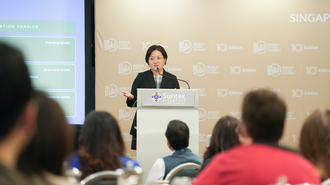
From left to right, David Fogarty (UN Global Compact Network, Singapore), Louisa Mammeri (UNDP), Jihye Lee (Singapore-ETH Centre), Pierre Ng (National Environment Agency), Adeline Sham (Temasek Foundation) and Carla Gomez Briones (UNDP).


Across Asia and the Pacific, the circular economy has shifted from a sustainability concept to a strategic policy priority linked to economic resilience and long-term development.
Today, over 100 countries have circularity embedded in their national road maps. In Southeast Asia, the 2021 Framework for Circular Economy for the ASEAN Economic Community sets out shared priorities for circularity regulations, trade facilitation, green technology investment, and ESG innovation, and the private sector has moved alongside it: circular startups across ASEAN have grown by 40% since 2024. The direction seems clear. And yet the numbers tell a more complicated story.
In 2025, 106 billion tonnes of materials entered the global economy. Less than 7% exited for circular processing. ASEAN’s circularity rate stands at just 2%, well below the global average of 9.1%. End-of-life recycling reaches only 1.3%, even as policy ambitions grow.
Nowhere is that tension between ambition and outcome more visible than in cities. As engines of economic growth, cities also drive the bulk of world’s resource consumption, emissions, and waste.
To explore how cities can turn this tension into opportunity, the UNDP Global Centre for Technology, Innovation, and Sustainable Development convened experts from government, industry, and international organisations at the World Cities Summit 2026. The event, Circular Pathways for Cities: Policy, Digital, and Systems Enablers for Urban Transitions, surfaced how cities can scale interventions to systemic change.




Digital technology as a platform for scale – but only when used with intent
Digitalisation holds enormous potential to accelerate circularity transitions when aligned with public and private intent. The UNDP Digital by Design Toolkit for Circular Economy maps how digital can be integrated across different stages of circular project design. The question is not whether to use digital, but how to use it intentionally to serve greater circular transitions.
That intentionality starts with understanding the issues and opportunities before introducing anything new. From there, digital can help make existing processes faster and more efficient, or create entirely new possibilities that did not exist in the analogue world.
A network of cities in the Philippines illustrates what this can look like in practice. City governments had collected solid waste data for years, but each did so differently, leaving the data fragmented. Standardising and digitising that reporting through a mobile app made material flows visible and comparable across cities for the first time, enabling value chain analysis of investment and monetisation pathways.
“When introducing digital tools into circular economy design, we must try to understand first what’s already working and identify the gaps within. Only then should you look for technology tools that can offer new options and create new market linkages. And it is from there that you can scale.”Louisa Mammeri, Innovation Specialist, UNDP Regional Bureau for Asia and the Pacific
Philanthropic capital as catalytic capital
As promising technologies emerge across the value chain, they routinely face structural barriers that prevent scaling: regulatory complexity, heavy upfront costs, and the absence of capital willing to absorb early risk.
Philanthropic capital is increasingly filling that gap. While it cannot replace public funding, private capital, or the regulatory and legislative environment that enables systemic change, it has proven to be a vital accelerant in the space between early innovation and institutional adoption.
Philanthropic capital steps in at the earliest stage – so that private investors who would otherwise stay on the sidelines are willing to follow. Regional sustainability challenges catalysed by Temasek Foundation, such as The Liveability Challenge, operate under this premise: they identify impactful green solutions from across the globe and partner them for proof-of-value pilots in Asia that demonstrate technical feasibility and commercial viability, de-risking them for private capital to enter and scale them further.
“Philanthropic capital can take risks and tolerate timelines that commercial investors can’t. By catalysing proof-of-value pilots, we help promising solutions build the track record they need – making the runway much more attractive for private investors to come in.”Adeline Sham, Director, Climate & Liveability, Temasek Foundation
Governments as enablers of scale
Governments are uniquely positioned to build conditions under which circularity can scale. Through policy frameworks, standards, incentives, and public investment, they help shape an enabling environment in which private capital, philanthropic actors, and communities can work towards feasible resource circularity systems and solutions. They also act as conveners, bringing industry, academia, and civil society together around systemic solutions.
Extended Producer Responsibility (EPR) schemes are one example that illustrate this enabling role. By assigning producers responsibility for the products they place on the market, EPR frameworks can support more coordinated approaches to collection, recycling, and product design, while encouraging collaboration among producers, collectors, recyclers, and communities.
Vietnam, the Philippines, and Singapore have each introduced EPR approaches suited to their national contexts, reflecting a broader regional commitment to closing the loop on product lifecycles. As these initiatives continue to mature, effective implementation will depend on more than legislation alone. It will also require coordination across stakeholders, operational systems capable of delivering results at scale, and sustained community participation.
“The Government continues to partner public and private stakeholders to promote resource circularity. Philanthropic capital and research institutions can help develop and testbed feasible solutions, providing important building blocks for effective regulation and implementation.”Pierre Ng, Director, Sustainability Division, National Environment Agency
Designing for community participation
Circular cities are ultimately human systems. Beyond legislation and investment, they demand community participation.
A comparative study by the Sea-City Interface module at Singapore-ETH Centre’s Future Cities Laboratory Global, conducted across Singapore, Seoul, and Zurich, found that urban water circularity cannot be sustained through governance, financing, and infrastructure alone. Blue-green infrastructure, unlike conventional grey infrastructure, is a living system that depends on continuous maintenance to deliver its intended benefits, maintenance that requires genuine community stewardship, not just institutional design.
Where institutions are strong but design for the community is absent, the study found, residents tend to disengage: stewardship feels unnecessary when no one has actually asked them to take part.
Across the three cities, the research identified a consistent pattern: community action took hold only where residents were brought in as co-designers from the start, not informed after the fact.
“Residents are often willing to contribute, but participation depends on whether the enabling conditions are in place: accessible information about the blue-green infrastructure in their community, clear pathways to act, visible evidence that their efforts matter, a sense of stewardship and belonging, institutional support, and confidence that expectations are fair.”Jihye Lee, Researcher and Module Coordinator, Future Cities Laboratory Global, Singapore-ETH Centre
Towards circular urban futures
The gap between ambition and outcome will not close on its own.
It requires a layered set of conditions: digital infrastructure that makes material flows visible, catalytic investment structures that absorb early risk, policy that holds steady enough to matter, and governance design that treats community participation as essential.
These conditions are not independent. Digital tools strengthen implementation but are most effective when supported by enabling governance and institutional capacity. Philanthropic capital helps catalyse innovation and de-risk new approaches. Community participation builds legitimacy and resilience, but also depends on incentives and institutions that enable meaningful engagement. Rather than operating in isolation, each condition reinforces the others.
The question, therefore, across Asia and the Pacific is no longer whether circular approaches are possible. It is whether the conditions to scale them can be built together and governed in locally grounded ways.
Success will depend on treating circularity not as a standalone initiative, but as a core principle guiding how cities plan, finance, and govern their future.
“Even amidst political and economic headwinds, the focus on sustainability still remains strong as it creates real value and lasting benefits. The opportunity now is to turn individual commitment into systemic change.”David Fogarty, CEO and Executive Director, UN Global Compact Network, Singapore