

 Locations
Mongolian delegation visits Korea to benchmark its carbon market and emission trading system
April 9, 2025

Mongolia is one of the fastest-warming countries in the world, facing rising temperatures, desertification, and an increasing frequency of climate-related disasters. In response, the government has committed to ambitious climate action under the Paris Agreement, aiming to reduce greenhouse gas (GHG) emissions by 22.7% by 2030 compared to a business-as-usual scenario, with the potential to reach a 44.9% reduction with international support. Establishing a domestic carbon market and engaging in international mechanisms, including Article 6 of the Paris Agreement and voluntary carbon markets, are seen as key strategies to achieve these targets.
To support Mongolia's efforts in developing its carbon market, the UNDP Seoul Policy Centre (USPC), in collaboration with the Korea Environment Corporation (K-eco), the Mongolian government and UNDP Mongolia, has launched a pilot project on carbon market and Emission Trading System (ETS). Funded by the Ministry of Foreign Affairs (MOFA) of the Republic of Korea (ROK), the project focuses on Korea’s ETS (K-ETS), Measurement, Reporting and Verification (MRV), and institutional arrangements. Drawing on the ROK's 12 years of ETS implementation experience, the project facilitates knowledge exchange between government and private sector stakeholders from both the ROK and Mongolia.
Study visit to Korea: Facilitating knowledge exchange on carbon market and emission trading system
From 7 to 9 April 2025, USPC hosted a Mongolian delegation for a study visit to the ROK. The mission aimed to support Mongolia’s path towards carbon neutrality by facilitating knowledge exchange on carbon market and K-ETS. The delegation comprised representatives from the Mongolian Parliament, Ministry of Economy and Development, Ministry of Environment and Climate Change, Ministry of Energy, National Committee on Reducing Air Pollution, Municipal Office, Chingeltei District, and UNDP Mongolia.
The study visit kicked off with an inception meeting at USPC, marking the official launch of the pilot project on carbon market and ETS, in collaboration with K-eco, USPC, UNDP Mongolia. Anne Juepner, Director of USPC, and Jeong-won Ha, Director of the Office of Global Strategy at K-eco, welcomed the Mongolian delegation and emphasized the importance of developing carbon markets in Mongolia. The session also provided an overview of the ROK’s climate policy and legal framework, laying the foundation for technical cooperation between Korean and Mongolian stakeholders.

Following the inception meeting, the delegation also visited the Korea Research Institute on Climate Change (KRIC), where they explored the ROK’s experience with international mitigation projects and carbon pricing mechanisms. The discussion offered practical guidance on developing carbon policy tools and accessing international markets, particularly under Article 6.2 of the Paris Agreement.


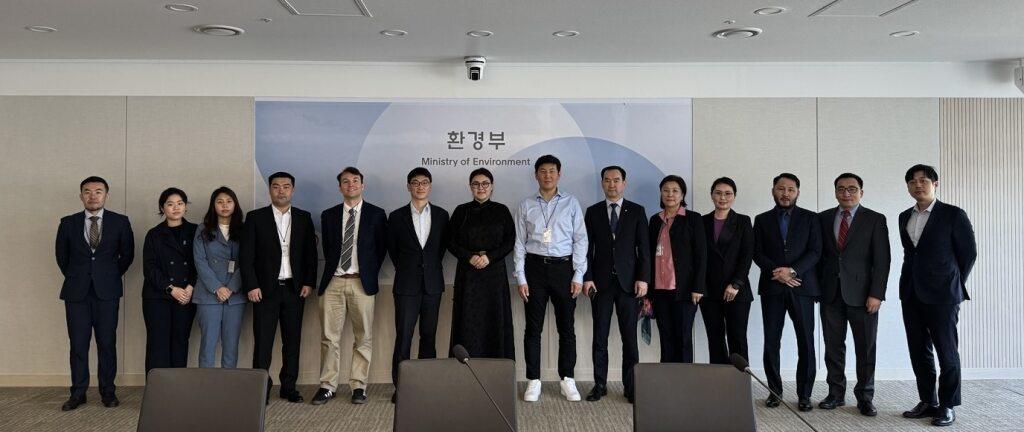
On Day 2 of the study visit, the delegation engaged with the Ministry of Environment of the ROK to deepen their understanding of the institutional and policy architecture underpinning K-ETS. The session provided a detailed overview of the ROK’s legislative and regulatory frameworks, implementation strategies, and inter-agency coordination mechanisms that ensure the effective operation of K-ETS. Particular emphasis was placed on the role of cross-ministerial collaboration in maintaining transparency and accountability across the carbon market. These insights were especially relevant for the Mongolian delegation as they work to establish a robust, transparent, and well-governed national carbon market.

The delegation also visited the Greenhouse Gas Inventory and Research Center of Korea (GIR), where GIR experts shared the ROK’s technical expertise in greenhouse gas (GHG) inventory development, cap-setting methodologies, and the design and operation of MRV systems essential for the effective functioning of K-ETS. The session provided the Mongolian delegation with a deeper understanding of the institutional and methodological foundations that underpin a regulated carbon market, reinforcing the importance of robust data systems and transparent governance in ETS.


On the final day of the study visit, the delegation visited the Korea Exchange (KRX), where they gained insights into the operational mechanics of carbon credit trading under the K-ETS. The session provided a comprehensive overview of the evolution of the ROK’s capital market and highlighted the technological innovations embedded within KRX’s trading platform that support market transparency, liquidity, and compliance. This engagement offered the delegation practical insights into how the ROK’s carbon market functions in real time, reinforcing the role of KRX as a cornerstone institution in the country’s climate policy architecture.


The study visit concluded with a meeting with the Korea Southern Power Co., Ltd. (KOSPO), one of the ROK’s power generation companies and a key participant in K-ETS. The delegation engaged in an in-depth exchange with KOSPO’s Climate Change Response Department, gaining valuable insights into how Korean power utilities are aligning their operations with national ETS compliance requirements and long-term clean energy transition objectives. The discussion highlighted KOSPO’s practical approaches to emissions reduction, including innovative decarbonization strategies. The session also served as a platform to explore opportunities for future cooperation and technical knowledge sharing with Mongolia’s energy sector stakeholders, reinforcing the potential for sustained collaboration in advancing low-carbon development pathways.


Overall, the study visit offered the Mongolian delegation valuable first-hand insights into the ROK’s carbon market development, governance structures, technical systems, and private sector engagement. These learnings will support Mongolia’s ongoing efforts to establish robust legislation and a national carbon market, while enhancing its readiness to participate in international carbon markets under Article 6. As Mongolia continues to develop its national carbon market and climate strategies, the partnerships between the ROK and Mongolia will serve as important building blocks toward a low-carbon and climate-resilient future.
Related
content
content


