

 Locations
The Blue Pacific on the Pale Blue Dot: Reflections from the BIOFIN Pacific Inception Workshop
September 12, 2025

Pacific Island Countries contribute only a tiny fraction of global emissions, yet they stand at the frontlines of climate and ecological disruption.
Reflecting on the image of the Earth as a “Pale Blue Dot,” astronomer and scientist Carl Sagan once famously mused, “That’s here. That’s home. That's us. On it everyone you love, everyone you know, everyone you ever heard of, every human being who ever was, lived out their lives... Our posturings, our imagined self-importance, the delusion that we have some privileged position in the Universe, are challenged by this point of pale light. Our planet is a lonely speck in the great enveloping cosmic dark. In our obscurity, in all this vastness, there is no hint that help will come from elsewhere to save us from ourselves.”
Sagan’s reflections echoed throughout the opening sessions of the BIOFIN Pacific Inception Workshop, held in Pacific Harbour, Fiji, from July 7-10, 2025.
Facilitated by Dr. Andy Seidl, Senior Technical Advisor of the UNDP Biodiversity Finance Initiative (BIOFIN) and Professor of Environmental and Development Economics at Colorado State University, the workshop began with an introduction to the current global biodiversity financing landscape and BIOFIN’s role within it.
Launched by the United Nations Development Programme (UNDP) in 2012, BIOFIN directly supports the Kunming-Montreal Global Biodiversity Framework (GBF), which calls on countries to significantly increase resource mobilization, phase out harmful subsidies, and align financial flows with nature-positive outcomes. In particular, Target 19(b) urges the development and implementation of National Biodiversity Finance Plans (NBFPs) tailored to national priorities and supported by long-term, costed strategies.

The pale blue dot.
The Pacific region joins the next phase of the global BIOFIN initiative, which is active in 133 countries and has developed over 150 biodiversity finance solutions. The Global Environment Facility, the European Union, the Government of Flanders, and the governments of Belgium, Germany, Switzerland, Norway, Sweden, the United Kingdom, and Canada support the programme.
Targeted financing strategies are urgently needed as biodiversity faces an accelerating decline, driven by the chronic undervaluation and exploitation of nature. Namely, while approximately US$143 billion is spent on biodiversity each year globally, this falls significantly short of the estimated US$824 billion required annually to protect and restore nature effectively. This approximately US$681 billion global biodiversity finance gap highlights the disparity between policy ambitions and committed resources. Moreover, the gap is simultaneously exacerbated by harmful subsidies, which continue to far outweigh positive investments.
While biodiversity-friendly financing totals roughly US$120 billion annually, subsidies that degrade ecosystems exceed US$500 billion. BIOFIN ultimately challenges the false trade-off between the environment and the economy, emphasizing that nature itself is a valuable economic asset, generating significant, yet often unmeasured, financial and societal benefits that are intrinsic to sustainable development.

pacrticipants gather outside the Pearl Resort in Fiji, for the UNDP BIOFIN Pacific inception Workshop.
As Deputy Resident Representative of the UNDP Pacific Office in Fiji, Abduvakkos Abdurahmanov, affirmed in his opening remarks for the workshop:
“With BIOFIN, we are working together to unlock financing that reflects the true value of biodiversity. It is about bridging the gap between environmental protection and sustainable development.”
“Nature is our most essential infrastructure,” he continued. “It sustains our food systems, water security, health, disaster resilience, cultural identity, and economies. Yet today, it is under immense pressure. One million species face extinction, and ecosystem degradation already affects over 40 percent of the global population. This is not just an environmental crisis—it is an economic one.”
Despite BIOFIN’s ambitious goals and demonstrated success, however, Carl Sagan’s reflection on Earth as a “Pale Blue Dot” serves as a sobering reminder that the global biodiversity crisis is unfolding on a “very small stage in a vast cosmic arena”—one marked by finite resources, limited financial capacity, and a narrowing window for action.
In the Pacific, small island developing states (SIDS) confront a disproportionate and concentrated array of biodiversity threats, including sea-level rise, ocean warming and acidification, coral reef degradation, invasive species, increasingly frequent extreme weather events, deforestation, pollution, limited institutional capacity, economic dependence on resource extraction, geographic isolation, and restricted access to climate finance.
Yet the Pacific also boasts a wealth of opportunity: strong regional collaboration, traditional ecological knowledge, and growing policy leadership. These strengths were on full display during the four-day BIOFIN Pacific Inception Workshop, where 15 Pacific Island Countries and Territories—including Fiji, Solomon Islands, Vanuatu, Samoa, Tonga, Kiribati, Tuvalu, Palau, the Republic of the Marshall Islands, the Federated States of Micronesia, Cook Islands, Nauru, Niue, Papua New Guinea, and voluntary participant New Zealand—engaged in focused, solution-oriented dialogue. The workshop underscored the Pacific’s readiness to take coordinated action on biodiversity finance.
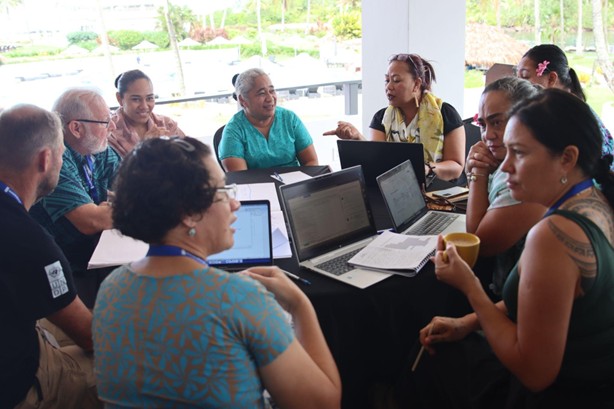
Lively discussions took place during group breakout sessions as delegates explored national biodiversity finance priorities.
“Pacific Island Countries face some of the world’s most acute biodiversity challenges, yet we also bring decades of experience in managing ecosystems under pressure,” stated Fiji’s Permanent Secretary, Ministry of Environment and Climate Change, Dr. Sivendra Michael.
“We understand that biodiversity…[is the] foundation of our identity. With stronger coordination and targeted financing, we can scale what already works and ensure our ecosystems continue to support the people who depend on them most.”
Throughout the workshop, delegates emphasized the importance of aligning BIOFIN with existing national frameworks such as National Biodiversity Strategies and Action Plans (NBSAPs), Nationally Determined Contributions (NDCs), and National Adaptation Plans (NAPs). They agreed that while these frameworks already serve as key vehicles for national climate and biodiversity commitments, BIOFIN offers a methodology to identify residual finance gaps, conduct expenditure and needs assessments, and develop costed finance solutions tailored to each country's context.
Workshop participants also learned how BIOFIN strengthens cross-sector coordination, particularly between environment and finance ministries, and supports resource mobilization, budget tracking, and implementation. Aligning BIOFIN with existing strategies was seen as essential to maximize efficiency and reinforce national ownership.

Participants listen closely as a delegate from the Federated States of Micronesia shares national perspective.
During the discussions, a delegate from Palau raised a fundamental question: “Why must we bear the burden of finding funding for a crisis we did not create?” The question was timely, following the July advisory opinion of the International Court of Justice, which concluded that states failing to mitigate climate change may be in violation of international law, and that countries disproportionately impacted could be entitled to reparations.
For Pacific Island Countries, the inequity is clear. Although the region contributes only 0.02 percent of global greenhouse gas emissions, it faces extreme climate variability and vulnerability. With low-lying topographies, averaging one to two meters above sea level, combined with the concentration of populations and infrastructure near coastlines, these countries are acutely vulnerable to sea-level rise and extreme weather events.
Given this context, participants questioned the rationale for investing heavily in biodiversity finance mechanisms. Dr. Andy responded directly: “To be less dependent on funding, of course.”
His remark underscored BIOFIN’s value proposition, predicated on building domestic financial resilience by reducing reliance on unpredictable external funding flows. With donors pulling back from traditional aid models, this capacity is essential to ensure that countries are not left behind as the rules of global development finance shift. By identifying financing gaps, improving budgetary alignment, and enabling costed biodiversity investment plans, BIOFIN equips Pacific Island Countries to mobilize and manage resources more strategically, despite broader structural injustices.
A locally-led biodiversity finance solution highlighted during the workshop was the Naidiri Marine Biodiversity Conservation Park, located along Naidiri Bay in Malomalo, Sigatoka. Since 2009, the park has operated as a community-managed Marine Protected Area (MPA) along Fiji’s Coral Coast, aiming to improve ocean health and sustain local livelihoods.
The park plays a key role in Fiji’s BIOFIN strategy, with a focus on coral restoration and eco-tourism as mechanisms to generate sustainable financing for conservation. In the Pacific, coral reefs serve multiple critical functions: they act as natural barriers against storm surges and coastal erosion, provide essential habitats for marine biodiversity, and support local economies through tourism and fisheries.
Naidiri’s central mission is threefold—restore, preserve, and nurture. Namely, the park aims to restore depleted fish stocks in the community’s traditional fishing grounds (qoliqoli), which have suffered from overfishing and unsustainable practices, to protect coral reefs, and to nurture future stewards of biodiversity by engaging and educating children and youth. According to the Naidiri Marine Biodiversity Conservation Park mission statement, “We believe in educating the children and youth of today to secure our tomorrow. We aim to inspire young minds to reconnect with nature.”

A BIOFIN workshop participant contributes to coral planting efforts at the Naidiri Marine Biodiversity Conservation Park.
At Naidiri, workshop participants had the opportunity to reconnect with nature firsthand through activities such as coral planting and snorkelling.
Wading waist-deep into the warm waters of the Coral Coast, they worked alongside community members to
attach small coral fragments to metal frame structures submerged on the seafloor. These structures serve as
artificial reefs, providing a stable base for coral growth and eventually regenerating habitats for fish and other marine species. Once secured, the coral fragments typically take several months to fuse to the structure and begin to grow, gradually forming more complex reef systems that support biodiversity and improve coastal resilience.
However, these early growth stages are particularly vulnerable to storm surges, strong currents, and rising sea temperatures, making ongoing maintenance and monitoring critical.

Participants from across the Pacific work side by side during coral planting efforts at the Naidiri Marine Conservation Park.
The hands-on experience reinforced key workshop themes by illustrating how local communities are applying practical, finance-backed conservation methods to address ecosystem degradation. Participants observed how BIOFIN-linked initiatives, such as Naidiri, generate sustainable financing through eco-tourism while contributing to national biodiversity and climate goals.
For many, the field visit underscored the value of investing in community-led, replicable, and nationally aligned nature-based solutions, such as those outlined in NBSAPs and NDCs. It also offered an opportunity to engage directly with the ecosystems and communities at the heart of biodiversity finance, deepening participants’ connection to the work and grounding two days of technical discussions in lived experience.

Naidiri village women prepare a shared meal for delegates.
The Naidiri field visit also highlighted the often-overlooked role of women in marine resource management. Like many coastal communities across the Pacific, women in Naidiri play a central role in daily subsistence and ecosystem stewardship. They engage in line fishing, octopus harvesting, and collecting shellfish and sea grapes (nama), while men more often conduct offshore spear fishing or net fishing in groups.
Women also played a key role in the success of the field visit and the Naidiri Village tour itself by organizing meals, coordinating logistics, and creating a welcoming and informative environment for the UNDP BIOFIN group.
BIOFIN rightfully recognizes gender equality as a foundational principle for sustainable development and adequate biodiversity financing. Although women are often primary users and stewards of biodiversity, particularly in rural and coastal contexts, they continue to be underrepresented in decision-making and often lack equitable access to the benefits of conservation. Correcting this imbalance is essential to achieving inclusive and durable outcomes.

Niue participants pause for a quick photo during the workshop.
The strong presence of women throughout the BIOFIN Pacific Inception Workshop, as participants, facilitators, and technical experts, highlighted the importance of placing women’s leadership at the center of biodiversity finance. Women made up over 60 percent of all workshop personnel and more than 65 percent of participants.
Additionally, young professionals aged 25 to 34 accounted for nearly one-quarter of the personnel and over 30 percent of the participants. This representation reflects BIOFIN’s commitment to gender-responsive and youth-informed approaches, aligning with the UNDP’s broader goal of ensuring that governance and financing systems are inclusive and reflective of the communities they serve.
In the Pacific, where women are key actors in natural resource management, their meaningful participation is not only a matter of equity but a prerequisite for effective and sustainable biodiversity
finance strategies.
So where does the Pacific fall on Carl Sagan’s “Pale Blue Dot”? After four days of discussion, collaboration, and peer learning, the participants of the BIOFIN Pacific Inception Workshop, including myself, left with a clearer understanding of the region’s role in shaping the future of biodiversity finance. Pacific Island Countries contribute only a tiny fraction of global emissions, yet they stand at the frontlines of climate and ecological disruption. They understand better than most the fragility of “a mote of dust suspended in a sunbeam,” and what it takes to protect it.
Sagan once stated that the image of our tiny planet from outer space “underscores our responsibility to deal more kindly with one another, and to preserve and cherish the pale blue dot, the only home we’ve ever known.” In truth, Pacific communities do not need that reminder.
For generations, they have sustainably governed marine and coastal resources long before any global frameworks existed. Biodiversity remains deeply embedded in their spiritual and cultural identity, as well as in their religious practices, knowledge systems, water and food security, livelihoods, and health.
Through BIOFIN, however, the tools and resources they need to strengthen biodiversity finance are finally coming into sharper focus. With continued support, their leadership may help chart a more sustainable course for the rest of the world to follow.
This blog was authored by Christy Lorenz, a former Programme Assistant who supported the UNDP Pacific BIOFIN Project Team during the organization of the Pacific BIOFIN Inception Workshop. The views expressed are those of the author and do not necessarily reflect those of UNDP.


