

 Locations
The Human Development and AI Paradox: A 35-Year Low with New Horizons for Ghana
July 9, 2025

UNDP
Accra, 9 July 2025 — Ghana has launched the 2025 Human Development Report at the Alisa Hotel in Accra, bringing together government officials, development partners, academia, private sector actors, and civil society to discuss the future of human development in the age of Artificial Intelligence.
The report shows that human development progress is experiencing an unprecedented slowdown, according to the new report released by the United Nations Development Programme (UNDP). The report highlights how Artificial Intelligence (AI), if deployed inclusively and ethically, could reignite development and open new pathways for progress.
Instead of seeing sustained recovery following the period of exceptional crises of 2020–2021, the report reveals unexpectedly weak progress. Excluding those crisis years, the meagre rise in global human development projected in this year’s report is the smallest increase since 1990. The 2025 Human Development Report “A matter of choice: people and possibilities in the age of Artificial Intelligence (AI)” analyses development progress across a range of indicators known as the Human Development Index (HDI), which encompasses achievements in health and education, along with levels of income. Projections for 2024 reveal stalled progress on the HDI in all regions across the world.
The report also highlights regional insights, including findings from Ghana, where more than 70 percent of respondents expressed optimism that AI will improve their productivity at work. Many anticipate the technology will create new opportunities in agriculture, education, and public service delivery. The report underscores the urgency for countries like Ghana to close digital access gaps and invest in inclusive digital infrastructure to ensure the benefits of AI reach all segments of society particularly youth and underserved populations.
Opening the session, our Resident Representative, Niloy Banerjee, emphasized the urgent need to harness AI for inclusive and sustainable development.
“This year’s Human Development Report shows us that #AI is reshaping the future of development. For Ghana, this means rethinking how we design policies—to protect data, expand access, and ensure that AI becomes a tool to empower people, not exclude them.”

UNDP Ghana's Resident Representative, Niloy Banerjee giving his opening remarks.
Giving the keynote address is Dr. Nii Moi Thompson, Chairman of the National Development Planning Commission. Addressing the launch, he said, "AI offers vast opportunities, but its deployment must be ethical and equitable, ensuring that its benefits are accessible to all socio-economic groups, not just a privileged few"

Dr. Nii Moi Thompson PhD, Chairman of the National Development Planning Commission, giving the keynote address
Beyond the alarming rate of deceleration in global development, the report finds widening inequalities between rich and poor countries. As traditional paths to development are squeezed by global pressures, decisive action is needed to move the world away from prolonged stagnation on progress.
“For decades, we have been on track to reach a very high human development world by 2030, but this deceleration signals a very real threat to global progress,” said Achim Steiner, UNDP Administrator. “If 2024’s sluggish progress becomes ‘the new normal’, that 2030 milestone could slip by decades making our world less secure, more divided, and more vulnerable to economic and ecological shocks.”

Achim Steiner, UNDP's Administrator
For the fourth year in a row, inequality between Low HDI and Very High HDI countries continues to increase, according to the report. This reverses a long-term trend that has seen a reduction in inequalities between wealthy and poor nations. Development challenges for countries with the lowest HDI scores are especially severe driven by increasing trade tensions, a worsening debt crisis, and the rise of jobless industrialization.
“Amidst this global turmoil, we must urgently explore new ways to drive development,” Mr. Steiner said. “As Artificial Intelligence continues its rapid advance across so many aspects of our lives, we should consider its potential for development. New capabilities are emerging almost daily, and while AI is no panacea, the choices we make hold the potential to reignite human development and open new pathways and possibilities.”
The report contains the results of a new survey that showed people are realistic yet hopeful about the change AI can bring. Half of respondents worldwide think that their jobs could be automated. An even larger share six in ten expect AI to impact their employment positively, creating opportunities in jobs that may not even exist today. Only 13 percent of survey respondents fear AI could lead to job losses. In contrast, in low- and medium-HDI countries, 70 percent expect AI to increase their productivity, and two thirds anticipate using AI in education, health, or work within the next year.
The report advocates for a human-centered approach to AI which has the potential to fundamentally redesign approaches to development. The survey results show that across the world people are ready for this kind of ‘reset’. The report outlines three critical areas for action:
• Building an economy where people collaborate with AI rather than compete against it
• Embedding human agency across the full AI lifecycle, from design to deployment
• Modernizing education and health systems to meet 21st-century demands
Democratization of AI is already underway. Around one in five of survey respondents report already using AI. And two-thirds of respondents across lower human development countries anticipate using AI in education, health, or work within the next year. That makes closing electricity and internet gaps more urgent than ever, so no one is excluded from emerging possibilities. Yet, access alone is not enough: the real divide will hinge on how effectively AI complements and augments what people do.
“The choices we make in the coming years will define the legacy of this technological transition for human development,” said Pedro Conceição, Director of UNDP’s Human Development Report Office. “With the right policies and focus on people, AI can be a crucial bridge to new knowledge, skills, and ideas that can empower everyone from farmers to small business owners.
The 2025 Human Development Report is available at hdr.undp.org/system/files/documents/global-report-document/hdr2025reporten.pdf
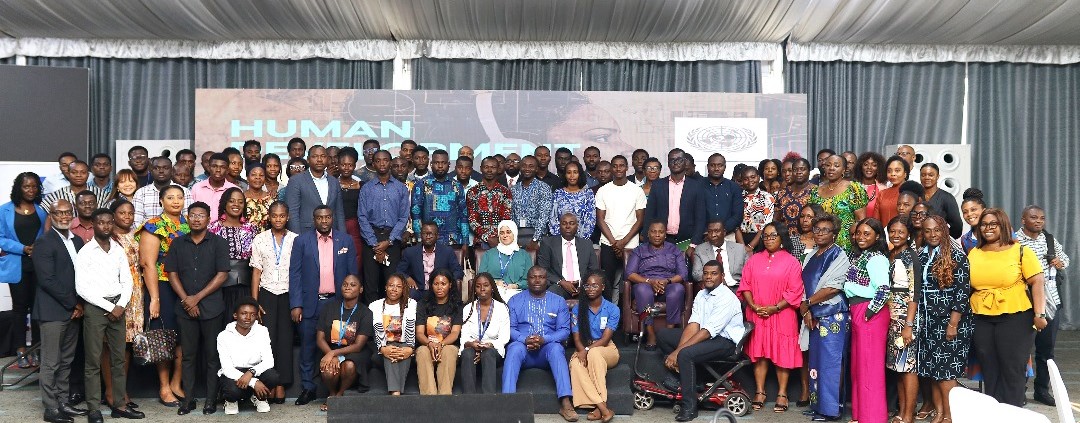
Group photo of participants at the launch
Media Contact:
Emelia Ainooson, Communications Lead
Email: Emelia.ainooson@undp.org
Phone Number: 0501323566
Ernestina Ocansey, Communications Specialist
Email: Ernestina.ocansey@undp.org
Phone Number: 0552381453
About the HDR:
Launched in 1990, the HDR enables the UNDP to play a catalytic role in helping the International Community to develop appropriate responses to major emerging issues relating to the dimensions of human development. In this regard, the HDR aims to generate debate on an important development issue and, if necessary, raise awareness and alert leaders to the threats if appropriate measures are not taken. It also shows the progress made by countries, the disparities that exist between them and within them according to Human Development Indicators: Human Development Index (HDI) and its components (life expectancy at birth, expected years of schooling, mean years of schooling, and gross national income per capita), Gender Development Index (GDI), Gender Inequality Index (GII) and Multidimensional Poverty Index (MPI).
About UNDP:
UNDP is the leading United Nations organization fighting to end the injustice of poverty, inequality and climate change. Working with our broad network of experts and partners in 170 countries, we help nations to build integrated, lasting solutions for people and the planet. Learn more at undp.org or follow at @UNDP
Related
content
content


