

 Locations
[Hackathon Spotlight] Simulating impact: How scenario-based modeling can support smarter ODA decisions
April 22, 2026

LifeSim platform developed by undergraduate students from the Department of Data Science at Dongduk Women’s University
The challenge of ODA decision-making
In recent years, Official Development Assistance (ODA) has faced increasing pressure. With tightening budgets and shifting global priorities, development practitioners are often required to make difficult decisions about where limited resources should be allocated.
However, these decisions are rarely straightforward. The impact of ODA varies significantly across sectors, and its effects often do not appear immediately. In many cases, the outcomes of investments—particularly in areas such as health or governance—may take years to materialize.
To address this challenge, as one of the winning teams of the 2025 Data Dive for Development Hackathon, our team developed LifeSim, a scenario-based simulation tool designed to explore how different ODA allocation strategies influence development outcomes over time. Our team is comprised of three students from the Department of Data Science of Dongduk Women’s University, namely Wonkyo Choi, Eunjun Choi and Hyewon Yang.
We focus on life expectancy as a central indicator, as it captures a wide range of socio-economic conditions including health, living standards, and environmental factors. As a case study, we selected Ethiopia, a country with substantial ODA inflows and diverse development dynamics, making it a meaningful context for policy-oriented simulation.
Introducing LifeSim: A decision-support tool
LifeSim is an interactive platform that allows users to simulate the impact of ODA allocation across different sectors and time horizons.
Users can:
- Adjust ODA investment levels across sectors such as health, social/environmental, and governance
- Explore “what-if” scenarios by comparing different allocation strategies
- Visualize both immediate and delayed effects on life expectancy
- Identify trade-offs between short-term gains and long-term outcomes
Through this interface, users are able to move beyond static analysis and actively explore how policy decisions may unfold over time.

The LifeSim landing page: An entry point to a scenario-based simulation system exploring the impact of ODA allocation on life expectancy
To support intuitive understanding, the platform provides visual outputs that clearly distinguish between short-, medium-, and long-term impacts, enabling users to interpret results without requiring advanced technical expertise.
How it works: Integrating data and time-lagged effects
The LifeSim framework integrates historical ODA data from the UNDP Seoul Policy Centre with development indicators from the World Bank, covering the period from 2014 to 2023.
To capture the complex relationship between ODA and development outcomes, we applied a combination of data-driven modeling techniques, including time-lagged analysis and predictive modeling approaches. These methods allow us to estimate not only whether ODA has an effect, but also when that effect becomes visible.
A key feature of the model is its ability to incorporate time-lagged relationships, recognizing that investments in different sectors produce impacts over different time horizons.
Scenario-based simulations are then used to test alternative allocation strategies, enabling users to explore how changes in ODA distribution influence future outcomes.

Scenario configuration interface for adjusting sectoral ODA allocations
What the data shows: Key insights from the simulation
The analysis reveals several important patterns regarding how ODA affects life expectancy:
- Health sector investments show a strong positive impact, but with a lag of approximately two years, reflecting the time required for infrastructure development and service improvements.
- Social and environmental investments demonstrate immediate positive effects, suggesting that improvements in living conditions can translate quickly into better outcomes.
- Governance-related ODA exhibits a short-term negative effect, likely due to transitional inefficiencies during institutional restructuring.
In addition, we find that institutional quality, measured through regulatory indicators, plays a critical role in amplifying and sustaining the impact of ODA across sectors.
These findings highlight that the effectiveness of ODA is not only sector-dependent, but also highly sensitive to timing and context.
“What stood out to us was that the impact of ODA isn’t immediate—it varies by sector and often takes time to unfold, which made us think about how these decisions could be explored more systematically.” — Team reflection

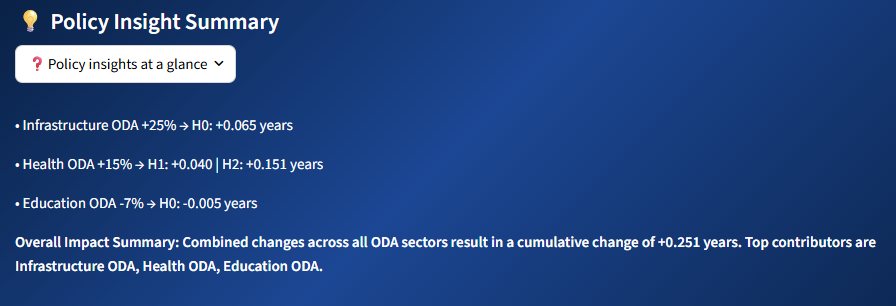
Scenario results visualizing projected life expectancy outcomes following sectoral ODA adjustments (Health +15%, Education −7%, Infrastructure +25%), alongside a policy insight summary
Why this matters: Implications for practitioners
These insights are particularly relevant in the current development landscape.
Over the past two years, significant reductions in ODA funding have forced donors and implementing organizations to prioritize more strategically, often under conditions of uncertainty and limited evidence.
LifeSim directly addresses this challenge by enabling practitioners to simulate the downstream effects of funding decisions. By making trade-offs explicit, the tool helps users understand how reallocating resources across sectors may influence outcomes such as life expectancy.
Importantly, the findings emphasize that timing matters. Policies that appear less effective in the short term—such as health investments—may yield substantial benefits over longer horizons. Conversely, sectors with immediate impact may be critical when rapid results are required.
This reinforces the need for multi-year planning frameworks that account for both short-term and long-term effects.
Finally, while this study focuses on Ethiopia, the underlying methodology is adaptable to other country contexts. With appropriate data, the framework can be extended to support evidence-based ODA planning in a wide range of settings.
Towards more informed ODA allocation
LifeSim demonstrates how data-driven, scenario-based modeling can support more informed and transparent decision-making in development policy.
By combining empirical analysis with an interactive simulation interface, the tool enables users to better understand not only what works, but also when and under what conditions it works.
As development challenges become more complex and resources more constrained, such approaches can play an increasingly important role in shaping effective and sustainable ODA strategies.
This blog article was written by Wonkyo Choi, Eunjun Choi and Hyewon Yang.
This article represents the views of the authors and does not reflect the views of UNDP.
About the United Nations Development Programme
UNDP is the leading United Nations organization fighting to end the injustice of poverty, inequality, and climate change. Working with our broad network of experts and partners in 170 countries, we help nations to build integrated, lasting solutions for people and planet. Learn more at undp.org or follow at @UNDP.
About UNDP Seoul Policy Centre
UNDP Seoul Policy Centre is a facilitator of innovative development cooperation to catalyse the achievement of the Sustainable Development Goals. Through its SDG Partnerships programme and other South-South and Triangular Cooperation initiatives, the Centre supports countries by sharing innovative, tested-and-proven practices and policy tools on strategic development issues globally. Learn more at undp.org/policy-centre/seoul or follow at @UNDPSPC.
2025 Data Dive for Development Hackathon
The Data Dive for Development Hackathon was an initiative led by the UNDP Seoul Policy Centre from July to November 2025, inviting young professionals to develop functional prototypes that extract, analyze and visualize insights from Official Development Assitance (ODA) data. Learn more at https://www.undp.org/policy-centre/seoul/events/data-dive-development-hackathon-2025.
Prototypes developed under the hackathon are currently not widely available to the public. For any inquiries and access requests, please contact info.kr@undp.org.
Related
content
content


