

 Locations
El Salvador Delegation’s Study Mission to the Republic of Korea on Sustainable Forest Fire Management and Capacity Building
June 2, 2025
El Salvador faces great threat to biodiversity and climate resilience due to increasing wildfires. The Ministry of Environment and Natural Resources (MARN), the lead agency of the Natural Protected Areas System and coordinator of the National Commission on Forest Fires (CNIF), oversees the protection and conservation of 193 Natural Protected Areas (NPAs) located in 15 Conservation Areas. MARN’s efforts focus on enhancing the resilience of these areas, emphasizing fire management in the prevention, response, and rehabilitation phases. However, significant challenges remain in developing an efficient early warning system for timely responses to wildfires in NPAs and buffer zones.
To mitigate the escalating wildfire risks in El Salvador and support its transition toward a climate-resilient future, UNDP Seoul Policy Centre (USPC) and UNDP El Salvador launched an SDG Partnership Project on Forest Fire Prevention and Management. Funded by the Ministry of Foreign Affairs (MOFA) of the Republic of Korea (ROK), the project aims to support the creation of an early warning system through knowledge exchange. The project will focus on integrating advanced technologies, enhancing inter-institutional coordination, and strengthening institutional and local capacities, laying the foundation for a more effective and timely wildfire response in El Salvador.
Study visit to Korea: Fostering knowledge exchange on forest fire management
As part of this SDG Partnership, USPC hosted a delegation from El Salvador for a study visit to the ROK from 26 to 30 May 2025. The visit aimed to foster knowledge exchange and share the ROK’s innovative technology and extensive experience in forest fire prevention and management. The delegation, comprising of six representatives from El Salvador’s Ministry of Environment and Natural Resources, Ministry of Agriculture and Livestock, Civil Protection, and Fire Department, visited multiple institutions and engaged with Korean experts on the integration of advanced technologies such as Geographic Information Systems (GIS) and Remote Sensing (RS) for spatial analysis, AI for predictive modeling, drones for real-time surveillance, and satellite systems for early detection, coordinated response to forest disasters, and post-fire restoration strategies.

The mission began with an inception meeting at USPC, where participants, including the Director of USPC, Anne Juepner and H.E. Jaime José Lopez Badiá, the Ambassador of the Republic of El Salvador to the ROK, discussed the importance of multilateral cooperation, community participation, and technological innovation in wildfire risk reduction.
Exploring innovative technologies on forest fire management


The delegates delved deeper into the ROK’s forest fire management strategies through an engaging session with experts, including Professor Woo-Kyun Lee of Korea University’s Division of Environmental Science and Ecological Engineering and OJEong Resilience Institute. During the session, the delegation explored the ROK’s GIS/RS technologies, including the Forest Disaster Diagnostic Model, and discussed its potential application in El Salvador to improve wildfire management.


The delegation also visited the Forest Disaster Prediction & Analysis Center, Digital Forest Resource Information Center and the National Forest Satellite Information & Technology Center at the National Institute of Forest Science (NIFoS), where they explored Information and Communication Technology (ICT) tools and ICT platforms. These included Light Detection and Ranging (LiDAR) technology, Artificial Intelligence (AI) for risk modeling, drone applications, and satellite surveillance. These visits helped the delegation gather practical insights into how these technologies can support the development of a more efficient and responsive wildfire management system in El Salvador.
Lessons from forest fire recovery and restoration efforts


Another engaging visit was to the Goseong forest fire recovery site, which has served as a site for natural and active reforestation since a large-scale forest fire in 1996. The visit provided valuable insights into the advantages and limitations of each restoration methods as well as approaches to land rehabilitation, soil stabilization, and post-fires ecosystem recovery. It also highlighted the delicate balance between government-led restoration efforts and the priorities of local communities, who may favor certain tree species for cultural or economic reasons, even if those species are more prone to disease or fire risks. Through this visit, the delegation recognized the importance of engaging with communities and understanding their needs before planning restoration strategies.
Korea’s early warning system: Leveraging technology for real-time coordination and response


At the Forest Fire Center of Gangwon State, the delegates gained firsthand insights into the ROK's wildfire response system, which includes real-time CCTV monitoring, integrated meteorological systems, an emergency operations center, and on-site overview of firefighting vehicles. The delegates also explored how advanced technologies and strong inter-agency coordination enhance the ROK’s regional and municipal firefighting capabilities.
At the Korea Forest Service’s Forest Aviation Headquarters, the delegation explored the ROK’s aerial firefighting strategies. They observed live demonstrations of drone and helicopter in action, gaining a comprehensive understanding of the ROK’s forest aviation infrastructure. The visit highlighted how the ROK’s aerial assets are strategically deployed to support rapid response, enhance situational awareness, and strengthen the overall effectiveness of wildfire suppression efforts.
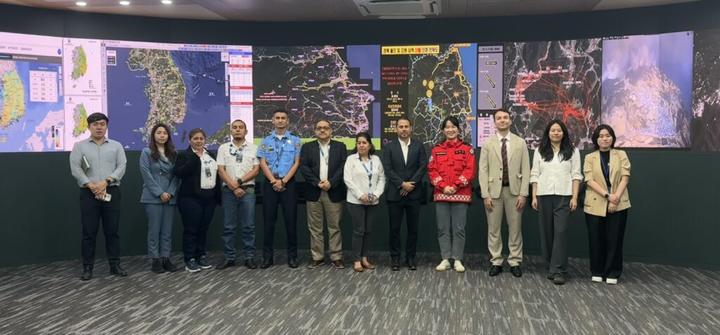
During the visit to the Korea Forest Service (KFS)’s Fire Situation Room, the delegates witnessed how advanced ICT systems are leveraged for real-time monitoring and coordination during forest fires and landslides. The session emphasized the role of not only advanced technology, but also the role of engaged local community reporting in enabling swift responses and improving overall effectiveness of the firefighting operations. In addition, the delegates shared El Salvador’s current policies, legal frameworks, and efforts to build capacity for wildfire management. Through discussions and Q&A sessions, both sides compared their strategies and exchanged practical ideas that could be adapted to El Salvador’s local context.
South-South & Triangular Cooperation: Sharing lessons learned

The mission concluded with a South-South and Triangular Cooperation (SSTC) session led by Erdenebat Erdenejav, Programme, Analyst at the UNDP Mongolia Country Office, who shared the key lessons learned from a previous SDG Partnership Project on sustainable forest management in Mongolia (2021-2023), implemented in collaboration with UNDP Seoul Policy Centre. The project resulted in the development of a digital platform that enables community reporting and tracking of illegal logging cases as well as legal mechanisms to incentivize the reporting of environmental crimes. The exchange underscored the importance of community engagement, inter-agency coordination and a robust legal framework in maximizing the impact of the SDG Partnership.
Key Takeaways
A key takeaway from the study visits was the role of fire situation rooms in the ROK’s forest fire response strategy. Equipped with real-time forecasting system, monitoring tools, drone and helicopter footage, fire spread prediction and fire damage status, these rooms are critical for coordinating rapid, on-site firefighting operations. The delegation visited several institutions, including NIFoS, KFS, KFS Aviation Headquarters, Forest Fire Center of Gangwon State, all of which operate these advanced situation rooms.
The visit highlighted how the ROK integrates early warning systems, inter-agency coordination and community engagement to effectively prevent and manage forest fires. This exchange has laid the strong foundation for El Salvador to adapt the ROK’s technological innovations and operational practices into a robust wildfire early warning system (EWS) in El Salvador tailored to its local needs.
Related
content
content


