

 Locations
By Access and Delivery Partnership x UNDP
A new chapter in the fight against river blindness: Ghana’s introduction of moxidectin
May 20, 2025

Photo: @Esther Aryee / @UNDP Ghana
In many rural parts of Ghana, the waters that nourish crops and sustain livelihoods also bring a hidden danger. Black flies, breeding along fast-flowing rivers and streams, carry the parasite that causes river blindness – a disease that has robbed countless people of their sight, their ability to work and their independence.
River blindness, or onchocerciasis, leads to relentless itching, disfiguring skin conditions and progressive vision loss that can end in permanent blindness. The impact can be devastating, driving cycles of poverty and lost opportunity. In 2023, nearly 250 million people required preventive treatment against river blindness, with the vast majority residing in Africa and Yemen.
Ghana has made significant progress against the disease, particularly through aggressive vector control and annual mass drug administration (MDA) campaigns – a strategy that involves treating entire communities, regardless of their infection status. Even though these efforts have dramatically reduced the number of cases across much of the country, 142 districts remain endemic, and 5.8 million people continue to be at risk.
The drug ivermectin has been the backbone of this river blindness control strategy for decades. While it effectively kills the parasite’s larval stage – the microfilariae – and halts their release by adult worms for several months, it does not kill the adult worms themselves. As a result, repopulation occurs, and annual MDA campaigns must be repeated indefinitely. This limitation has made it difficult to fully eliminate the disease in areas where transmission persists.
Now, a promising new drug is offering hope for elimination: moxidectin
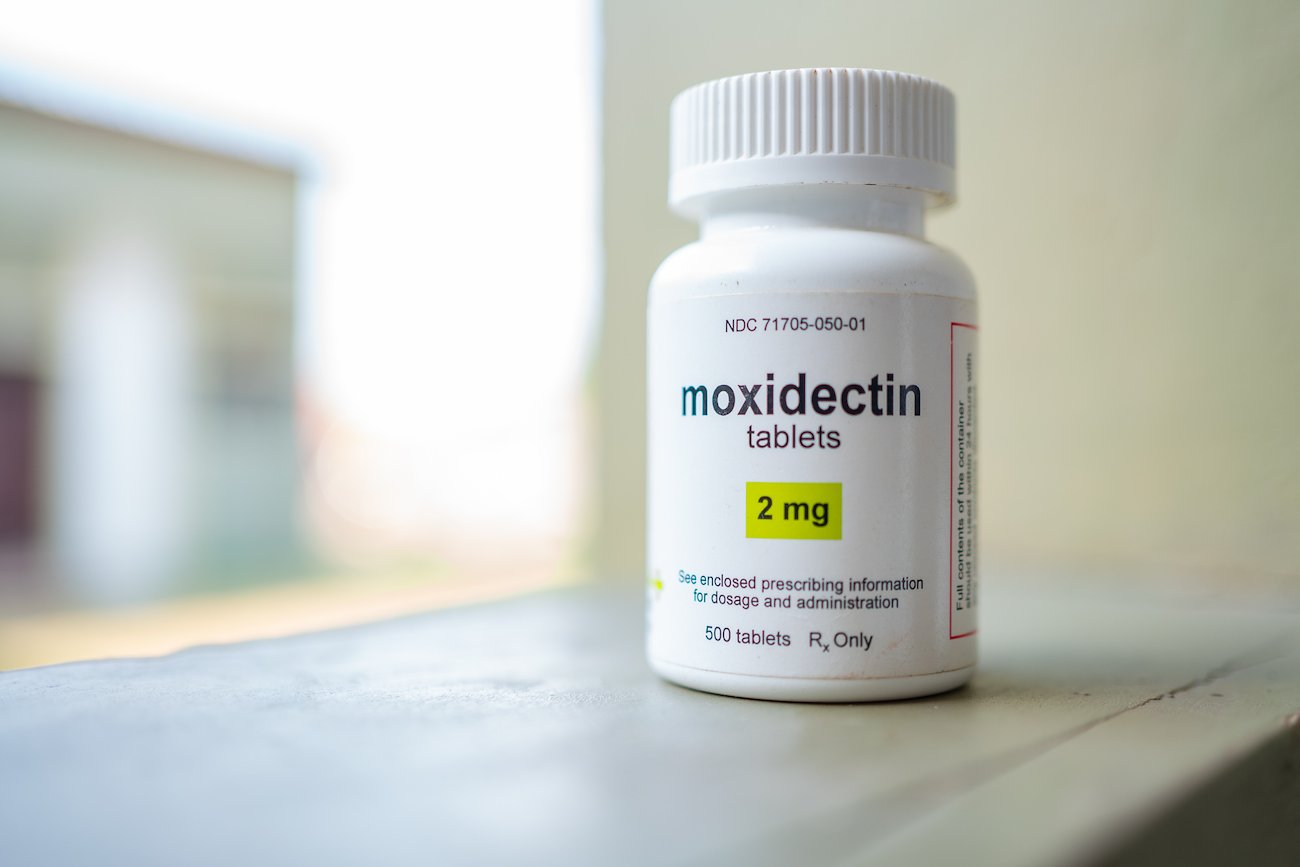
Photo: Esther Aryee/ @UNDP Ghana
In the Twifo-Atti Morkwa District of Ghana’s Central Region, the lush, green waterways of are a prime breeding ground for black flies, particularly during the rainy season months of April to October. Communities have long lived under the burden of river blindness. But that may be changing. Moxidectin, recently approved for use in Ghana for individuals aged four and above, provides longer-lasting suppression of microfilariae. By keeping microfilaria levels significantly lower for up to 12 months after treatment, it is expected to enhance the impact of MDA campaigns and could accelerate progress towards disease elimination.
An implementation research study supported by the UNDP-led Access and Delivery Partnership project and jointly conducted by the Special Programme for Research and Training in Tropical Diseases (TDR), The Bruyere Health Research Institute, Medicines Development for Global Health, Ghana Health Services and the University of Health and Allied Sciences, is assessing the feasibility and acceptability of replacing ivermectin with moxidectin in MDA campaigns, with the goal of finally eliminating the disease. The Access and Delivery Partnership project is supported by the Government of Japan.
As part of the study, MDAs were carried out in Twifo-Atti Morkwa – using ivermectin in July 2024 and moxidectin in January 2025. Following each MDA, the research team conducted Community Knowledge, Attitudes, and Practices (KAP) surveys and in-depth interviews with local community members, along with focus group discussions with community drug distributors and Ghana Health Services District Directors. In early April 2025, these activities were conducted in relation to the moxidectin MDA.

Prior to embarking into the field to collect data, a training was held 7-9 April 2025 for community health workers implementing the study.
Photo: @Esther Aryee / @UNDP Ghana

Research team members went door-to-door conducting surveys and facilitating group discussions, recording responses directly into tablets.
Mustapha Immurana, a senior research fellow at the University of Health and Allied Sciences, explains why the potential transition to moxidectin matters. “Moxidectin has proven to be effective in suppressing microfilariae for a prolonged period. Therefore, it has an advantage in dealing with the disease in an endemic setting. I see moxidectin as having great potential for elimination of river blindness in Ghana and other countries where it will be implemented.”
“People in the community get infected when they go to farms or get close to water bodies, where they come into contact with infected black flies,” he adds. “Since it has been approved for people 4 years and above, it means it will help both the young and elderly.”
Although it is still too early to draw concrete conclusions, the study is progressing smoothly, with strong community engagement driven by an understanding of its relevance and potential benefits.
For Emmanuel Sam, a health worker in Wamaso, one key lesson has been the importance of strong community engagement. “Many people don’t fully understand what river blindness is, so it can be difficult for them to accept the treatment. During community engagement sessions, people asked about side effects and we addressed their concerns. Overall, people seem willing to accept the new drug.”

Scenes of interactions with the community members
That community buy-in has been bolstered by local champions like Thomas Aidoo, a community volunteer who has been helping with the local response for years. “When onchocerciasis first appeared in the community, it caused a lot of concern, and we began taking steps to protect ourselves. Over time, we’ve done well in minimizing its impact, and in recent years, the disease is not as common.”
For Aidoo and others, the stakes are clear. Although the disease is less common today than in years past, the black flies are still around, especially during the rainy season. “Just like we beat polio, we can beat river blindness if we stay consistent.”

Community buy-in is aided through the enlisting of local volunteers like Thomas Aidoo.
“We held a meeting to discuss the drug and educate the community about it,” explains George Frimpong Sem, an assemblyman and community health committee member. “We can only combat onchocerciasis by taking treatment. Without it, there’s little we can do. I believe that with consistent use, we can eventually eliminate the disease from our community.”
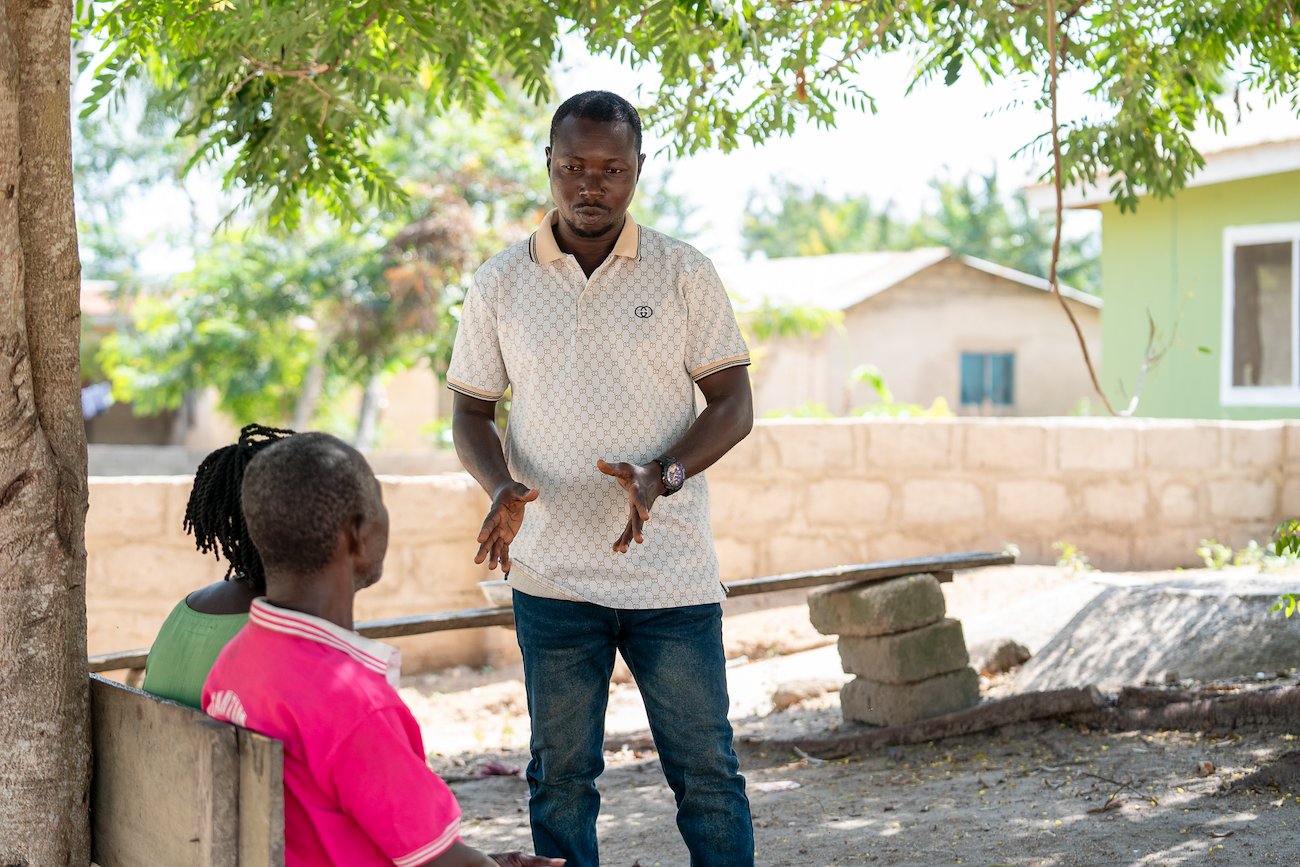
Assemblyman and community health committee member George Frimpong Sem takes part in a community engagement session to raise awareness of the importance of public participation in river blindness control activities.
The research team is now preparing for the next phase of the study. A second MDA with moxidectin is scheduled for July 2025, after which an additional round of assessment will measure changes in community perceptions and acceptability, as well as drug efficacy. In totality, the study will provide critical data to inform broader deployment across the country.
Investing in health, investing in futures
Ultimately, the introduction of moxidectin is about more than just a new pill – it is about expanding access to innovation, accelerating elimination of devastating neglected tropical diseases and improving lives. “We call on policy makers, governments and all stakeholders to invest in the response to neglected tropical diseases,” Mustapha says. “It’s worth investing in.” Thanks to the coordinated efforts of the UNDP-led Access and Delivery Partnership project, TDR, The Bruyere Health Research Institute, Medicines Development for Global Health, Ghana Health Services, the University of Health and Allied Sciences and local communities, that future feels closer than ever.
Ultimately, the introduction of moxidectin is about more than just a new pill – it is about expanding access to innovation, accelerating elimination of devastating neglected tropical diseases and improving lives. Thanks to the coordinated efforts of the UNDP-led Access and Delivery Partnership project, TDR, Ghana Health Services, the University of Health and Allied Sciences and local communities, that future feels closer than ever.
Related
content
content


