Locations
Shape tomorrow’s agrifood system
Futures Simulation: Nutrition Nexus
February 3, 2026

Shape tomorrow’s agrifood system
Nutrition Nexus
A futures simulation game that helps multi-sector stakeholders experience trade-offs, negotiate and explore collaboration pathways.
Overview
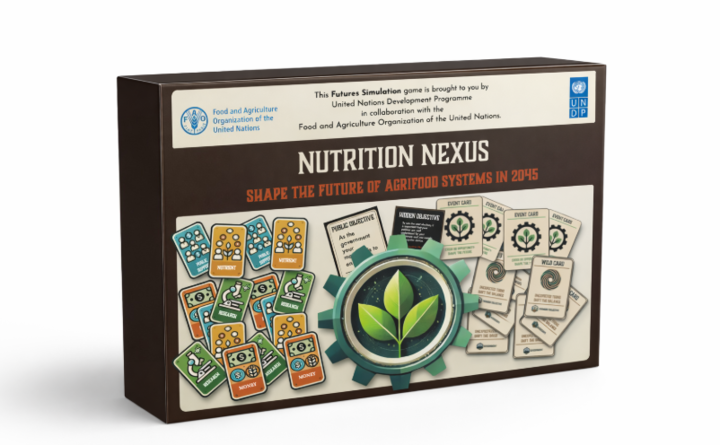
Nutrition Nexus is a facilitated futures simulation game designed to help diverse stakeholders explore how today’s decisions could shape tomorrow’s agrifood system.
Set in a near-future context, the game places participants in the roles of key actors across the nutrition and food ecosystem and confronts them with unfolding crises, opportunities, and constraints. Through timed negotiations, resource trade-offs, and coalition-building, players experience firsthand how well-intentioned actions can interact, collide, or compound within a complex system.
Rather than aiming for a single “correct” outcome, Nutrition Nexus creates a shared space for experimentation and reflection: surfacing tensions between short-term interests and long-term system stability, and making visible the often-hidden dynamics that shape outcomes at scale. The game was developed by United Nations Development Programme in collaboration with Food and Agriculture Organization of the United Nations as part of broader efforts to strengthen anticipatory, systems-based decision-making.
Watch the trailer
Why futures—and why a game?
Agrifood system challenges sit at the intersection of climate change, economic pressures, technological innovation, governance choices, and shifting social norms: factors that evolve unevenly and interact in unpredictable ways.
Futures approaches are valuable not because they predict what will happen, but because they help decision-makers explore what could happen under different assumptions, incentives, and constraints. By engaging with plausible future conditions rather than extrapolating from the present, participants are able to test strategies, partnerships, and policy choices before they harden into path dependencies.
Games are uniquely conducive to systems thinking. […] Game processes that capture the essence of real-world systems allow for safe and rich explorations of how those systems could be changed.-Pablo Suarez, Rethinking The Future Of Governance Through Games, 2017
In Nutrition Nexus, futures thinking is embedded through experiential learning: uncertainty is not abstract but felt, trade-offs are not theoretical but negotiated, and systemic risks become tangible through play.
If you’re interested in playing the game, or understanding how it could help your team, download the Nutrition Nexus presentation deck provides a comprehensive overview of the game’s intent, design, and use cases. It explains the rationale for using a futures simulation to explore agrifood systems, outlines the core design principles and mechanics of the game, and highlights who the game is for and how it can be applied in policy, learning, and multi-stakeholder settings.
The deck is useful for facilitators, partners, and institutions seeking to understand the thinking behind the game, position it within broader futures and systems-thinking work, or introduce Nutrition Nexus to new audiences ahead of a session or collaboration.
Download the Nutrition Nexus presentation
How the game works
- Event phase: Each round begins with a player drawing an Event Card, revealing a crisis or opportunity that impacts the agrifood system. Players have 5 minutes to negotiate and pool resources to resolve the event and prevent negative effects.
- Action phase: Players collaborate by offering resources to resolve the drawn event. If consensus isn’t reached within 5 minutes, a Wild Card is introduced, adding complexity and forcing players to adapt their strategies for the remaining 5 minutes of negotiation time.
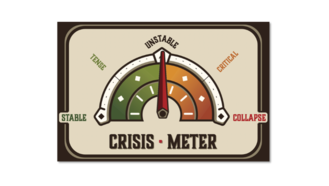
- Resolution phase: After all players have acted, the group’s collective progress is evaluated. The Crisis Meter is updated based on the success or failure of resolving the event, determining the overall stability of the system.
Core components
Nutrition Nexus is built from a set of interlocking components that structure decision-making, create productive tension, and make system dynamics visible. Together, they shape how players negotiate, collaborate, and experience the consequences of their choices over time.


Downloads
(and print specifications)