

 Locations
AI at the service of development
From Early Warning to Early Action in Egypt
September 12, 2025

AI at the service of development
From Early Warning to Early Action in Egypt
The Context
In late 2023, UNDP Egypt was grappling with a critical delivery challenge. Programme teams were struggling to meet targets, citing inflation, shifting government priorities, and abrupt policy changes as reasons for delays. While much of this disruption was certainly hard to predict, systematic monitoring of emerging trends could have alerted the team earlier to what might happen.
In team leaders’ meetings, a common frustration emerged: “We need something that will keep us alert to changes and connect those changes directly to programme planning so we can meet our delivery targets.”
It was during a regional Data Thursday session that Engy Abdel Wahab, the Head of Exploration at UNDP Egypt’s Accelerator Lab, saw a possible solution. UNDP Sudan’s Accelerator Lab presented its horizon scanning platform—a tool designed to detect and interpret signals of change.
Engy recognized the overlap between Sudan’s approach and Egypt’s needs, and initiated discussions to localize the model for Egypt’s context. Senior management approved the idea, and Egypt’s version was born.
The Process
The development process was grounded in co-design and rapid adaptation:
The first step was to determine which features of Sudan’s platform were most relevant. Egypt adopted the emerging issue and programme simulation features but replaced others with country-specific features. A notable addition was the Digital Avatar, a one-stop shop for national data indicators that would streamline and speed up desk research – a direct request from the Resident Representative.
Data sources were also customized: while Sudan drew from many sources, including radio and song lyrics, these were not considered credible in Egypt’s context. Instead, Egypt’s platform weighted social media more heavily, alongside national statistics and vetted open-source feeds.
A multidisciplinary team—two economists, a data scientist, a mathematician, and a full-stack developer—built the system’s architecture. They created a bilingual glossary to ensure the platform recognized equivalent English and Arabic terms; developed a mathematical model to flag outliers in macroeconomic indicators; and introduced a margin of error function to spot when data points falling outside historical norms could signal a change.
All of this became the input for AI to scan and identify emerging signals of change and highlight them on the main dashboard as an ‘emerging issue of the month’ to CO colleagues.
UNDP Programme colleagues as well as partners from government, civil society, and the private sector were invited to validate features and explore data-sharing.
The Monitoring & Evaluation team was asked to validate and weight the significance of each data source, based on their expertise
After the development of the platform, the team conducted user testing acceptance workshops with programming colleagues from the UNDP Egypt CO and external partners to test drive the platform and incorporate their feedback.
Some Early Testing
The first full test of the platform was on an emerging issue developing for Egypt: the sudden influx of Sudanese migrants amidst ongoing economic stress and inflationary pressures.
With little existing data, the team used the platform to combine signals and insights from research, including 200 primary surveys conducted in the community. Then, it used the AI-enabled Egypt Horizon Scanning platform to design and develop a programme to respond to the emerging situation: a practical demonstration of how the platform could generate a service offer from scratch.
Another test case addressed urban resilience, commissioned by the new Deputy Resident Representative. This time, no primary research was needed: the Scanner used the digital avatar, emerging issue, intervention mapping, and AI-enabled programmatic simulation features to generate a full programme proposal without the need for time-intensive manual research.
Main Features of the EHS
The Egypt Horizon Scanner integrates multiple functions into a single platform. Five of the most interesting features of the platform are shown below.
Click the arrow to the right to scroll through them.


Learnings and Next Steps
A key lesson from the Egypt’s journey was the importance of bringing Country Office colleagues along from the very start.
While AI-powered tools can be exciting, it is easy to become absorbed in the possibilities of the technology and overlook the human dimension.
In Egypt, although the platform addressed a clear operational need, its ability to ‘automate’ significant parts of the programme design process was, for some, a source of concern. Many colleagues perceived it as a potential replacement for their work rather than an aid to it.
Even with strong support from Country Office leadership, Engy and her team had to invest substantial time in demonstrating that the platform was designed to support, not supplant, programme teams. They emphasised that the platform’s outputs were a starting point—an informed foundation for further refinement and contextualisation by the teams—not a final product.
Today, Egypt’s platform is proving especially valuable in exploring thematic areas that are new to the Country Office—such as sustainable health and sustainable finance, domains where in-house expertise is limited, desk research would be time-consuming, and reliable data is scarce.
In such cases, the platform’s ability to automatically draw from and synthesise a wide range of qualitative and quantitative sources allows programme teams to accelerate the design process significantly.
For example, when health and sustainable finance were recently added to UNDP Egypt’s portfolio for the first time, the platform was used to scan emerging issues, consolidate national and international indicators, and simulate programmatic options—saving the team significant amounts of time .
By automating the early stages of research and sense-making, the Horizon Scanner not only saves time but also helps teams to move confidently into new areas of work.
The Horizon Scanner brought together diverse data and insights to guide strategic planning and innovation. It empowered us to anticipate emerging challenges and design more responsive, future-ready programs. The Horizon Scanner felt like a compass in a storm—bringing clarity through data and foresight.Mahmoud El-Mekawy, UNDP Egypt Ex-RBM Associate
As artificial intelligence becomes embedded in daily workflows, the ability to communicate benefits clearly and foster trust will be essential. Positioning such tools as enablers of efficiency, insight, and collaboration—rather than as replacements for humans—can ease concerns over job security and encourage ownership of innovation.
Engy drew on her earlier experience in UNDP Cameroon, where she tested a similar foresight approach in climate finance. There, extensive consultations and multiple feedback loops with leadership and programme teams led to programmatic simulations that were far better received by colleagues.
Building on that success, UNDP Cameroon is now exploring how such a tool could be developed for the Ministry of Economy, recognising that combining qualitative and quantitative data with signals of change can help detect shifts early, even in volatile environments.
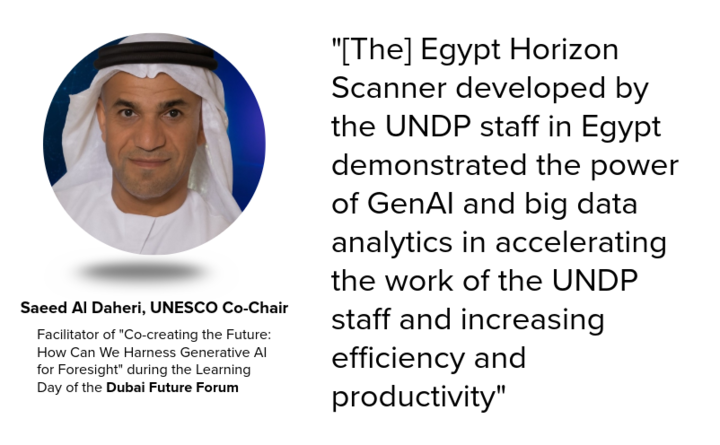
The platform was demonstrated at a workshop titled "Co-creating the Future: How Can We Harness Generative AI for Foresight" during the Learning Day of the Dubai Future Forum. Saeed Al Daheri, UNESCO Co-Chair and facilitator of the session remarked, "[The] Egypt Horizon Scanner developed by the UNDP staff in Egypt demonstrated the power of GenAI and big data analytics in accelerating the work of the UNDP staff and increasing efficiency and productivity”.
Ultimately, the lesson is clear: the most powerful foresight tools are not just those that anticipate change, but those that inspire people to act on it together. In Egypt, the Horizon Scanner is proving that when technology is combined with human insight, even volatile futures can be approached with confidence and purpose.