

 Locations
Embedding Foresight in CPD Section 3
Programme & Risk Management


Introduction
The Programme and Risk Management section of the Country Programme Document (CPD) is critical for ensuring the success of UNDP’s interventions. This section requires country offices to identify potential risks, both internal and external, that could hinder the achievement of development results. It also emphasizes the need for robust risk management mechanisms to address these challenges while enhancing the programme’s resilience and effectiveness.
Foresight tools like anti-vision with backcasting and windtunneling with pre-developed scenarios directly support this section by providing structured methodologies to identify, classify, and address risks in a future-oriented manner. By integrating these tools, teams can ensure that their risk management plans are not only grounded in the present but also responsive to emerging uncertainties.
The importance for the CPD
By linking foresight tools to the CPD, country offices can strengthen their risk management strategies and demonstrate a commitment to adaptive, future-informed programming. The structured insights generated from these exercises will directly feed into the CPD, ensuring that risks are clearly articulated and robust mitigation plans are in place.
- Specific Risks to the Programme’s Objectives: Foresight tools enable teams to identify risks through a combination of introspective (anti-vision) and scenario-based (windtunneling) methods.
- Social and Environmental Risks: Both methods highlight these risks by considering the ripple effects of external trends, such as climate change or economic shifts, on programme goals.
- Governance Mechanisms: Foresight tools can help teams assess how governance structures might need to adapt in different futures to mitigate risks effectively.
- Innovative Programming Instruments: Insights generated through foresight can guide the use of adaptive programming approaches that are resilient to uncertainty.
By linking foresight tools to the CPD, country offices can strengthen their risk management strategies and demonstrate a commitment to adaptive, future-informed programming. The structured insights generated from these exercises will directly feed into the CPD, ensuring that risks are clearly articulated and robust mitigation plans are in place.
Two options
This guide offers two foresight-driven methods for identifying risks: anti-visioning and wind tunneling with scenarios.
Each method allows teams to explore vulnerabilities in programme design, but its applicability depends on the team's resources and context. Both approaches aim to equip teams with actionable insights to mitigate risks while ensuring that programmes are robust enough to adapt to unforeseen challenges.
Teams can choose the method that best suits their context and resources. In some cases, combining both methods may provide a more comprehensive understanding of risks, with antivisioning focusing on internal vulnerabilities and wind tunneling addressing external uncertainties.

Option 1: Anti-Visioning: Visualizing Failure to Learn and Adapt
Anti-visioning is a powerful yet unconventional exercise where teams imagine a future where their programme has failed. This approach enables proactive identification of risks, fostering the design of interventions that are more robust, resilient, and aligned with dynamic realities. The exercise is rooted in the principle that learning from potential failure can be more insightful than only envisioning success. By uncovering blind spots and vulnerabilities, anti-visioning encourages strategic foresight that minimizes risks while enhancing programme success.
However, anti-visioning can be an uncomfortable exercise for many teams. Poking holes in one’s own programme design can feel counterintuitive, even disheartening. It requires psychological safety, open communication, and an acknowledgment that vulnerability in this process is key to resilience.
To reduce bias, it is often helpful to bring in external perspectives—stakeholders, experts, or facilitators—who can challenge assumptions and offer fresh insights.
Research in psychology and decision-making validates the importance of visualizing failure. Techniques like premortem analysis—a strategy often used in business and project planning—highlight that by anticipating failure and working backward, individuals and teams can:
- Overcome confirmation bias, which leads to overlooking weaknesses in their own plans.
- Stimulate creative problem-solving by thinking critically about what might go wrong.
- Foster a culture of constructive criticism that strengthens programme design.
Overview of method
Identifying Risk
In this step, teams craft a detailed narrative of a future where their programme has failed. This involves imagining the headline, milestones, and key factors contributing to the failure, providing a structured way to uncover potential risks and blind spots.
Mapping Risk
The risks identified during anti-visioning are classified based on their impact (severity of consequences) and influenceability (UNDP’s ability to control the risk). These risks are plotted on a Risk Radar, enabling teams to prioritize the most critical threats.
Managing Risk
Once risks are mapped, teams develop tailored mitigation strategies. Highimpact, highinfluenceability risks can be addressed immediately, while high-impact, lowinfluenceability risks are monitored and tracked with contingency plans, ensuring the programme remains resilient and adaptive.
Identifying Risk: Using the Visioning Template for Anti-visioning
The same visioning template used to craft success stories for the programme can be repurposed for antivisioning. However, each section of the template will be reoriented with questions focused on failure.
Below are the prompts for each section, using the youth unemployment challenge as an example:
Headlines & Short Description
Create a headline and a short description that captures the future state where the programme has failed, and the development challenge has either not been addressed or perhaps got worse.
Prompt Questions:
- What would the headline be in a world where this programme has failed to achieve its goals? What does failure look like?
- What image or photo would accompany this story?
Key Obstacles, Failures & Lowlights
Identify the obstacles that led to this outcome. Write a short narrative connecting the milestones to the overall vision.
Prompt Questions:
- What happened to create this failure? What major factors contributed to this outcome?
- What external shocks could have derailed progress? (e.g., economic downturns, climate events).
- What operational failures could UNDP have experienced? (e.g., funding, resources, programme management).
- What systemic barriers couldn't be overcome?
Partnerships and Collaboration
Identify the blockers to achieving the desired partnerships and collaborations.
Prompt Questions:
- Were there missed opportunities for collaboration?
- What could have prevented partners from wanting to collaborate with UNDP?
- What more could the UNDP team have done to strengthen partnerships – that wasn't done?
From Risk Insights to Risk Statements
The anti-visioning exercise generates a detailed narrative of potential programme failure, providing valuable insights into risks that could materialize if certain challenges are not addressed.
Translating these insights into risks involves reframing the identified causes of failure into actionable risk statements. These statements describe potential events or conditions that could negatively impact the programme’s objectives, allowing teams to evaluate their likelihood, severity, and required mitigation strategies.
Reframing Risk Insights to Risk Statements
The outputs of the anti-visioning exercise will consist of ideas framed in the past tense describing why the programme failed. These ideas can be easily and intuitively reframed as risks to the programme, which can then be prioritized on the risk radar.
To reframe the key issue in the anti-vision exercise as a risk, you will need to focus on the key issue or event that contributes to the failure of the programme. For example, ask yourself, “What part of the anti-vision narrative describes an event, condition, or action that negatively impacts the programme?” The answer you come up with could be, for example, “The training programmes didn’t match market needs”. This is a possible risk.
Some other risks that emerge from the example anti-vision exercise are:

The outcome of this exercise is a ‘laundry list’ of everything that could potentially go wrong in implementing the programme. However, not all risks are equal in their impact or urgency.
The next step is to map these risks based on their potential impact on the success of the programme and the ability of UNDP to influence of control the risk.
Click here to download the PDF version of the Anti-Vision Template
Option 2: Wind-tunnelling
Wind-tunneling is a foresight methodology designed to test the resilience of a strategy, plan, or programme against various future scenarios. Named after the aviation industry practice of testing aircraft designs in wind tunnels, this method evaluates how well a strategy can withstand or adapt to external pressures. In the context of development planning, wind-tunneling helps ensure that programmes are robust and adaptive, enabling teams to identify potential risks, weaknesses, and opportunities before implementation.
This exercise is particularly useful in complex environments where uncertainty about future conditions could undermine well-intentioned plans. In development planning, wind-tunneling helps uncover risks by testing a programme’s assumptions and components against diverse scenarios.
By analyzing what might fail, thrive, or need adjustment in different contexts, teams can identify specific risks to programme success. For example:
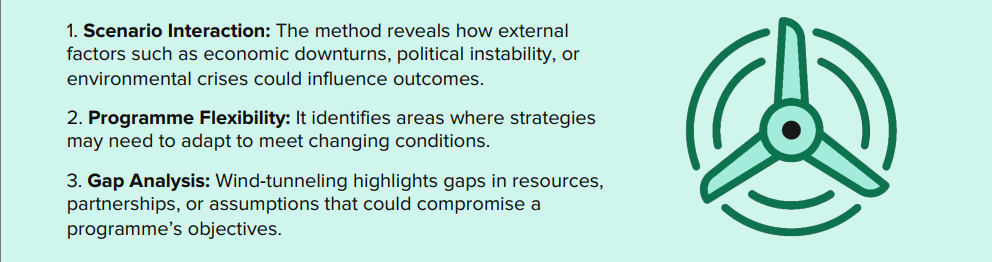
The result is a clearer understanding of what might disrupt a programme and the strategies needed to mitigate those disruptions.
Prerequisites: Scenarios for Wind-Tunneling
Wind-tunneling requires detailed future scenarios to test programmes against. Teams may choose one of three options:

A note on the ‘Off-the-Shelf’ UNDP scenarios
The “Development in 2035” scenarios were crafted through a rigorous, multi-phase foresight process to support UNDP’s Strategic Plan 2026–2029. These scenarios reflect a deep understanding of global trends and uncertainties and are designed to guide strategic decisionmaking.

Click here to download the Scenarios in PPT
Wind-tunnelling Method Overview
Wind-tunneling involves testing a programme or strategy against multiple plausible futures (scenarios) to identify potential risks, opportunities, and areas for improvement. The process ensures that the programme design is resilient, adaptable, and robust across a range of future contexts.
Step 1: Clarify the Programme or Strategy
Before diving into the scenarios, ensure the programme's objectives and desired outcomes are clearly articulated.
This provides a solid foundation for the analysis.
Prompting Questions:
- What is the primary goal of the programme? (e.g., reducing youth unemployment by equipping young people with future-ready skills)
- What are the assumptions underlying the programme design?
Step 2: Test the Programme Against Each Scenario
For each scenario, evaluate the programme's ability to achieve its goals.
Prompting Questions:
- Will the programme achieve its goals in this scenario? If not, why?
- What risks or barriers emerge in this scenario? (e.g., limited access to digital tools in rural areas)
- Which aspects of the programme are vulnerable in this scenario?
- What external factors might derail the programme?
- Are there risks specific to partnerships, technologies, or beneficiaries?
Expected Outcome: Risk List from Wind-tunnelling
The wind-tunnelling exercise is designed to yield a comprehensive list of risks based on how the programme performs in different scenarios. These risks provide critical input for the next steps:
- Risk Mapping: Placing these risks on the Risk Radar based on Impact vs. Influenceability to prioritise risks that need addressing in the CPD.
- Risk Management: Develop targeted mitigation or adaptation plans for high-priority risks based on their categorization.


Click here to access the Mural version of the workshop setup
Click here to download the PDF version of the Anti-Vision Template
Mapping Risk: Classifying Risks for Effective Management
By systematically evaluating risks based on their impact and the degree to which they can be influenced or managed, teams can make informed decisions about where to focus resources and interventions. This process is essential for a few key reasons:

The Risk Radar
We suggest prioritising the risks you have just identified using the Risk Radar. This Radar maps the risks based on ‘Impact’ and ‘Influenceability’. For simplicity we suggest classifying each risk on a ‘High-Moderate-Low’ scale.
Impact: Assess the severity of the risk’s consequences if it materializes. Does it threaten the programme’s objectives, credibility, or stakeholders significantly?
- High Impact: Directly undermines the core objectives of the programme or damages UNDP’s reputation.
- Moderate Impact: Affects secondary outcomes or creates manageable challenges.
- Low Impact: Has minimal or localized effects on the programme.
Influenceability (Control): Evaluate the extent to which UNDP can influence, mitigate, or control the risk.
- High Influenceability: UNDP has significant levers to prevent or mitigate the risk (e.g., design adjustments, proactive communication).
- Moderate Influenceability: UNDP can partially influence the risk by leveraging partners or modifying activities.
- Low Influenceability: The risk is largely external or systemic, requiring adaptation or long-term monitoring rather than direct mitigation.

Managing Risk: Mitigate, Avoid or Develop Contingency Plans
Once risks have been mapped based on their impact and influenceability, it’s essential to develop strategies to mitigate, avoid, or manage these risks effectively. Through the mapping , we have identified the high-to-moderate impact risks, which we suggest focusing on for the CPD. The risk management strategies you will likely employ will depend on the influenceability of those risks. Below is a proposed template and approach to guide teams in crafting responses for each risk.
High/Moderate Impact and High/Moderate Influenceability Risks
For these risks, its important to ask, “What can UNDP do to mitigate or avoid this risk?”.
Some prompt questions could include:
- Can programme design be adjusted to eliminate the root cause of this risk?
- What specific actions or interventions can reduce the likelihood of this risk occurring?
- Are there resources or partnerships UNDP can leverage to strengthen its position?
- Are there operational safeguards (e.g., flexible programme structures) that can be built in?
For the risk, “Training programmes fail to align with market needs,” UNDP could:
- Conduct regular consultations with privatesector employers to ensure alignment with current job market trends.
- Incorporate feedback loops and adjust training curricula based on participant and employer inputs.
- Use pilot programmes to test alignment before scaling initiatives.
- Establish a quarterly review mechanism with stakeholders to monitor programme relevance and make rapid adjustments as needed.
High/Moderate Impact and Low Influenceability Risks
Since UNDP will not be able to exert much influence on these risks, its important to ask, “How can UNDP monitor this risk? And what contingency plans can be developed?”.
Some prompt questions could include:
- What data sources or indicators can provide early warning signals of this risk materializing?
- Are there external partnerships or collaborations that can help track relevant trends or risks?
- Can alternative programme approaches be designed to ensure continuity in achieving objectives, should this risk materialize?
For the risk, “A global recession limits job creation,” UNDP could:
- Monitor macroeconomic trends and forecasts.
- Develop dashboards that track key indicators, such as unemployment rates, GDP growth, and external shocks.
- Develop contingency programmes focused on entrepreneurial skills and self-employment opportunities for youth, which are less sensitive to macroeconomic conditions.
Click here to access the Mural version of the workshop setup
Click here to download the PDF version of the Risk Radar
Recap
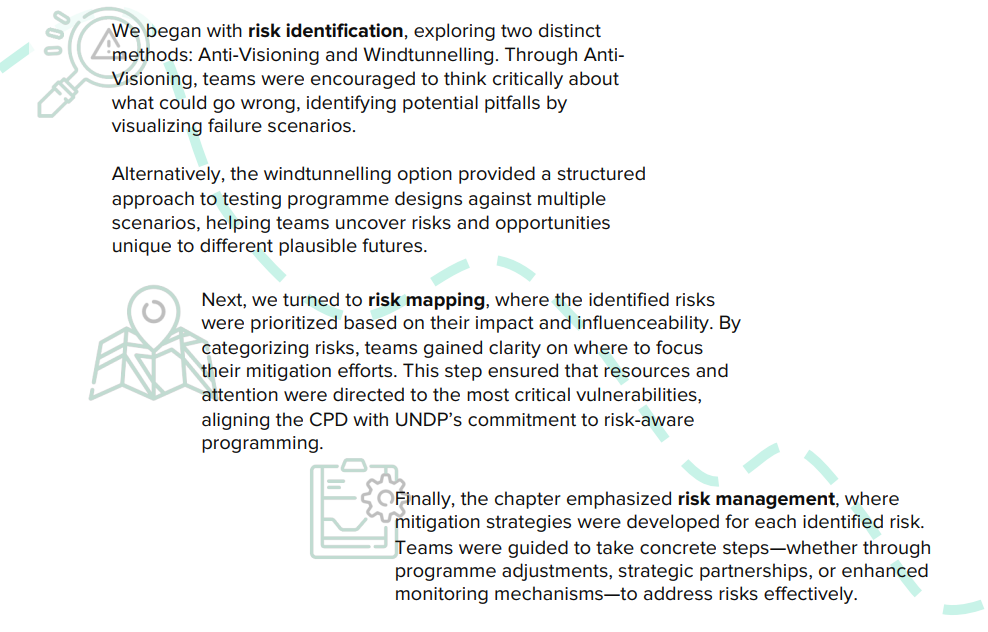
Looking Ahead
With a clear understanding of the potential risks and a well-thought-out strategy to manage them, we now transition to the next section of the CPD guide: Monitoring, Evaluation, and Learning (MEL).
This chapter will focus on embedding foresight into MEL frameworks to ensure that the CPD remains adaptable and responsive to emerging changes throughout its lifecycle. Together, these efforts will ensure that UNDP continues to deliver on its mission of sustainable development in an ever-changing world.