

 Locations
The Technical Expert Programme enables partner governments to sponsor senior professionals who provide advisory services in key areas aligned with UNDP’s strategic priorities.
Bridging National Expertise and Multilateral Impact: Talgat's Technical Expert’s Journey at UNDP
February 4, 2026

Talgat Zhumagulov presenting a guest lecture at Nazarbayev University on “Cases in Public Diplomacy. Astana , Kazakhstan 2024
Photo: Nazarbayev University
Could you briefly walk us through your professional and academic journey?
I have been working in international relations and communications for more than 25 years. Over the years, I worked in the Foreign Ministry in the capital, diplomatic missions, and the Parliament of Kazakhstan. My involvement in multilateral diplomacy included work related to the Conference on Interaction and Confidence Building Measures in Asia, participation in the team of Kazakhstan’s Chairmanship of the Organization for Security and Co-operation in Europe, and engagement in processes linked to my country’s membership in the UN Security Council.
This experience shaped my strong interest in how international organizations work in practice, especially how policy, expertise and partnerships come together at country and regional levels.
How have your previous roles in public diplomacy, media, and government shaped the expertise you bring to UNDP today?
My previous experience helped me better understand how public institutions operate, how decisions are made, and how cooperation between national and international actors is structured. Working in public diplomacy, academia and media also taught me the importance of communication, trust and proper positioning. These skills are especially important in partnership work, where results often depend not only on technical content, but also on how relationships are built.
Prior to joining UNDP, much of your work involved international public engagement and media. Which experiences from that period most strongly influenced your approach to partnerships and multilateral cooperation?
One of the main lessons from that period was that partnerships only work when all sides clearly understand the mutual value of cooperation. In public diplomacy, I learned how to consider different perspectives, adapt messages to different audiences, and build shared narratives. This approach is directly relevant to multilateral cooperation, where partners often come from different institutional and cultural contexts.
What inspired you to apply for the UNDP Technical Expert Programme?
The UNDP Technical Expert Programme attracted me as an opportunity to move from classical political diplomacy and communications to more practical work in international development. It was important for me not only to observe multilateral processes from a government perspective, but also to work inside an international organization in order to better understand its logic, tools, constraints and real ways of creating impact.
Was there a specific development challenge or policy area that motivated your interest?
I was generally interested in how development strategies and policies are translated into real programmes and partnerships. In particular, I wanted to better understand how international organizations coordinate with governments, donors and other partners to address complex regional challenges.
As a Technical Expert seconded by the Government of Kazakhstan, what does this form of partnership mean to you personally and professionally?
For me, this format represents a two-way exchange between national and multilateral systems. Personally, it allows me to apply my previous government experience in a new institutional environment. Professionally, it gives me the opportunity to better understand how the international development system works from the inside. I see this mainly as a process of mutual learning.
What were your expectations before joining UNDP RBEC, and how have they evolved during your assignment?
Before joining, I expected to gain a clearer understanding of how UNDP operates at the regional level. Over time, these expectations evolved into a deeper understanding of the complexity of development processes, especially in terms of coordination, negotiations and institutional alignment between different actors. At UNDP, I also observed a strong institutional culture and professional practices. A lot of attention is given to onboarding new staff and knowledge sharing. Learning does not stop after the initial period, but continues on an ongoing basis. This creates an environment where professional development and institutional learning are highly valued.

Talgat Zhumagulov, Partnership Specialist at UNDP RBEC
Photo: Talgat Zhumagulov
As a Partnership Specialist in RBEC, what are your key areas of technical focus?
At the UNDP Regional Hub in Istanbul, I work as a Partnerships and Communications Specialist with a regional focus on Central Asia. My work includes supporting partnership processes between UNDP and government, international and private sector partners, as well as contributing to analytical and communication work related to regional initiatives.
How do these priorities support UNDP’s mandate in the region?
These priorities directly support UNDP’s mandate, as partnerships are a key instrument for implementing development programmes. They help bring together expertise, resources and interests of different stakeholders and translate regional strategies into concrete initiatives at country and sub-regional levels.
How does your work help strengthen strategic collaboration between UNDP and partner governments – including your own?
My background in government helps me better understand how public institutions think and operate. This allows me to support dialogue between UNDP and government partners, including my own, by translating expectations, priorities and institutional constraints from one side to the other.
In practical terms, how do you work across teams – country offices, regional hubs, government counterparts – to advance partnership goals?
In practice, my work is built around constant interaction with country office teams, colleagues in the Regional Hub, headquarters in New York, and offices in different countries. This usually includes discussing ideas for potential partnerships, contributing to the preparation of concepts and analytical materials, and supporting dialogues with partners. Often, this work is cross-functional and requires coordination between programme, analytical and communication teams.
Any cross functional collaboration you are particularly proud of?
For me, the most valuable aspect is the collaborative nature of the work itself. Many initiatives require close cooperation between different teams and experts, and I value being part of processes where different perspectives and skills come together to shape joint solutions.
In your view, why is it important for development institutions like UNDP to incorporate expertise from national governments through programmes like this?
Such programmes allow international organizations to better understand how national systems work in practice. Government experts bring real institutional experience, which helps design more realistic and applicable development policies and programmes.
How does the Technical Expert model contribute to strengthening national capacities, fostering innovation, deepening understanding of multilateral processes, and building long-term development talent pipelines?
This model strengthens national capacities by exposing professionals to international standards and practices. It fosters innovation by bringing new perspectives into international organizations. It deepens understanding of multilateral processes by allowing experts to work inside global institutions. Finally, it helps build long-term professional communities of specialists who can operate at the intersection of national and international systems.
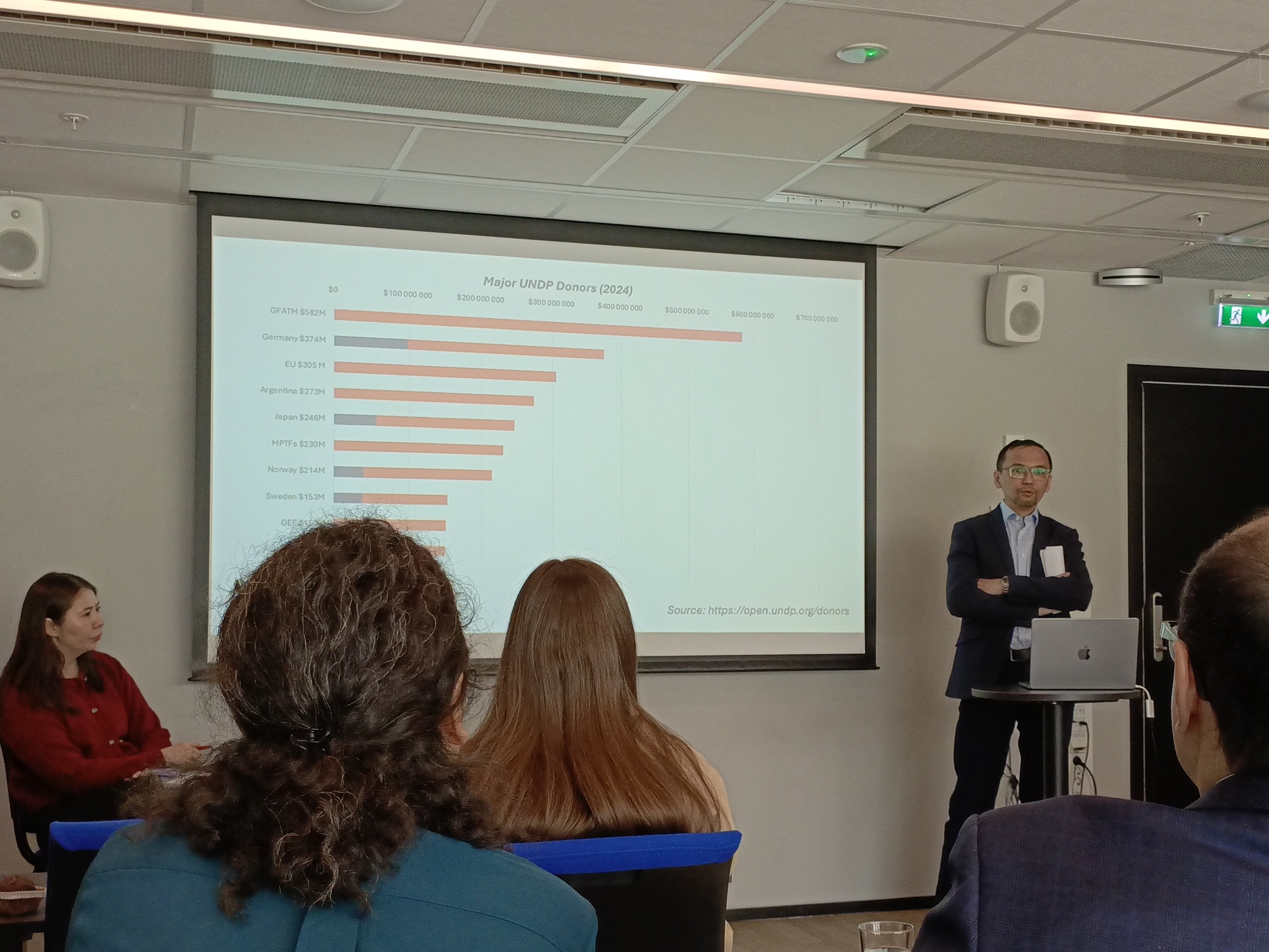
Talgat presenting a lecture at the Norwegian Institute of International Affairs 2025
Photo: Talgat Zhumagulov
How has this Technical Expert assignment shaped your long-term professional aspirations?
This experience strengthened my interest in working at the intersection of national and international systems. It confirmed for me the value of roles that combine policy, partnerships and institutional learning.
Where do you see the biggest opportunities for deepening partnerships between UNDP and governments in the coming years?
I see strong opportunities in areas such as sustainable development, climate resilience, digital transformation and regional cooperation. These are areas where governments increasingly need international expertise and where UNDP can play a strong coordinating and advisory role.
If you could advise governments considering sponsoring a Technical Expert, what would be your main message?
My main message would be that this is an investment in human capital. Such programmes help develop professionals with international experience, institutional knowledge and strong professional networks, which are valuable both for national systems and international cooperation.
Do you have a message for young professionals considering careers in development, diplomacy, or public policy?
I would advise young professionals to stay open to learning and flexible in their career paths. Development and diplomacy require not only technical expertise, but also the ability to work in complex, multi-level and multicultural environments. Programmes like the Technical Expert Programme offer a unique opportunity to understand not only what needs to be done, but also how the international development system really works.
Related
content
content


